
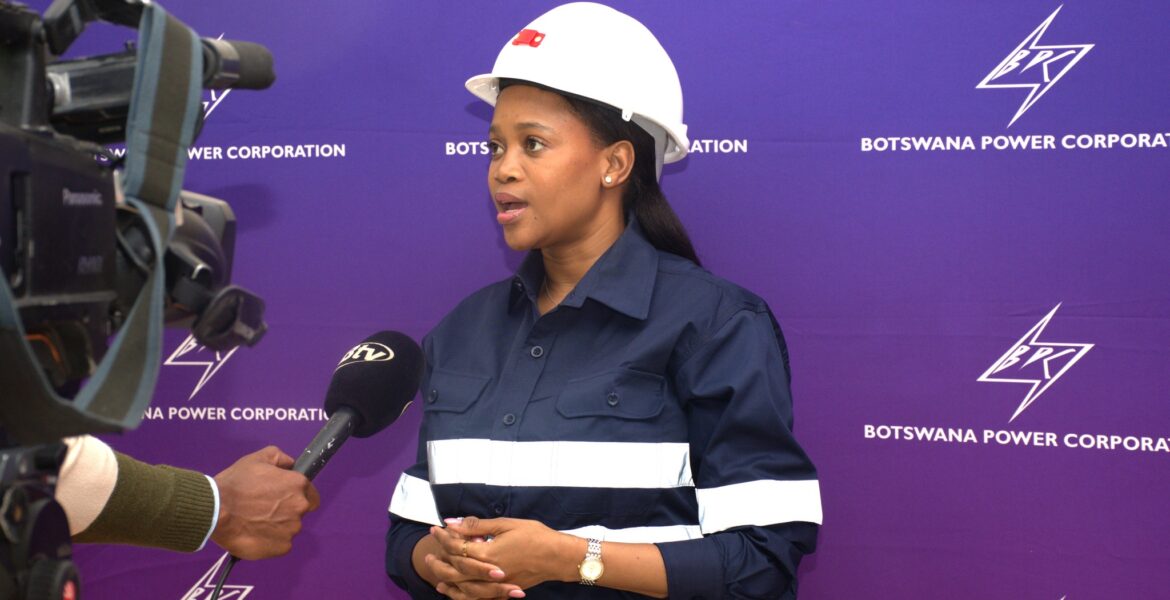
- Government outlines imports, new plants and market reforms as electricity demand continues to rise
GAZETTE REPORTER
Botswana’s electricity supply remains structurally constrained as the country still does not have a reserve margin, requiring continued power imports alongside new generation capacity and demand-side interventions to maintain grid stability.
Minister of Minerals and Energy Bogolo Kenewendo said rotational load shedding will be implemented when necessary to manage supply shortfalls and the high cost of imported electricity.
“Consequently, rotational load shedding will be implemented as necessary to manage supply shortfalls and the high cost of imported electricity until all new generation projects come into service,” Kenewendo recently told Parliament while presenting her ministry’s committee of supply speech.
The government expects some improvement in domestic generation toward the end of the 2025/26 financial year.
“However, generation performance is expected to improve towards the end of the 2025/26 financial year following the completion of remediation works on one unit at Morupule B Power Station and the commercial operation of the 100 MW Mmadinare Solar Plant as well as the operation of the 100 MW Jwaneng Solar Plant,” Kenewendo said.
These developments, she said, are expected to increase the share of electricity demand met through local generation.
“These developments are expected to increase the proportion of national electricity demand met from local generation to at least 72 percent on a sustained basis,” she said.
New Generation
In addition to solar projects and improvements at Morupule B, the government is also pursuing new coal-based generation capacity.
Kenewendo said construction of a 600 megawatt coal-fired Independent Power Producer power plant at Mmamabula has started.
She said the first phase of the project will deliver 300 megawatts by the first quarter of 2027, with the remaining 300 megawatts expected to be fully commissioned in 2028.
“This project will significantly strengthen baseload generation capacity, enhance security of supply, and reduce reliance on electricity imports,” Kenewendo said.
Electricity demand in Botswana continues to grow steadily, driven by several economic and demographic factors.
Kenewendo said national demand is increasing at an average rate of five percent annually, supported by population growth, mining activity and expanding household electrification.
Demand is projected to reach approximately 7,000 gigawatt hours by 2040.
Market Reforms
At the same time, the government is reviewing the structure of the electricity supply industry.
Kenewendo said the Ministry of Minerals and Energy, working through the Botswana Energy Regulatory Authority, is reviewing the current electricity market structure with the aim of moving away from a vertically integrated model toward a more liberalised electricity market framework.
In parallel, the government is implementing a Cabinet directive to unbundle and corporatise the generation business unit of Botswana Power Corporation while keeping transmission and distribution as regulated monopoly functions.
“The Transmission function will operate as a Transmission System Operator (TSO), responsible for maintaining grid stability, coordinating power flows, and ensuring open access to the network,” Kenewendo said.
The proposed structure will allow Independent Transmission Providers to invest in and develop transmission infrastructure under regulatory oversight while system control remains centrally coordinated.
Kenewendo said the reforms are expected to result in amendments to the current legislative framework.
“These reforms are expected to culminate in amendments to the existing legislative framework, which will be presented to Parliament by the second quarter of the 2026/27 financial year,” she said.