
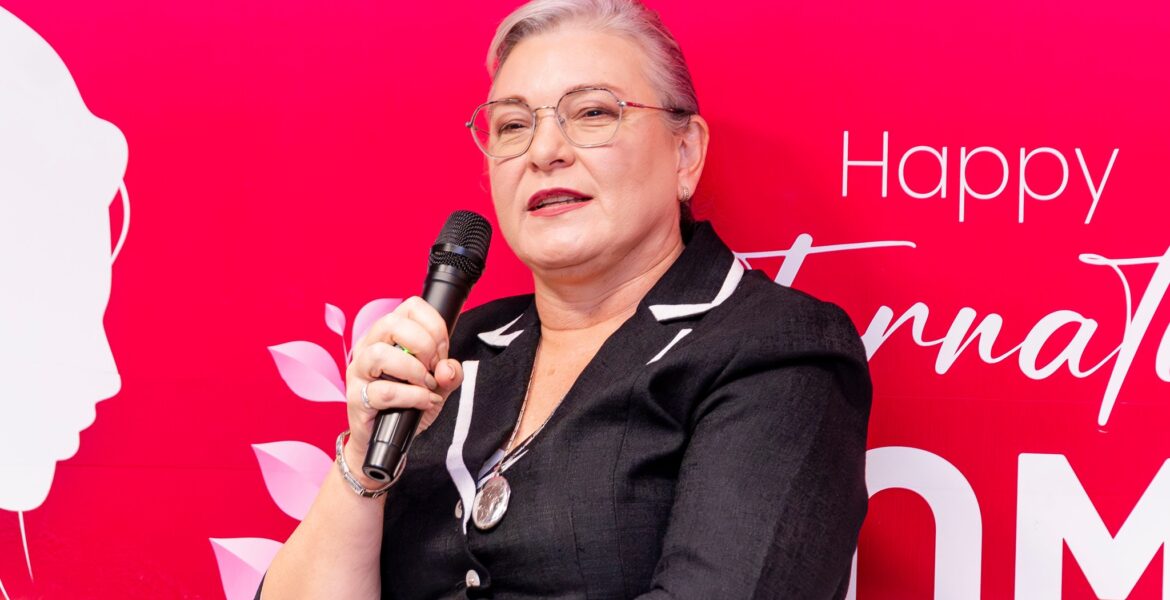
- Says equal representation is achievable, but structural and cultural changes remain essential for women to advance into leadership.
GAZETTE REPORTER
Letshego Africa Holdings Limited Group Chief Executive Officer Reinette Estelle van der Merwe says the financial services group has achieved near gender parity across its workforce and leadership.
Van der Merwe said the company is in what she described as a “fortunate position,” with gender equality effectively at a 50-50 balance. At the holdings level, she said, 51 percent of employees are women, while women also account for 51 percent of the executive committee.
She made the remarks during a panel discussion at the Botswana Stock Exchange Limited March Opening Bell Ceremony, held on the eve of International Women’s Day. The event was themed “Rights. Justice. Action. For All Women and Girls” and featured an all-women panel.
Van der Merwe, who is in her sixth month as chief executive, said while some women have been able to reach leadership roles through opportunity and hard work, broader policy and structural changes are still necessary.
Policy Support
She said legislation and workplace policies must evolve to better accommodate the realities women face, including motherhood and family responsibilities.
“So if it doesn’t start at home and in the schools and at grassroots levels, it’s not going to happen,” she said. “We need to change that at the very grassroots level, and also in terms of company policies, country policies. We need to embed that so that from a policy perspective, there’s no distinction; it is actually equal, and people can just pursue it.”
Van der Merwe also pointed to research indicating that men often have more work-related skills exposure than women, which can discourage women even when they are equally capable.
“What needs to be done is give women that encouragement and then support them in those roles, because that’s what men do,” she said. “Women need to start supporting each other. Women need to start working together and also support their female colleagues, in the same way.”
The discussion was moderated by Gofaone Modise, director of Inbound Media, who asked panelists to reflect on women’s representation and practical ways to advance empowerment.
Financial Tools
Mothei Mokgedi, product development specialist at the Botswana Stock Exchange, said women should embrace their own leadership styles rather than feeling pressure to mirror traditionally male approaches.
“You don’t have to be a man to succeed in those spaces,” Mokgedi said. “So I think we need to unlearn that idea of presenting ourselves in a rigid and martial way.”
She also highlighted the role of financial markets in advancing social goals, pointing to the concept of social bonds — financial instruments where proceeds are directed toward social initiatives.
“So here at the BSE, we want to be a force for good, and we want to produce products, solutions, in fact, that benefit the greater public,” she said, adding that the exchange offers a transparent marketplace that can support such instruments.
Representation Gap
Una Munamati, representing CFA South Africa, said Botswana’s private sector already has several female chief executives and gender-balanced executive teams, though more progress is needed.
“I think more can be done in the schools to educate children, to educate their families, that it’s okay for men to do some household chores like cooking,” she said.
Munamati added that women’s leadership should grow through merit rather than quotas, with measurable improvements in representation.
Education Role
Godisang Mookodi, senior lecturer at the University of Botswana, said greater representation of women in leadership and policymaking remains important.
She said fear sometimes discourages women from stepping forward, even in a relatively progressive environment.
“As with academia, we need to understand that the foundation of everything is academia,” Mookodi said. “We start in schools and that’s where we learn.”
She added that societal challenges such as gender-based violence and leadership gaps are interconnected and require new thinking.
“The biggest challenge for people is to challenge the business-as-usual approach,” she said. “We need to actually understand that the realities require for us to be more innovative.”