
- CEO links improved results to strategy, tighter controls and restored farmer confidence
TLOTLO KEBINAKGABO
The improved performance at the Botswana Meat Commission (BMC) is anchored in a renewed institutional purpose defined by the “Thuo Khumo” Transformation Strategy, according to the commission’s chief executive, Mmabasotho Tibe.
“The improved performance at BMC is primarily attributable to a renewed sense of purpose as articulated in the Thuo Khumo Transformation Strategy,” Tibe said in response to questions from The Botswana Gazette. “At its core, Thuo Khumo repositions BMC from being a struggling public entity into a commercially disciplined, farmer-centric and market-driven enterprise. This renewed purpose has translated into clearer priorities, stronger accountability and more decisive execution across the commission.”
Bailout Legacy
For much of the past decade, BMC was largely defined by recurring government bailouts and persistent operational challenges. Between 2015 and 2022, the commission required several financial rescues amounting to hundreds of millions of pula, while farmers endured delayed payments, limited market alternatives and pricing pressures.
This prolonged period of intervention stood in contrast to BMC’s mandate as a commercially viable institution central to Botswana’s livestock economy. Recent developments, however, indicate a shift in direction.
Arrears Clearance
Asked what enabled the clearing of approximately P698 million in farmer arrears, Tibe pointed to specific financial arrangements and operational changes.
She noted that it is important to acknowledge the impact of the revolving credit facility that was arranged with Rand Merchant Bank, which facilitated reduced turnaround time for farmers’ payments.
“There has been restoration of confidence and trust with key stakeholders, particularly farmers, government, customers and employees,” Tibe added. “We deliberately re-engaged stakeholders, addressed long-standing operational bottlenecks and reinforced BMC as a reliable participant in the national beef value chain.”
She said these actions “resulted in improved throughput and stronger market engagement.”
Revenue Growth
BMC has reported revenue growth of more than 31 percent, exceeding P1 billion. Tibe said this followed the implementation of “practical operational stabilisation measures.”
These, she noted that included tighter cost controls, improved plant discipline, better livestock planning and renewed focus on yield optimisation as well as product mix.
“Rather than pursuing growth for BMC’s sake, the focus has been on doing the basics and doing them consistently,” she added.
Plant Performance
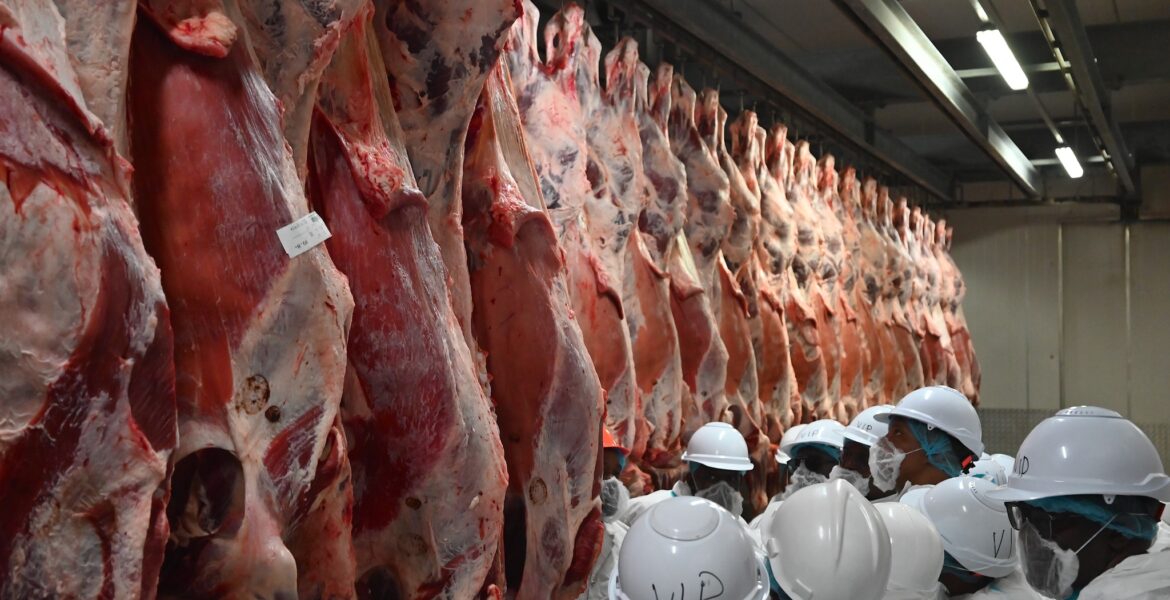
Throughput at the Lobatse plant has reportedly increased by 22 percent. Tibe said this improvement was driven by changes in management approach. She noted that the Thuo Khumo introduced a results-oriented management culture. She said management decisions are now guided by data, financial discipline and clear performance metrics, including production capacity optimisation.
As such , she noted that continuous engagement with farmers and closer monitoring of quota conversion rates also contributed to the improvement. She stated that central to the performance was the elevation of farmers from suppliers to customers, with dedicated relationship managers.
Market Strategy
BMC has also intensified market diversification and revenue optimisation efforts. Tibe told this public that beyond traditional export markets, BMC has been actively engaging regional and niche markets, including hospitality and institutional buyers.
“This has reduced the risk of over-reliance on single markets and improved revenue resilience,” she added, noting that China remains inaccessible pending finalisation of market authorisation processes.
Medium Outlook
Looking ahead, Tibe said BMC is focusing on five interventions: institutionalising the renewed purpose; operational efficiency and asset optimisation; farmer-centric value chain development; market diversification and value addition; and people, systems, governance and financial sustainability.
“The performance is the result of a clear renewed purpose, disciplined execution and stakeholder alignment under the Thuo Khumo transformation strategy,” she said. “ While challenges remain, the foundations have been laid to ensure that this performance is sustained and strengthened over the medium term, in the best interest of farmers, the beef industry and the national economy.