
By Dr. Douglas Rasbash
Botswana is planning a bigger, modern bus rank for Gaborone — underground, spacious, and expensive. But beneath the concrete lies a deeper failure: the absence of a public transport policy. Without a clear vision for how people should move, the country risks pouring money into infrastructure that locks in inefficiency instead of fixing it.
Public transport in Botswana has reached a peculiar moment. It is simultaneously absent from national policy and dominant in daily reality. Despite moving the majority of urban passengers every day, public transport is missing from party manifestos, from NDP12, and from the Botswana Integrated Transport Plan. Yet in recent weeks it has dominated headlines: fare increases, strike threats by bus and combi operators, and proposals for a “new modern bus rank” in Gaborone.
This contradiction exposes the core problem. Botswana does not lack buses, combis, or ranks. It lacks a coherent public transport policy. The proposed solution — a larger, more spacious bus rank — is conceptually outdated. It assumes that public transport requires more land, more parking, more layover, and more congestion. In reality, modern public transport systems require less space, not more.
Why Bigger Is Not Better
In contemporary transport planning, a city-centre bus interchange is not a parking lot. It is a flow-through node. Vehicles arrive, load passengers, and depart according to fixed timetables published digitally and enforced operationally. Layover, refuelling, charging, cleaning, and overnight parking take place off-site, outside the interchange.
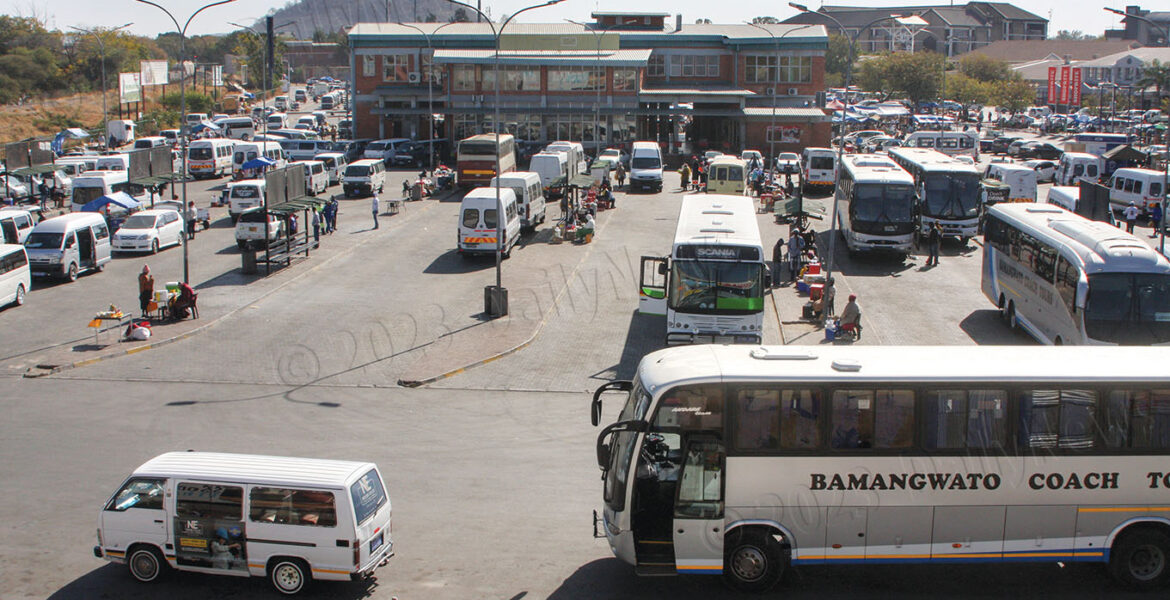
Gaborone’s current bus rank fails precisely because it functions as a bus storage yard rather than a transport interchange. Buses occupy scarce urban land for hours — sometimes days — consuming space that should serve passengers, pedestrians, commerce, and urban regeneration. Expanding this model merely locks in inefficiency.
The Opportunity Cost of Prime Land
The existing bus rank and its surroundings represent one of Gaborone’s most significant missed development opportunities. Internationally, cities have transformed central transport nodes into high-value mixed-use precincts, integrating retail, offices, housing, public space, and seamless multimodal connectivity.
Instead, Botswana continues to dedicate prime urban land to low-productivity vehicle parking. This is not just a planning error; it is an economic one. Urban land is capital. When it is misallocated, growth is suppressed. A modern bus interchange should therefore be smaller, denser, and embedded within a broader urban redevelopment strategy — not expanded outward as a standalone project.
An Informal Industry Doing a Formal Job
Behind the infrastructure debate lies a deeper structural issue. Botswana’s public transport industry is atomised and informal, yet expected to deliver a quasi-public service. Thousands of individually owned buses and combis operate under weak licensing conditions, minimal coordination, inconsistent standards, and no meaningful self-regulation.
Price disputes and strike threats are therefore not anomalies. They are the predictable outcome of a system with no institutional spine. Public transport is a classic network industry, characterised by scale economies, coordination benefits, and strong public-interest externalities. Treating it as a loose collection of independent operators guarantees inefficiency, volatility, and conflict.
From Chaos to Coherence
The solution is not heavier regulation for its own sake, but industry restructuring and rationalisation. This includes quality-based licensing, where operating rights are conditional on vehicle standards, safety, emissions, and service reliability. It also requires consolidation into route-based operating companies or cooperatives that enable economies of scale, professional management, and collective bargaining.
Operators must be repositioned as service providers rather than fare-chasers. Predictable contracts, clear routes, published timetables, and performance monitoring replace fare hikes as the mechanism for financial sustainability. Without this shift, infrastructure investment alone will deliver little more than cosmetic change.
Decarbonisation Missed in Plain Sight
Public transport is Botswana’s fastest route to transport decarbonisation, yet this potential is entirely absent from current planning. Electrifying buses and high-utilisation combis lowers operating costs per kilometre, reduces exposure to fuel price shocks, improves urban air quality, and cuts foreign-exchange leakage from fuel imports.
Given Botswana’s solar potential, electric public transport is not aspirational — it is economically rational. Buses can arrive, connect to rapid charging, and depart. Station canopies can double as solar infrastructure. Yet without clear policy direction, operators cannot finance the transition and financiers cannot assess risk. Once again, the absence of policy becomes a binding constraint.
Designing for the Bus of the Future
More fundamentally, the proposed new bus station offers a generational opportunity to standardise the bus of the future. Agreeing on vehicle design and specifications is not secondary — it is foundational. A modern interchange must be designed around known vehicle dimensions, capacities, turning radii, dwell times, and energy requirements.
Planning infrastructure before defining the fleet risks a perverse outcome: ageing, low-capacity diesel buses occupying a brand-new terminal designed for a different era. International best practice is clear. Cities that modernised successfully first defined the vehicle, then the routes, and only then the interchange.
Vision Before Concrete
At the heart of the matter lies a strategic question Botswana has never formally answered: what should the future balance be between private and public transport? Left unmanaged, rising incomes push cities toward congestion, sprawl, and fiscal drain. Every serious urban economy now recognises that good public transport is not a welfare service; it is an economic productivity tool.
A bigger bus rank may satisfy political appetites, but it is retrogressive. Botswana does not need another infrastructure project designed in isolation. It needs vision before concrete. A modern bus interchange should be the visible outcome of a national public transport policy — not a substitute for one.