
Reducing oil dependence is no longer just environmental policy. For Botswana it has become a question of economic resilience and national security as global oil markets grow increasingly volatile.
By Douglas Rasbash
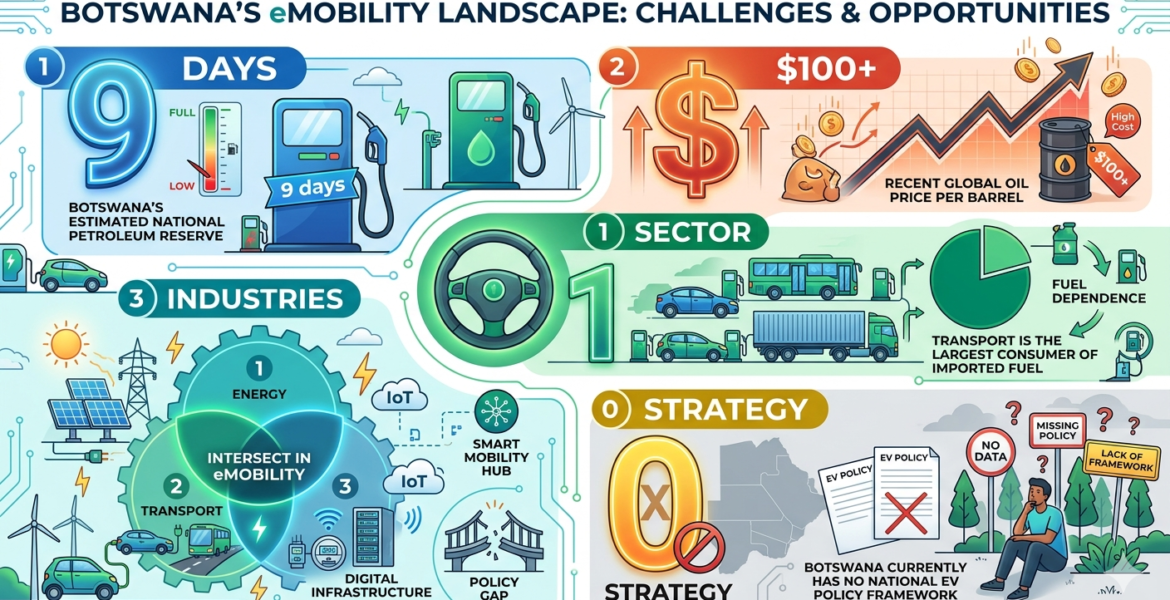
Oil prices have surged past $100 per barrel once again. Wars in the Middle East, shipping disruptions and geopolitical tensions have reminded the world of a basic truth. Oil is not simply a commodity. It is a geopolitical instrument.
For Botswana this reality carries particular urgency. The country reportedly holds barely nine days of petroleum stocks. In energy security terms that is not a reserve. It is a countdown clock. If tanker deliveries are disrupted or regional refineries face supply interruptions, Botswana could face fuel shortages within weeks. Transport would slow. Food and goods prices would rise. Inflation would follow.
Yet at precisely the moment when energy security should dominate national planning, Botswana continues to delay the most obvious structural solution available: electrifying transport.
ENERGY SECURITY
Transport is the single largest consumer of imported petroleum in Botswana. Every car, taxi, bus and delivery vehicle running on petrol or diesel locks the country deeper into dependence on international oil markets.
When oil prices spike, Botswana pays the price through higher fuel costs, higher transport costs and rising prices across the economy. That dependence exposes the country to external shocks over which it has little control.
Electric vehicles offer the most direct path to reducing that vulnerability. They replace imported fuel with electricity. That electricity can increasingly be produced domestically through solar power generation and regional electricity markets.
Instead of sending billions of pula abroad to purchase oil, Botswana could power its transport system through domestic energy infrastructure. This is not simply an environmental opportunity. It is an economic and strategic necessity.
POLICY VACUUM
Despite the strategic importance of electrifying transport, Botswana still lacks a clear institutional framework for eMobility.
There is no lead ministry responsible for the sector. There is no national EV strategy, no national charging infrastructure plan, no coordinated regulatory framework and no standards regime. In effect, the country is drifting.
Without clear leadership, policy progress stalls. Ministries wait for one another to move first. Regulatory uncertainty discourages investors. Private sector initiatives remain fragmented.
In policy terms this is known as an institutional vacuum. Botswana currently has one.
ECONOMIC POTENTIAL
Ironically, the hesitation persists even though electric mobility aligns directly with Botswana’s economic transformation objectives.
Electric mobility sits at the intersection of three critical sectors: energy, transport and digital infrastructure. A national charging network would require electrical engineering, civil construction, grid integration and smart software systems.
That means new industries in installation, maintenance, software management and energy services. Charging networks would stimulate EV imports and eventually local assembly. Fleet electrification across taxis, government vehicles and delivery services would create entirely new markets.
Electric transport would also increase electricity demand. That strengthens the commercial case for solar generation and other renewable energy investments.
In other words, EV infrastructure is not a niche environmental project. It is a platform industry capable of generating employment, investment and industrial capability.
GLOBAL SHIFT
Across the world governments have already recognised this strategic shift.
China, the European Union and the United States are investing billions into charging networks and electric vehicle supply chains. These countries understand that electrified transport will define the next generation of industrial development.
Vehicle manufacturers worldwide are rapidly shifting production towards electric platforms. Markets that adapt early will capture the benefits of new technologies, supply chains and skills development.
Countries that delay will eventually import the technology at a higher cost while missing the industrial opportunities that come with the transition.
STRATEGIC CHOICE
Botswana therefore faces a clear decision.
It can continue to debate institutional mandates while the rest of the world electrifies transport. Or it can recognise that eMobility is not merely an environmental aspiration but a core pillar of national energy security and economic transformation.
The first step is straightforward. Government must designate a lead authority responsible for eMobility. It must develop a national EV strategy and prioritise the rollout of charging infrastructure across the country.
Because in the twenty first century energy security will not be determined by how much oil a country can import. It will be determined by how quickly it can stop needing it.