
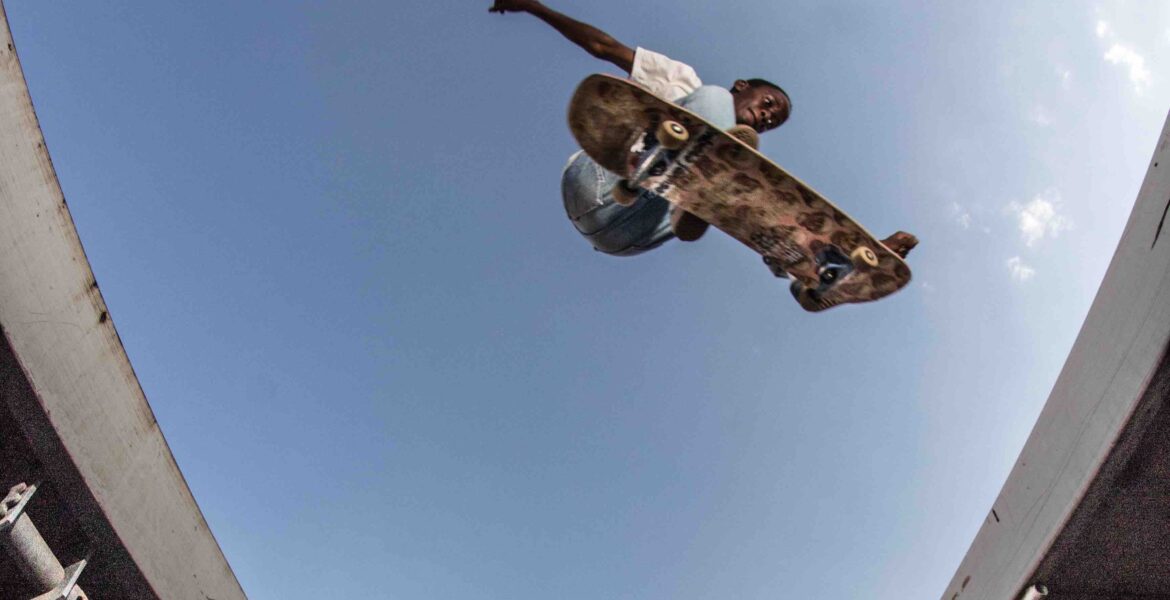
A decade of kickflips, concrete poetry and cultural reclamation lands inside Alliance Française de Gaborone, where Mosako Chalashika turns Africa’s skate scene into a global visual language, no charity lens, no outsider gaze, just lived asphalt truth
GOSEGO MOTSUMI
Walk into Alliance Française de Gaborone and the walls hum like a half-pipe. Mosako Chalashika’s lens doesn’t just show skateboarding, it breathes it. Born in Gaborone, sharpened in Cape Town, the photographer-skater has spent ten years documenting a movement that was always here, just rarely seen on its own terms.
“My work is rooted in the necessity of self-representation,” he told Time Out, rejecting the tired Western charity gaze that once framed African skate culture as novelty instead of mastery. What hangs in the gallery until March 10 is more than an exhibition but a cultural correction.
KNUCKLEHDS AS MANIFESTO
At the centre is Knucklehds, a photograph that represents a pivotal moment in the evolution of Botswana’s urban subcultures, capturing the camaraderie and collective identity of a new generation of skateboarders in Gaborone.
The image captures a collective he helped found, a brotherhood that turned empty urban pockets into classrooms of risk, style and survival.
“The photograph is more than a visual record,” Chalashika explained. It’s a declaration that Gaborone’s youth aren’t waiting for permission to exist globally, they’re already there, flicking boards into international dialogue.
THE INSIDER LENS
Chalashika shoots from within the session, not from the safety of the sidewalk. Being a skater means he knows the physics of a trick before the shutter clicks and the weight shift, the pop, the split-second apex that separates a make from a slam.
“We tell our own story the proper way as insiders who live and breathe the asphalt,” he said.
FROM WALLS TO WORLD
The photographs are available for purchase directly through the exhibition’s organized sales channels. After the three-week run, the images won’t disappear,th ey’ll migrate online, available to collectors and global audiences.
What Chalashika has built is not just an archive of tricks and style. It’s a visual sociology of belonging, proof that Gaborone’s concrete has always been a canvas, and its skaters, its authors.