
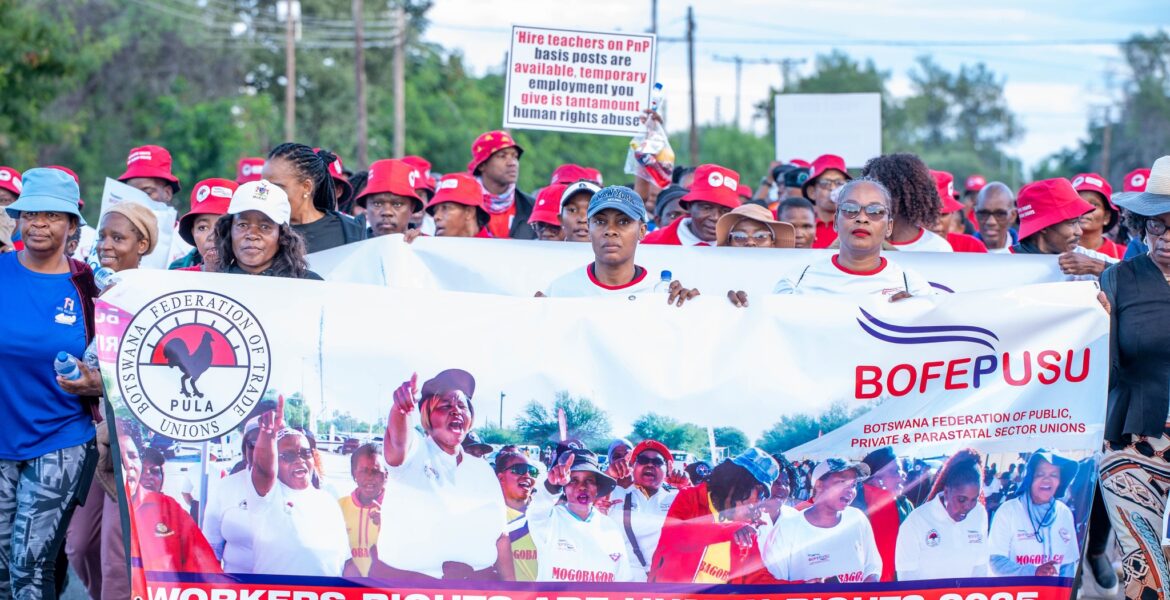
Unemployment remains severe, estimated at 28 percent with youth unemployment rising to 38 percent
GAZETTE REPORTER
Botswana’s economic outlook has worsened significantly with the International Monetary Fund (IMF) warning that the country faces deepening fiscal and external vulnerabilities unless urgent reforms are undertaken.
In its 2025 Article IV Consultation concluded recently, the IMF issued one of its starkest assessments yet, noting that “Botswana’s economic outlook has deteriorated markedly over the last twelve months” as global demand for natural diamonds continues to plunge. The Fund said the decline has been “sharper and is expected to be more persistent than anticipated,” with no immediate relief in sight for the country’s mineral-dependent economy.
THE DIAMOND FALL
According to the report, Botswana’s economic activity contracted by 3 percent in 2024, driven by falling mining output, reduced diamond trading and a slowdown across non-mineral sectors. While construction and tourism registered modest growth, this was outweighed by contraction in manufacturing and agriculture. Unemployment remains severe, estimated at 28 percent with youth unemployment rising to 38 percent.
The IMF now expects the economy to shrink by another 1 percent in 2025, before staging a gradual recovery over the medium term largely dependent on a partial rebound in the global diamond market.
Meanwhile, declining diamond exports and weak capital inflows have deepened the country’s vulnerability. International reserves fell further to US$3.5 billion, equivalent to just five months of import cover by July 2025. Inflation, though still within the Bank of Botswana’s target range, stood at 3.7 percent year-on-year in September.
GOVERNMENT RESPONDING
Despite the grim outlook, the IMF acknowledged that the government has begun taking steps to respond to the crisis. Authorities have launched the Botswana Economic Transformation Program (BETP) to stimulate private-sector-led growth, ahead of the forthcoming National Development Plan (NDP). To contain fiscal pressures, government has implemented initial consolidation measures, while the Bank of Botswana has tightened monetary policy raising interest rates from 1.9 to 3.5 percent—and adjusted the exchange-rate framework to safeguard reserves.
But these measures, the IMF warned, are still insufficient.
“Unless additional fiscal consolidation and economic diversification reforms are adopted and monetary policy is tightened, public debt could rise sharply over the medium term,” the Executive Board cautioned.
PROJECTIONS
Under current projections, the current account deficit is expected to widen to 6 percent of GDP in 2025, driven by weaker exports and lower Southern African Customs Union (SACU) revenues. Though a gradual improvement is anticipated over the medium term, the Fund warns that without further action, “persistent external current account deficits and external outflows would contribute to a further decline in reserves.”
The fiscal deficit is equally worrying. After rising to 7.1 percent of GDP in FY2024/25 due to weak mineral revenues, it is now expected to exceed 8 percent of GDP in FY2025/26. Without deeper spending cuts and stronger non-mineral revenue generation, the IMF warns public debt could escalate rapidly.
The Fund stressed that structural reforms especially diversification can no longer be delayed.