
With profits heading for a 46% fall, BTC bets on Starlink satellite connectivity to regain ground in Botswana’s telecoms market
BONGANI MALUNGA
Botswana Telecommunications Corporation (BTC) is betting on a transformative partnership with satellite communications giant Starlink to strengthen its competitive position at a time when its profits are projected to plunge by as much as 46%.
The partnership, announced last Wednesday has assumed greater significance following Friday’s financial warning issued through the Botswana Stock Exchange (BSE), which exposed the mounting pressure facing one of Botswana’s longest-established telecommunications operators.
PROJECTED DECLINE
In a BSE published trading statement, BTC’s board revealed that “profit before tax for the half year ended 30 September 2026 is expected to be between P80 million and P89 million.” This represents a projected decline of between 40% and 46% from the P148.4 million recorded during the corresponding period last year.
While the company has yet to explain the factors behind its declining profitability, its latest satellite partnership presents an opportunity to reclaim lost ground in Botswana’s increasingly competitive telecommunications industry.
The urgency is reflected in Botswana Communications Regulatory Authority (BOCRA) figures, which show BTC’s mobile market share declining from 15% in March 2024 to 14% in March 2025. During the latter period, Orange Botswana commanded 46% of the market, followed by Mascom at 40%.
BTC’s position in mobile broadband was even weaker, accounting for just 7% of the market, compared with Orange’s 50% and Mascom’s 43%.
LIMITATIONS INTO OPPORTUNITY
The Starlink agreement could, however, give BTC a competitive advantage by addressing one of the telecommunications industry’s longstanding challenges of connectivity disappearing once customers move beyond the reach of conventional network towers.
Businesses operating in mining, agriculture, tourism and remote locations have encountered unreliable connectivity that has traditionally disrupted communication between employees, clients and business operations.
Through the planned BTC Satellite service, compatible smartphones will be able to connect directly to Starlink satellites outside conventional mobile coverage areas, enabling messaging, location-sharing and selected data services without specialised satellite equipment.
2027 INTRODUCTION
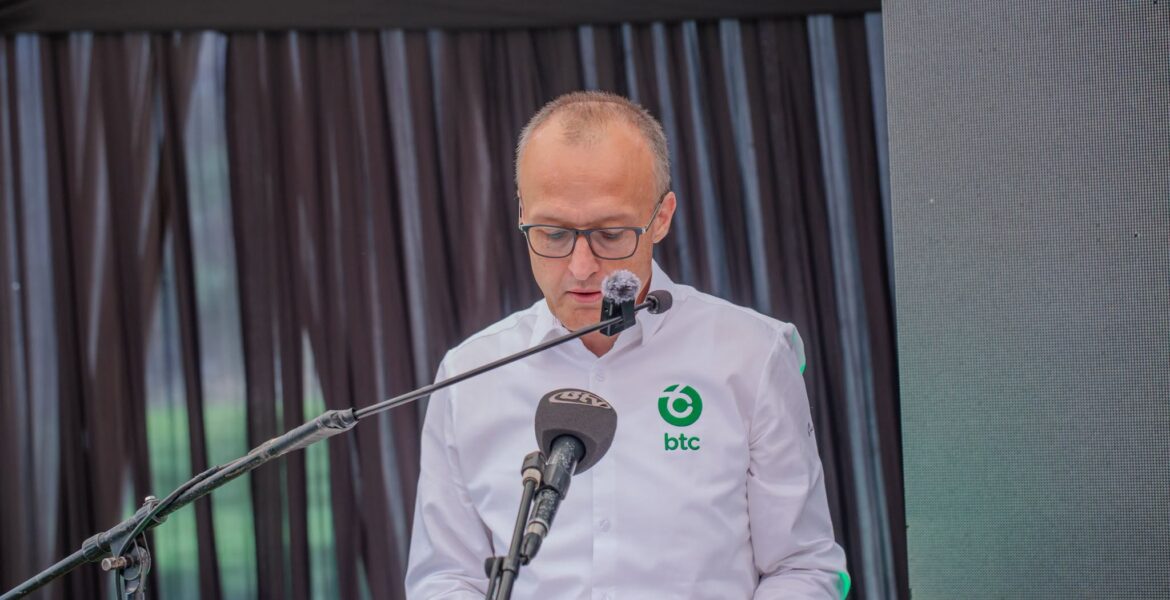
BTC chief executive Jürgen Peschel has indicated that the service is scheduled for commercial introduction in early 2027. The arrangement could help BTC attract business customers whose operations regularly take employees beyond established network infrastructure, while strengthening customer retention and creating opportunities for additional revenue. The move also follows a growing international blueprint in which Starlink collaborates with established telecommunications operators rather than relying exclusively on direct consumer relationships.
In Uganda, Airtel introduced satellite-to-mobile connectivity through its Starlink partnership in September 2026, while Beeline Kazakhstan launched a similar service during the same month. These arrangements demonstrate how traditional telecommunications operators can use satellite infrastructure to extend their services into previously underserved locations.
The commercial opportunity is significant for BTC but success will depend on competitive pricing, reliable service and customers’ willingness to pay for expanded connectivity. Importantly, the satellite arrangement does not automatically guarantee a reversal of the operator’s declining profits.
With BTC’s detailed interim results expected by 30 November, the bigger question is whether this technological breakthrough can eventually translate into stronger earnings and a recovery of its diminishing mobile market share.