
A closer look at the BETP project list reveals a critical mismatch between spending and the transformation goals Botswana urgently needs to achieve
DOUGLAS RASBASH
SPECIAL CORRESPONDENT
Botswana’s Economic Transformation Programme (BETP) is the most ambitious development agenda the country has ever assembled. A USD 32 billion investment pipeline made up of 188 projects across 13 sectors, it promises a new growth model built on high-income ambition, economic diversification, digitalisation, and the creation of 500,000 jobs. No post-independence programme has attempted transformation at this scale. Yet as the Gazette’s analysis of the full BETP project list shows, an unexpected and worrying pattern emerges: the spending does not match the goals.
PLAN MISALIGNED WITH ITS PURPOSE
About 50 % of the BETP Capital Expenditure or CAPEX is allocated to enabling projects that do not themselves generate jobs, diversification, digitalisation or income growth directly — but can create the conditions for others to do so. This has been the classical developer economics model that has been used of the years. It is assumed that spending on roads and bridges, power generation and transmission, water supply and sanitation, digital backbone infrastructure, border post upgrades, industrial parks ( if not linked to specific firms/value chains ) and lastly transport hubs and airports, directly generate GDP growth jobs and will diversify the economy, but this is no longer the case. Unemployment has risen and GDP declined despite the abundance of infrastructure.
This misalignment—not capacity, not funding, not political will—is the single greatest risk to the success of the BETP. When the BETP was launched, it was framed around four clear missions: 1) Boosting Employment (labour-absorbing sectors), 2) Enhancing Economic Diversification (growing non-mining GDP to ~70%), 3) driving Growth to High-Income Status and 4) Digitisation and Public-Sector Efficiency. These objectives are sound, necessary and widely supported. They represent exactly what Botswana must achieve as the diamond era fades and global competitiveness becomes the new currency of prosperity. However, when the Gazette reorganised all 188 BETP projects according to these four missions—rather than by sector—the structure of the plan changed dramatically. A new classification emerged, showing which projects genuinely contribute to the national goals and which serve as enabling or supporting investments.
HOW TRANSFORMATION LIKERT SCORES WERE ASSIGNED
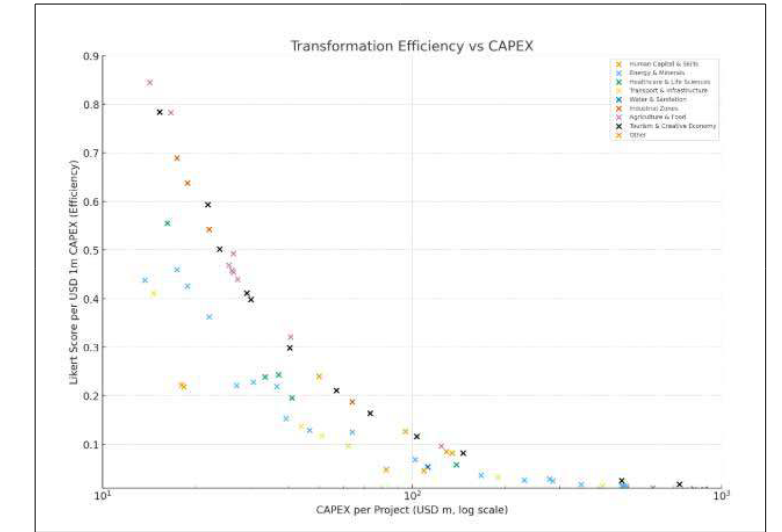
Each BETP project was evaluated using a 0–5 Likert scale against Botswana’s four transformation objectives: Job creation, Economic diversification, Digitalisation and public-sector efficiency and Growth in per capita GNI. Scores were derived from the project’s sector characteristics, description, expected economic effects, and evidence from comparable investment types (such as job intensity, diversification potential, productivity gains, and digital readiness). For each objective, a project was assigned a likelihood score using the following scale:
- 0 – Not at all: No contribution expected
- 1 – Very unlikely: Minimal or marginal impact
- 2 – Unlikely: Weak or indirect relevance
- 3 – Likely: Reasonable, expected contribution
- 4 – Very likely: Strong, direct contribution
- 5 – Highly likely / Perfect: Primary purpose advances the objective
The four scores were then summed to produce a Total Transformation Score out of 20.
This provides a consistent, transparent basis for comparing all 188 projects and identifying which investments most strongly support Botswana’s transformation goals. Across all 188 projects in the BETP, the average transformation alignment score is just 9 out of 20—barely mid-table. In other words, the typical BETP project is not strongly aligned with the country’s own transformation objectives. The highest scoring sectors were financial services, digital and e Government and Agriculture and Food, whereas the lowest transport, water and social protection.
Correspondingly, the highest scoring BETP projects were those related to financial services and agro processing as shown in the top ten project league table.
| Rank | Project Title | Sector Group |
| 1 | Bank of Botswana Innovation Hub | Financial Services |
| 2 | Regulatory Sandbox | Financial Services |
| 3 | National Re-Insurance Company & Regulatory Strengthening | Financial Services |
| 4 | Botswana National Chili Export Value Chain | Agriculture & Food |
| 5 | Digital Ecosystem & Infrastructure Upgrade for SMEs | Digital & e-Government |
| 6 | Tutume District Livestock Farming & Meat Processing | Agriculture & Food |
| 7 | Opulent Film City | Tourism & Creative Economy |
| 8 | Safflower & Moringa Processing & Commercialisation | Agriculture & Food |
| 9 | Green Park Integrated Agro-Industrial Processing Hub | Agriculture & Food |
| 10 | Botswana Integrated Agro-Industrial Processing Zone | Agriculture & Food |
A critical consideration is whether BETP provides value against its four overarching objectives. Using the BETP data set, the analysis in the graph clearly shows that as CAPEX increases along the horizontal axis transformative effectiveness reduces along the vertical axis. Different colours denote different sectors of each project
A RETURN TO ‘FIRST REPUBLIC’ THINKING?
What needs to be realised is that while the classical developer economic model got us to middle income status in the ‘First Republic’ something very different is needed to get us to high income status in the Second Republic’. Information super highways and internet marketing will more likely achieve BETP transformation than asphalt and steel, yet it is the latter that is soaking up the BETP CAPEX. A Way Forward is to put the objectives back at the centre of strategic planning. The good news is that BETP can still be course-corrected. The country has the resources, the stability, and the policy space to act decisively. What is needed is simple: 1)Reorganise the BETP around its four national objectives, (not around sectors or ministries). 2)Shift funding toward programmes that actually deliver jobs, diversification and digitalisation. 3) Create a delivery-focused implementation unit with authority across ministries. 4) Publish transparent progress dashboards and link the BETP website to the full project database. The Gazette will publish the full 188-project dataset online for public inspection (insert link)
This transparency is essential: transformation only works when citizens understand not just the ambitions—but the allocations. Transformation does not fail because plans are too ambitious. Transformation fails when ambition and money are not pointing in the same direction. BETP has the right goals. But unless its spending is realigned to those goals, Botswana risks reverting to the development philosophy of the First Republic by delivering more infrastructure—but not more prosperity. The path to success begins with a simple correction: Put the objectives back at the heart of the BETP, and let the money follow the mission.