

Southern Africa may be rich in corridors and integration plans, but its 2024 trade figures show a region still overwhelmingly organised around South Africa rather than a genuinely shared economy.
DR DOUGLAS RASBASH
For decades, Southern African leaders have spoken of regional integration as though repetition would eventually make it real. Communiqués celebrate corridors, free-trade agreements, one-stop border posts and ambitious infrastructure plans. Botswana even talks of becoming a regional transport hub. Maps show a continent covered in railways, highways, ports and power lines. But trade does not occur on maps. It occurs when one country produces something another country wants to buy.
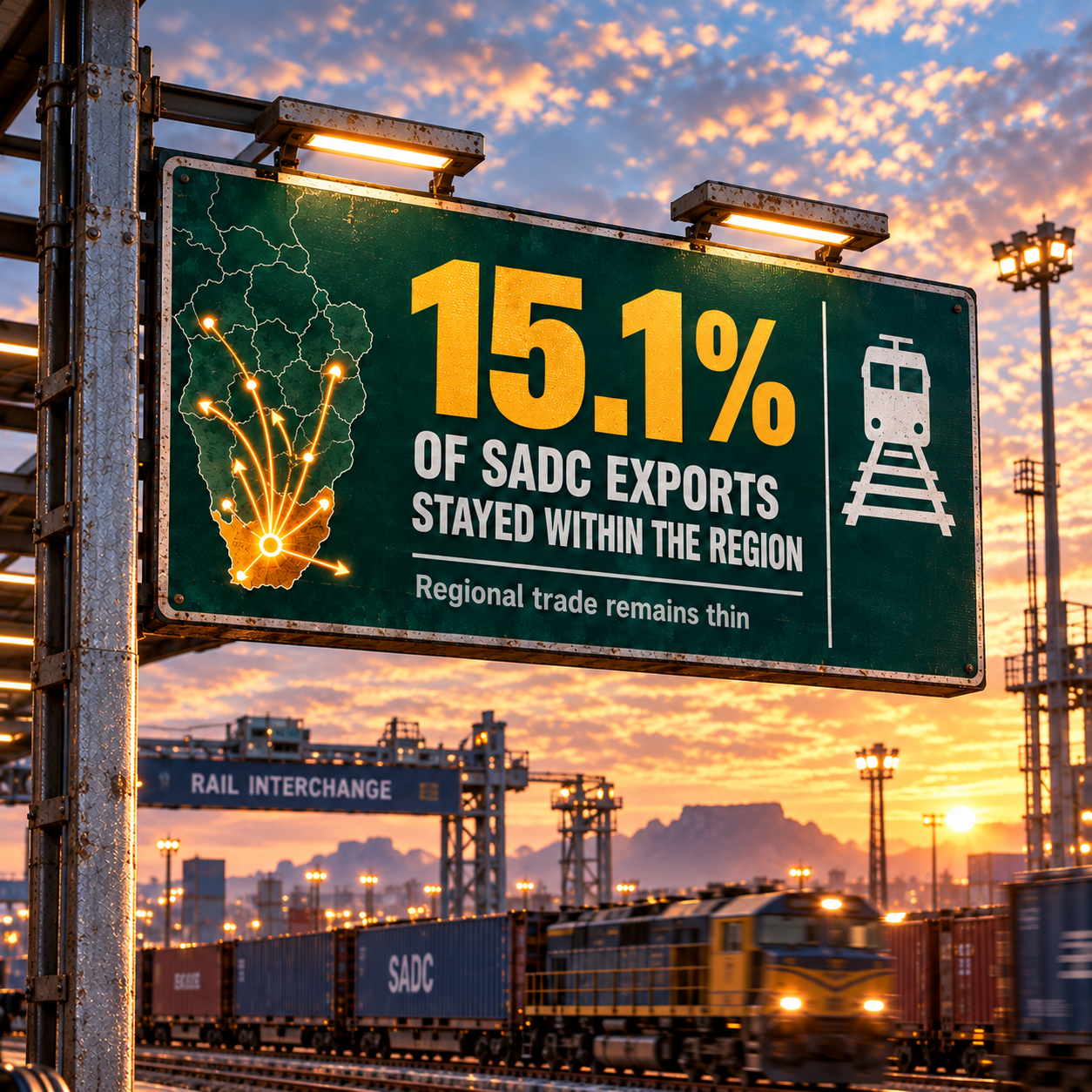
SADC’s 2024 trade figures raise an uncomfortable question: outside South Africa’s economic orbit, how integrated is the region really? The answer is remarkably little. The sixteen SADC members exported goods worth approximately US$254 billion in 2024. Only US$38.5 billion, about 15.1 percent, went to other SADC countries. Of approximately US$241 billion imported, only US$39.2 billion, or 16.3 percent, came from within the region.
SOUTH AFRICA DOMINATES
Even these modest shares overstate the depth of integration because most intra-SADC trade is not a web of exchanges among sixteen increasingly connected economies. It is principally trade with South Africa.
South Africa supplied approximately US$22.9 billion of the goods SADC countries imported from within the region and imported approximately US$8.3 billion from regional partners. Combining both directions, roughly US$31.2 billion, or 80.9 percent, of recorded bilateral trade within SADC involved South Africa. Only about US$7.4 billion, representing 19.1 percent, occurred among the other fifteen members without South Africa being one side of the transaction.
This is predominantly a hub-and-spoke system in which South Africa is the hub and the remaining economies are connected more strongly to it than to one another.
Some apparently strong performers reinforce the argument. Eswatini sent 92.6 percent of its exports to SADC, Lesotho 41.6 percent and Namibia 45.5 percent. Yet these figures largely reflect the gravitational force of South Africa and the Southern African Customs Union. SACU is comparatively integrated. SADC is not.
Elsewhere, the weakness is unmistakable. Only 3.1 percent of Angola’s exports went to SADC, 1.7 percent for the Democratic Republic of Congo and 9.6 percent for Zimbabwe. Botswana, Malawi and Tanzania each directed approximately 15 to 16 percent regionally. SADC’s members share geography and institutions. They do not yet share much of an economy.
BOTSWANA’S DEPENDENCE
Botswana illustrates the difference between regional integration and dependence upon a dominant neighbour. Approximately 78.5 percent of Botswana’s imports came from SADC, but three-quarters of those regional imports came from South Africa. Botswana imported approximately US$4.27 billion from South Africa out of US$5.67 billion sourced within SADC.
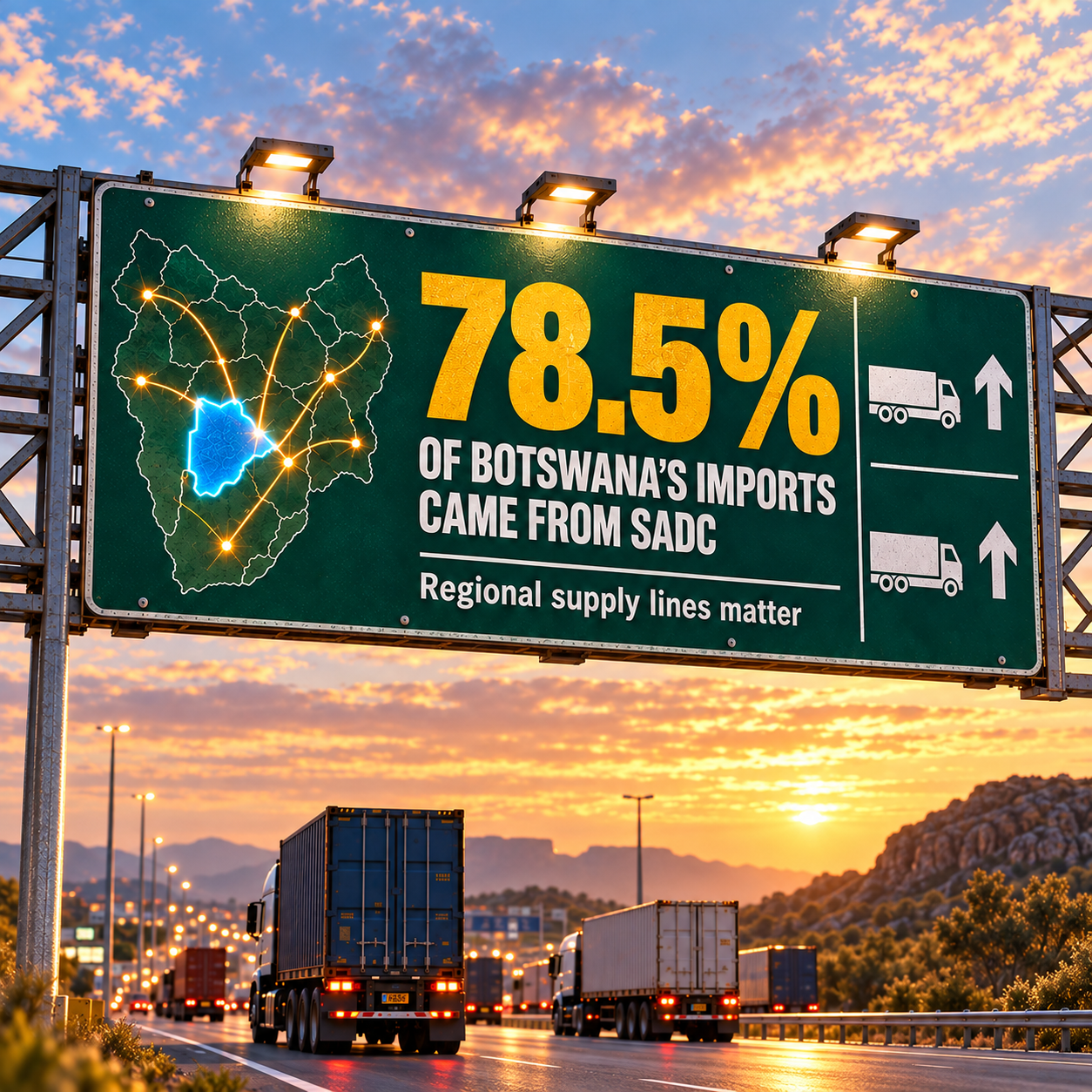
Botswana exported approximately US$737 million to SADC, but about US$607 million went to South Africa. More than four-fifths of Botswana’s regional exports were absorbed by a single market. Botswana is highly integrated with South Africa but only weakly integrated with SADC as a whole.
This matters. Dependence upon one efficient regional supplier can lower costs and provide reliable access to goods, but it also creates exposure to South African ports, railways, border systems and domestic disruptions. The objective should not be to weaken trade with South Africa. That would be economically self-defeating. It should be to build additional productive relationships with neighbouring SADC states. True integration adds connections. It does not cut the strongest existing one.
CORRIDORS OR TRADE?
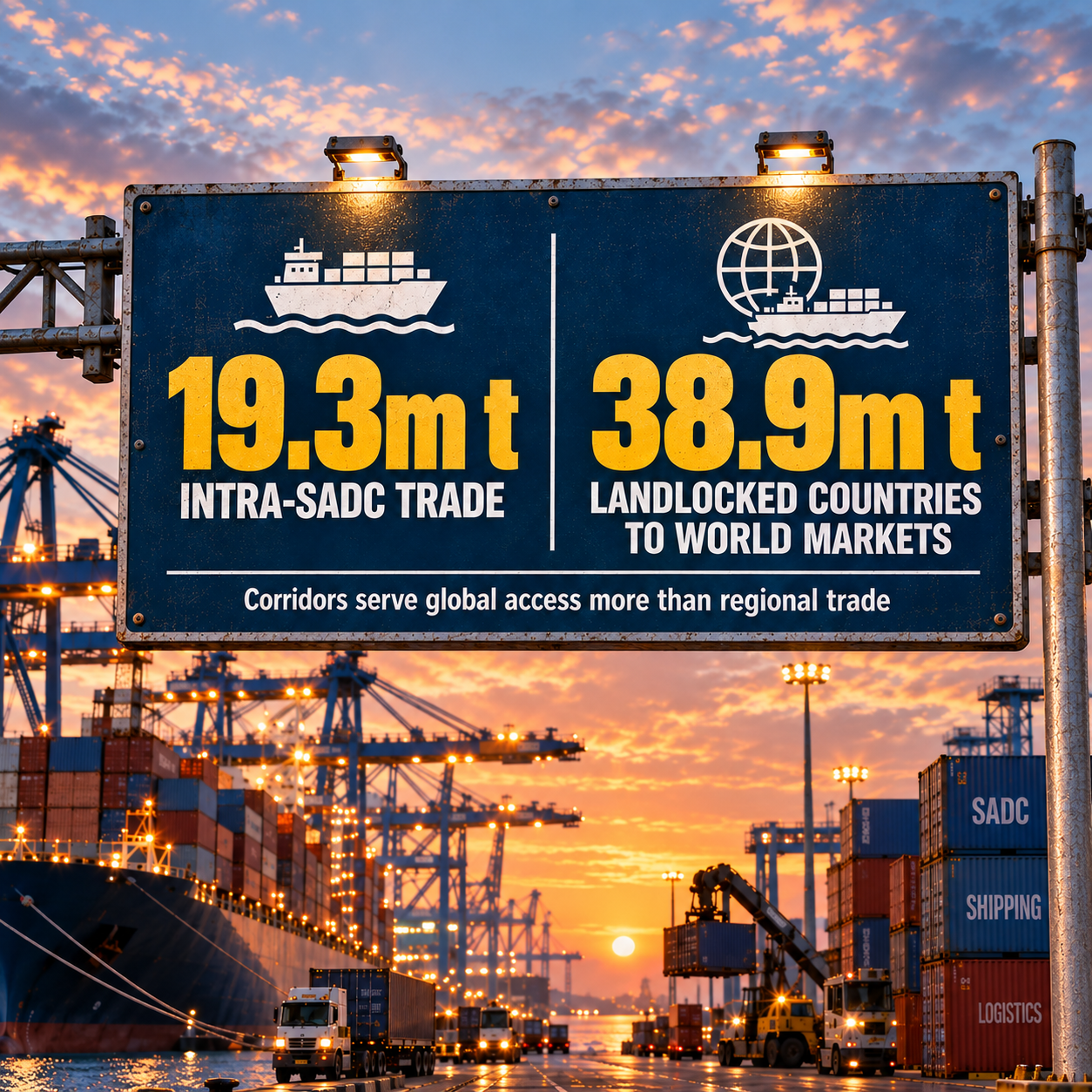
At an assumed average trade value of US$2,000 per tonne, recorded intra-SADC bilateral trade represents approximately 19.3 million tonnes. By contrast, trade between SADC’s seven landlocked members and the rest of the world that requires regional corridor access represents approximately 38.9 million tonnes, more than twice the intra-SADC volume.
Southern Africa’s corridors therefore currently serve world-market access more than regional integration. Their principal function is often to move minerals and imports between landlocked countries and seaports rather than support dense regional production networks.
Lobito and Beira are important largely because they provide the DRC, Zambia and Zimbabwe with access to overseas markets. The North-South Corridor carries substantial regional trade, but much of this reflects South Africa’s dominant commercial position. A railway to a port may diversify a country’s export route without integrating its economy with the countries through which the train passes.
Transit is not integration. Nor is infrastructure automatically trade creation. A new railway does not manufacture goods. A modern border post does not create an export industry. A corridor can become an efficient pipe carrying raw materials out and finished products in while generating limited production, employment or value addition along its route.
WHY IT STALLED
Physical barriers are only part of the explanation. SADC economies frequently produce similar primary commodities for sale to the same overseas markets. They manufacture too little, process too little and often lack the complementary industries required to trade intensively with one another.
The remaining barriers are institutional and commercial: slow borders, incompatible standards, import permits, unreliable logistics, fragmented payment systems, limited trade finance and policies that protect national markets while publicly endorsing regional integration. Governments sign regional agreements and then defend domestic monopolies. They speak of free movement while transporters face permits, delays and inconsistent charges. The rhetoric is regional. The implementation remains national.
MEASURE IT HONESTLY
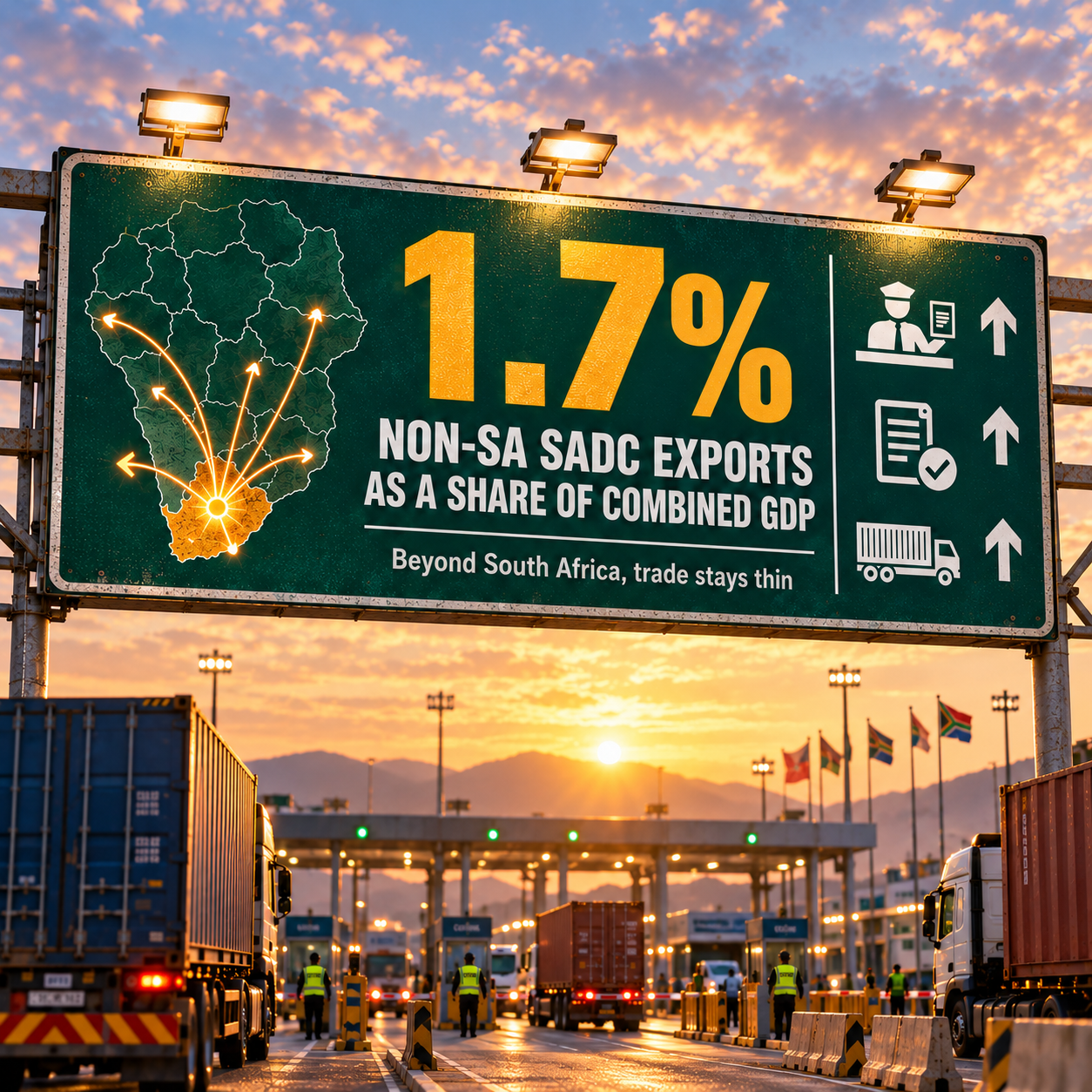
Among SADC’s fifteen economies other than South Africa, merchandise exports to one another amounted to only US$7.4 billion in 2024, equivalent to approximately 1.7 percent of their combined GDP of US$445.6 billion. Without South Africa, the regional market is not merely thin. It is scarcely functioning as an integrated economy.
That should change how integration is measured. Treaties signed, meetings held, kilometres of corridor identified and infrastructure projects announced are not enough. A more meaningful test is whether smaller economies trade more with one another, create regional value, develop cross-border production chains and reduce border time, logistics costs and unreliability. Rail interoperability, open access and realistic freight demand also matter.
The revealing question is simple: how much intra-SADC trade would remain if South Africa were removed from the matrix? In 2024, the answer was only about one-fifth of the recorded regional total. That is the integration deficit.
Southern Africa does not lack corridors. It lacks sufficient production to fill them with regionally traded goods. It does not lack declarations. It lacks implementation. It lacks a genuinely regional economy beyond one dominant centre.
The next phase of integration must therefore begin in farms, factories, warehouses, payment systems and border procedures, not at another summit. Until the smaller SADC economies trade substantially more with one another, talk of the transport hub and regional integration will remain hubris.