

As President Duma Boko prepares for his November State of the Nation Address, a review of 117 earlier commitments reveals progress, unfinished promises and questions about delivery.
DR DOUGLAS RASBASH
A State of the Nation Address is a statement of intent. Its real value emerges later, when the nation can compare what was promised with what has changed. With the next November SONA approaching, the review of President Duma Boko’s November 2025 commitments reveals a mixed picture: some meaningful improvements, many initiatives still taking shape, and several deadlines for which delivery remains unconfirmed.
The President’s theme was “The Steady Path: Delivering on Our Promise, One Step at a Time”. Ahead of the next November address, the question is whether those steps are producing the outcomes citizens were led to expect.
MEASURING PROMISES
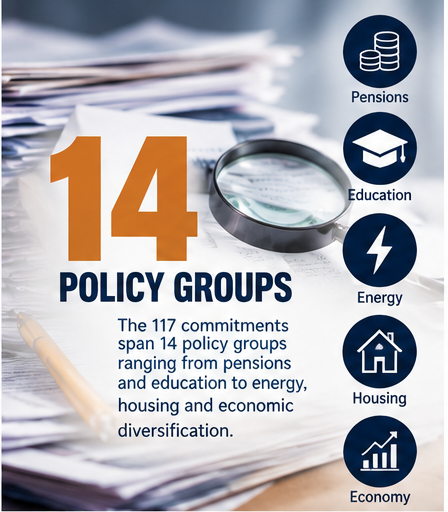
To examine this, we organised the address into a database of 117 commitments across 14 policy groups. These range from pensions, infant grants and school meals to electricity generation, housing, constitutional reform and economic diversification. The review uses information available up to 14 October 2026, approximately eleven months after the address.
Each assessable commitment received a score from zero to five. One indicates initial work, two substantial preparation, three measurable partial delivery, four substantial delivery and five achievement.
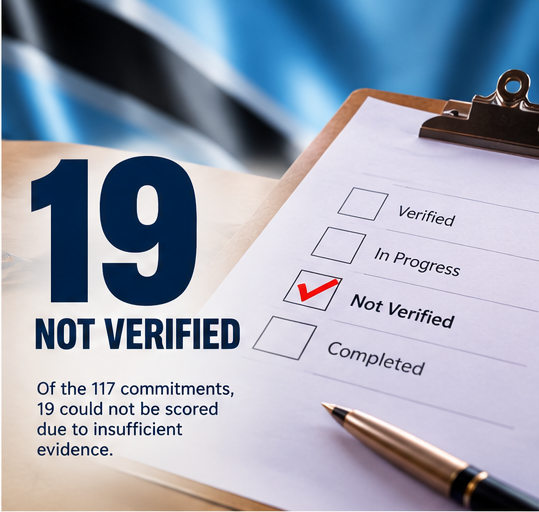
Where the evidence could not support a defensible judgement, the item was marked “not verified”, or NV. Missing information was not converted into a zero. Equally, a launch, allocation or memorandum of understanding was not automatically treated as a completed promise.
This is an evidence review, not an audit. Some sources report government’s own account of progress. Thirty-one scores rely on work described in the original address without a clear subsequent update. The database therefore measures what can presently be demonstrated, rather than claiming complete knowledge of implementation.

The distribution is revealing. Of 117 commitments, 19 could not be scored. Among the remaining 98, seventeen received one, forty-four received two, twenty-three received three, ten received four and only four received five. The largest concentration is therefore in preparation. More commitments have reached the drafting, planning or institutional-development stage than demonstrable full delivery.
No item received zero. That should not be interpreted as proof that every promise has advanced. Some poorly documented commitments remain NV, while others already had preparatory activity underway when SONA was delivered.
DELIVERED RESULTS
The 30% water-tariff reduction was reported as implemented. Infant support has also moved beyond announcement: by August 2026, payments of the P300 monthly Child Support Grant had begun, including arrears from its April commencement date. Full coverage of every eligible baby remains unverified, but actual payments distinguish this intervention from programmes that exist mainly on paper.
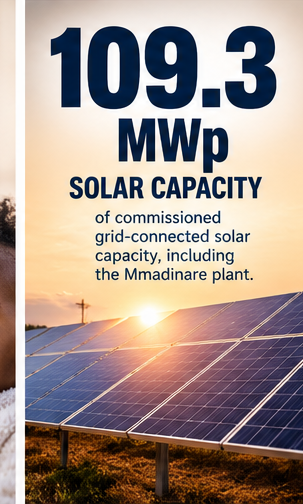
Electricity generation offers another measurable achievement. Botswana Power Corporation reports 109.3 MWp of commissioned grid-connected solar capacity, including the Mmadinare plant, which entered full commercial operation in the final quarter of 2025. On BPC’s stated capacity basis, this supports achievement of the promise to connect more than 100 MW of solar by December.
The forensic audit provides a further example of a completed output. Its report reached the President on 30 April 2026, approximately one month after the promised March deadline. Completion merits recognition, but acting on its findings requires separate evidence. A delivered report is the beginning of accountability, rather than its conclusion.
Other programmes show credible partial delivery. The first consignment of Girolando dairy cattle arrived in July. Special Constables have been absorbed into the regular police service. These are identifiable benefits, even where the full promised scale remains outstanding.

UNFINISHED BUSINESS
The pension promise remains only partly fulfilled on the evidence reviewed. February reporting still records P1,400 against the P1,800 commitment. From the original P830, the P570 increase delivers about 59% of the promised P970 uplift. That is substantial assistance, but it is not full fulfilment. Similarly, the increase in TVET allowances to P1,900 does not establish delivery of P2,500 across tertiary students.
Electricity affordability requires particular care. The 30% reduction applied to domestic consumers using below 200 kilowatt-hours monthly, while other customer categories faced increases. Describing this simply as a universal household tariff reduction obscures the difference between targeted relief and the broader promise.
Several ambitious deadlines also remain unsupported by completion evidence. Government promised a platform delivering all public services digitally within six months. March reporting records expansion from 33 to 52 electronic services, which is progress, but falls short of demonstrating that all services were available. The STEAM curriculum was promised across educational levels from January 2026; August reporting still describes some curricula as ready for rollout and primary syllabuses under review.
The Sovereign Wealth Fund illustrates the difference between creating an institution and delivering its economic purpose. In August, the responsible minister reported that no funds had yet been invested domestically or internationally. Preparation is not evidence of diversification benefits.
The largest economic promises remain especially difficult to assess. September’s BETP update reports useful achievements, including titles issued for 82 Special Economic Zone land parcels. It repeats the ambition to create 512,000 jobs, but provides no cumulative actual employment count against that target. Investor interest, land titles and project approvals are necessary inputs. Jobs require an employment register.
POLICY SCORECARD
Group averages offer a broad comparison, with NV excluded. Water and sanitation scores highest at 4.00, followed by electricity and petroleum security at 3.57. Environment, climate and wildlife averages 1.50. Some high scores recognise infrastructure already near completion when SONA was delivered. They are neither percentages achieved nor a ranking of ministerial competence.
The central finding is that Botswana has delivered some tangible benefits while much of its reform programme remains in preparation or partial implementation. The financial strain facing government helps explain the difficulty. It also increases the importance of realistic deadlines and transparent reporting.
The forthcoming November SONA should make comparison easier. Each major commitment needs a baseline, target, deadline, responsible institution and current result. Houses should be counted when completed, jobs when people are employed, and health improvements when patients can reliably obtain treatment. This analysis calls on the administration to report against such a scorecard in the forthcoming address. The President promised to measure progress by outcomes. A year on, that remains the right test.