
Ignored, misunderstood, and rarely discussed, pelvic health is quietly shaping lives, livelihoods, and dignity across Africa.
By Kabelo Wame and Douglas Rasbash
Across much of Africa, an entire domain of human health remains largely invisible, misunderstood, or simply never discussed: pelvic health. Pelvic health sits at the intersection of women’s health, childbirth, ageing, dignity, productivity, and economic development. Importantly, pelvic health conditions affect both men and women. They include commonly overlooked issues such as pubic symphysis dysfunction and tailbone pain.
HIDDEN COSTS
Paying less attention to pelvic health conditions carries profound social and economic costs. Addressing it openly could be transformative, to both governments and the individual.
Simply put, the pelvis is the bony structure inside your hips, buttocks and pubic region. Pelvic health refers to the functioning of the pelvic floor muscles and organs, the bladder, uterus, vagina, prostate, and rectum, and the muscles and ligaments that support them. When these systems function well, individuals maintain continence, sexual health, reproductive function, and exercise. Pelvic dysfunction signs and symptoms range from incontinence to prolapse, sexual dysfunction, chronic pain and reduced mobility. Addressing pelvic floor dysfunction results in significant changes to quality of life and pain reporting.
WIDESPREAD ISSUE
In Africa, pelvic health problems are widespread but vastly underdiagnosed. They affect people across all life stages, from adolescents during sporting activities to aged adults.
Many pelvic health issues are related to childbirth. Many women have multiple pregnancies and births, limited access to skilled obstetric care, and insufficient ante and post natal care, to include rehabilitation. With limited research in this area to provide specific numbers, conditions such as pelvic organ prolapse and obstetric fistula still affect hundreds of thousands of women across the continent. Some think it is normal to leak urine post child birth and go on without seeking medical advice.
Pelvic health issues are not limited to childbirth. Men are also affected by prostate disorders, urinary dysfunction, and pelvic pain syndromes. Older adults face weakening pelvic muscles that lead to incontinence and reduced mobility, often forcing withdrawal from community life.
SOCIAL IMPACT
These are not merely medical conditions; they can become social tragedies. Women suffering from fistula, for example, may face stigma, isolation, and economic exclusion because of constant leakage and odour. Men lose confidence.
Shame and embarrassment to talk about intimate organs due to religion and socialisation may also contribute to limited engagement with health services. Geographic location also precipitates reduced follow up care as most people live in rural areas and small farms.
Despite this knowledge gap, pelvic health education is rarely included in school curricula, public health messaging, or primary care training.
CULTURAL SILENCE
The silence surrounding this topic reflects powerful cultural dynamics. Discussions of bodily functions, sexuality, and reproductive anatomy are often considered taboo. Many people assume these conditions are a normal part of growing older and come to expect them. Health systems may reinforce this invisibility by focusing narrowly on diagnosis and surgical interventions, such as maternal survival or prostate assessments, while overlooking the long term quality of life that follows.
This silence is costly.
Poor pelvic health reduces women’s ability to work, farm, or run businesses. It can limit girls’ participation in school sports, affect marital relationships, and create long term health burdens that strain already stretched health systems. When half the population is quietly coping with preventable disability, the economic consequences are significant.
PATH TO CHANGE
The good news is that many pelvic health problems are preventable or treatable.
Interventions like education, improved obstetric care, early diagnosis, proper follow up services, have shown to be effective at addressing pelvic health issues. Countries that have introduced physiotherapy and gynecologists as part of maternal care have seen substantial reductions in incontinence and prolapse. Likewise, reviewing men post procedures like removal of the prostate help address subsequent issues.
Education is the starting point.
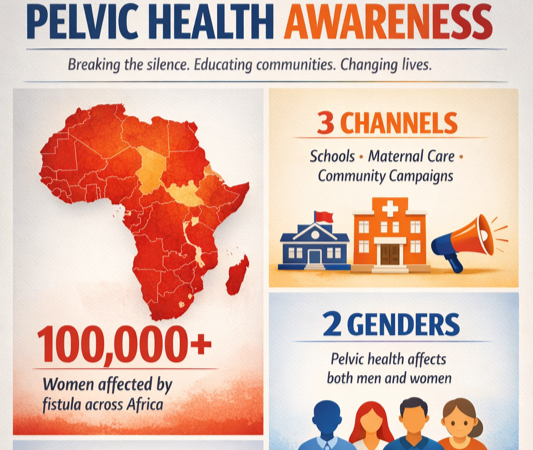
Pelvic health literacy could be introduced through three simple channels:
First, school health education should include basic anatomical knowledge and muscle training awareness. Teaching girls and boys about the pelvic floor in adolescence removes stigma and builds lifelong good health habits.
Second, maternal healthcare programmes should include pelvic floor rehabilitation alongside antenatal and post natal care. Women routinely receive advice about breastfeeding and nutrition; they should also receive guidance on pelvic recovery after childbirth.
Third, community health campaigns can normalize conversation around pelvic health. When information is delivered through trusted channels, nurses, midwives, community leaders, taboos quickly dissolve.
Africa has already shown that culturally sensitive health education can change behaviour dramatically. The continent’s successes in HIV awareness, malaria prevention, and maternal survival demonstrate what is possible when information is shared openly and systematically.
Pelvic health deserves the same attention.
In an era when African governments are focusing on human capital development, women’s empowerment, and labour productivity, ignoring pelvic health is no longer tenable. Healthy pelvic function is not merely a private medical matter; it is part of the infrastructure of human wellbeing.
A continent with the world’s youngest population cannot afford to let millions of women suffer in silence from preventable conditions.
Pelvic health education is therefore not a luxury.
It is an African imperative. And a cost saving measure.