
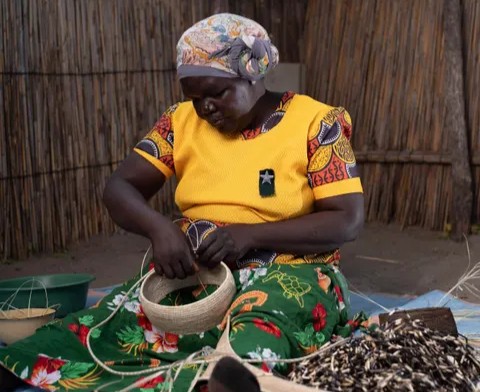
From Ngamiland to Venice, Shakunona Parata has pushed Okavango basketry beyond the souvenir shelf one coil, quill and sculptural experiment at a time.
GOSEGO MOTSUMI
Venice has canals. Botswana has the Okavango. At Homo Faber 2026, the two worlds met through the hands of master basket weaver Shakunona Parata, who took an ancestral Ngamiland craft and gave it a decidedly contemporary twist.
Parata became the face of Botswana’s first showcase at the international craftsmanship biennial, held at Fondazione Giorgio Cini recently. Supported by De Beers, she delivered live weaving demonstrations and unveiled Diware, a sculptural work developed with Peter Mabeo of Mabeo Studio.
FROM BASKET TO SCULPTURE
Parata learned the craft from her mother as a child, mastering the traditional coil-weaving technique using finely cut palm leaves and grass. Her Okavango practice is rooted in the landscape and communities surrounding the river, where natural materials have long been part of everyday life.
In Venice, she interpreted a Mabeo Studio design using traditional weaving alongside foraged porcupine quills, semiprecious stones and hand-carved wooden charms.
The result: basketry that refuses to stay in the basket aisle.
HOW FAR CAN THE CRAFT GO?
Parata’s fascination is experimentation. She has explored dyes made from unconventional plants, experimented with industrial inks and continually tested how far the medium can stretch without losing its identity.
Homo Faber describes her practice as an “instinct for experimenting with Okavango basketry” a fitting description for an artist working between inheritance and invention.
The collaboration was also part of De Beers’ wider work with Mabeo Studio, exploring “the artistry and craftsmanship that emerge from the same landscapes as natural diamonds.”
De Beers said it was proud to support a platform that shared Botswana’s heritage and creative talent internationally, while recognising “the dedication, knowledge and traditions” nurtured across generations.
For Parata, the future of basketry is not about freezing tradition in time. It is about allowing it to evolve while keeping its roots firmly planted in the Okavango.
And that may be the real flex: Botswana’s heritage does not need to be repackaged to travel. Sometimes, it just needs to be woven differently.