
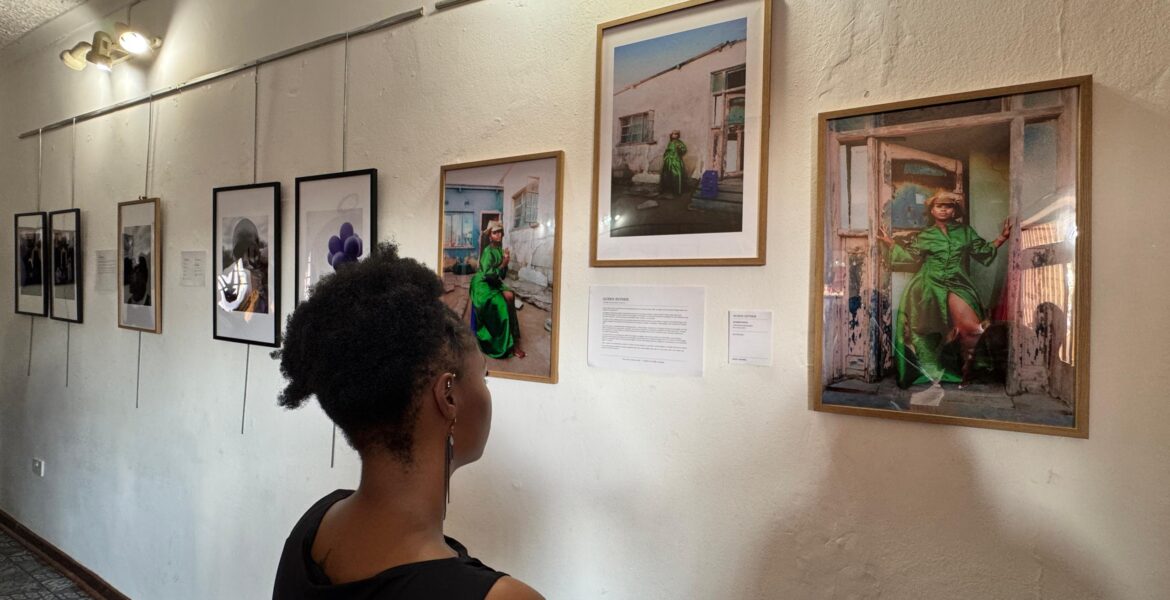
A smartphone, a family legacy and a fascination with the unseen have led Giovanni Jangano to his first photography exhibition, where the images ask audiences to look beyond what meets the eye.
GOSEGO MOTSUMI
A girl in a white dress walks into a pond. She cannot see what lies beneath the water, and neither can the viewer. It is an unsettling image, but perhaps that is the point.
Titled Into the Unknown, the photograph has become one of the striking talking points at Zimbabwean-born, Botswana-based visual artist Giovanni Jangano’s first exhibition at Alliance Française de Gaborone. It captures the uncomfortable business of stepping into uncertainty, without a guarantee of what comes next.
Across the exhibition, Jangano turns ordinary spaces, human expressions and carefully considered colours into conversations about faith, identity, vulnerability and resilience.
PHOTOGRAPHY CHOSE ME
Interestingly, Jangano’s relationship with photography did not begin with a camera. It began with editing.
Growing up in a modest household, he lacked access to the sophisticated smartphones he admired on Instagram. Rather than abandon the ambition to create striking images, he learnt to transform ordinary photographs through digital editing. That curiosity eventually became an artistic pursuit.
“In terms of selecting the type of medium to use as an artist I didn’t choose photography, photography chose me and this is my first exhibition,” he says.
There is also an artistic inheritance behind the lens. His grandfather, the late Zimbabwean artist Shepard Jangano, established a distinctive family tradition of naming children after celebrated artists. Giovanni’s father is Rembrandt, while other relatives carry names including Picasso, Leonardo and Mona Lisa. Giovanni now continues that creative lineage through photography rather than painting.
MORE THAN PRETTY PICTURES
The exhibition refuses to stay in one emotional lane. Weight of Man confronts the pressures of masculinity and the expectation that men should endure without showing vulnerability. In Solidarity with Women for Change South Africa uses purple, black and grey to address gender-based violence and femicide, while Beyond Our Differences celebrates female solidarity without demanding sameness.
In Queen Esther, faith, companionship and courage take centre stage. Meanwhile, Full Circle returns to his smartphone beginnings, challenging the assumption that compelling photography requires expensive equipment.
Together, the collections reveal an artist interested less in simply documenting appearances than in provoking reflection.
For Jangano, the photograph is not the end of the conversation. It is the invitation.
The exhibition remains on view until 3 December 2026.