
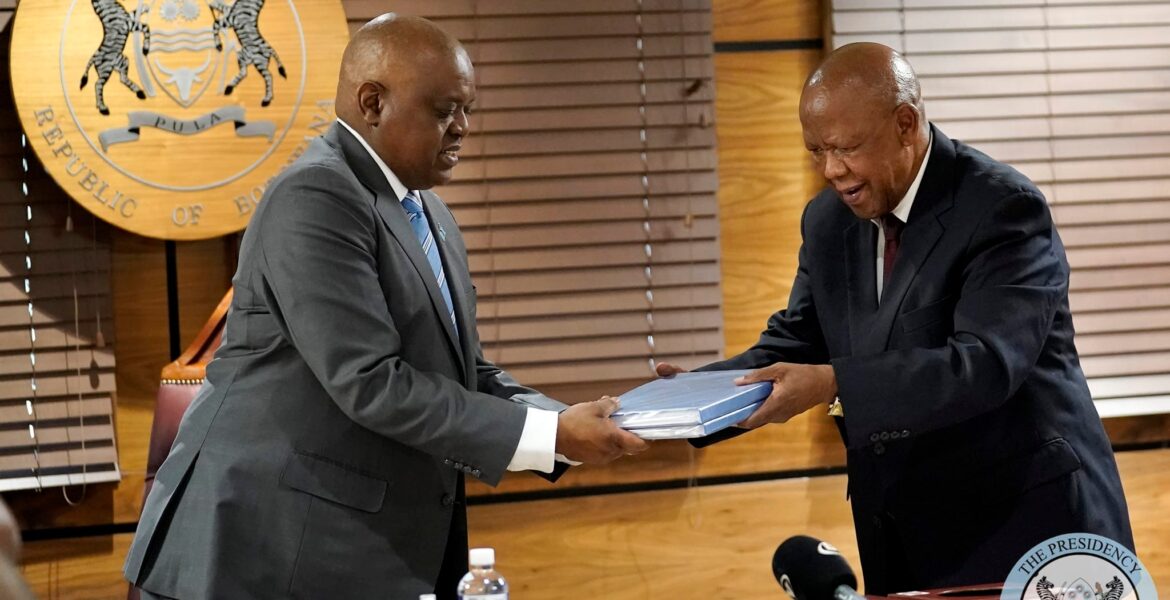
…as NGOs, Dikgosi, unions, churches and the opposition oppose Constitutional Court bill
GAZETTE REPORTER
Under mounting pressure from a broad coalition of civil society groups, Dikgosi, trade unions, churches and opposition parties to halt the constitutional amendment process establishing a Constitutional Court, President Duma Boko has turned to the much-criticised Dibotelo Commission report for justification, a commission he previously dismissed.
In Parliament on Monday, Boko invoked findings of the commission to support his insistence that the process should proceed despite calls for widespread consultation and public education.
COMMISSION’S FINDINGS
According to the same commission that the President once sharply rejected, “there were submissions to establish the Constitutional Court… The reasons for establishing the Constitutional Court were that there are delays in completion of cases and trials at the High Court.”
In what amounted to a rejection of the above finding, the commission said that “no evidence was provided regarding the statistics of constitutional cases that reached the Court of Appeal. Further, there was proof that the current system of dealing with constitutional matters is not effective.”
CRITICISM
The Commission of Inquiry into the Review of the Constitution, chaired by former Chief Justice Maruping Dibotelo, was established in December 2021 by then-President Mokgweetsi Masisi and handed its report to him in September 2022. The report was widely criticised and later rejected by Parliament after public outcry over its omissions, gaps and alleged failure to reflect the nation’s views.
BOKO INVOKES DISCREDITED REPORT TO JUSTIFY BILL
Despite that history, Boko told MPs that Batswana have spoken explicitly in support of a Constitutional Court, claiming the Commission had recorded such submissions even if it ultimately did not adopt them. He has dismissed calls to wait for the promised holistic constitutional review, arguing that the constitutional court is urgently needed.
“The people have requested and directed. It is not true that Batswana do not want a Constitutional Court,” Boko said, insisting that such a court would strengthen the rule of law, deepen constitutionalism and ensure justice that is “accessible and fair to all.”
According to the Commission’s own record, it conducted extensive national consultations covering 132 places across Botswana, held 132 kgotla meetings and 158 interest-group sessions, with 28,524 people attending kgotla gatherings.
Critics maintain the Commission lost credibility long before its report reached Parliament. The President, they say, cannot rely on a report he previously rubbished to push through a constitutional amendment of this scale.
In response, the UDC counters that its 2024 manifesto explicitly pledged to establish a Constitutional Court.