
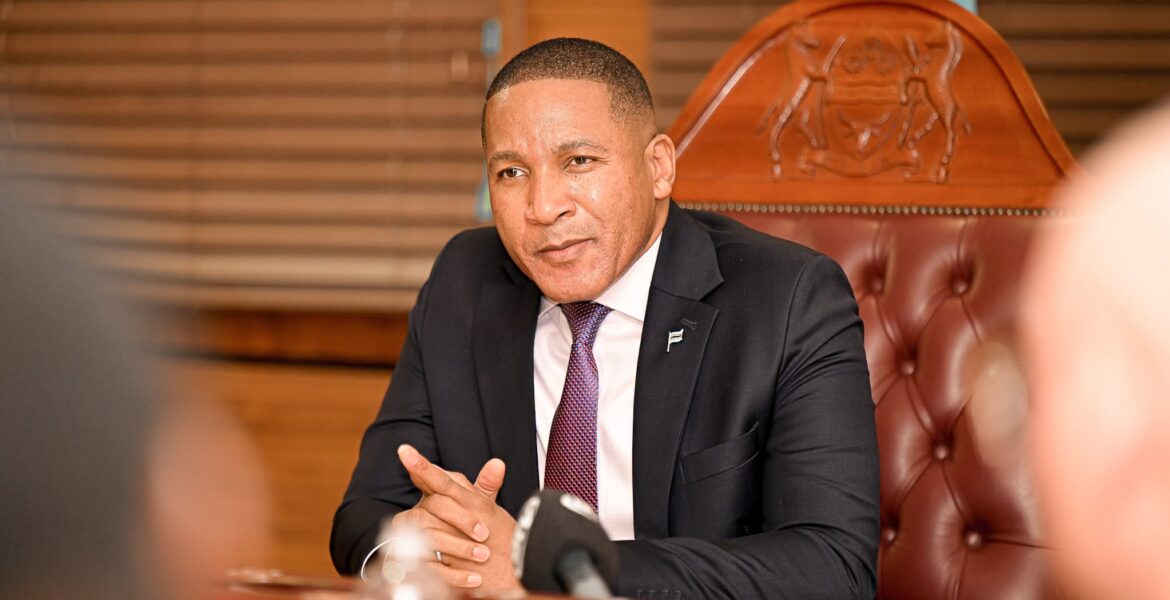
DITSHWANELO warns that unresolved clemency applications prolong the psychological burden on death-row prisoners, despite the absence of executions under President Duma Boko.
GAZETTE REPORTER
Human rights organisation DITSHWANELO has urged President Duma Boko to decide outstanding clemency applications, warning that death-row prisoners should not be left indefinitely uncertain whether they will live or be executed.
Boko, whose government has placed human rights at the centre of its agenda, has not presided over an execution since taking office in 2024. Botswana, however, retains the death penalty, and his administration has not declared a formal moratorium.
Responding to questions from The Botswana Gazette, DITSHWANELO said the absence of executions was significant but should not leave condemned prisoners in indefinite uncertainty.
“We have noted the fact that no executions have been carried out since President Duma Boko assumed his office. However, the continued existence of prisoners on death row, particularly where applications for clemency remain undecided, remains a matter of serious human dignity concern,” the organisation said.
End the Uncertainty
DITSHWANELO called for a transparent, fair and timely process for determining clemency applications.
“Where a person has petitioned the President for clemency, there should be a transparent, fair and timely process for considering that application. Death-row prisoners and their families should not be left in prolonged uncertainty regarding their fate,” it said.
“The absence of an execution should not become an indefinite state of uncertainty in which prisoners remain under the psychological burden of potentially being executed.”
The organisation also criticised the lack of information available to prisoners during the process.
“The clemency process is an opaque one, with little or no information available to the condemned prisoner. They are only informed about the outcome of the process,” it said.
Mercy, Not Execution
DITSHWANELO wants Boko to exercise his constitutional powers of mercy in favour of prisoners facing execution.
“DITSHWANELO urges the President to exercise his constitutional prerogative of mercy in favour of commutation rather than execution,” it said.
“In particular, where prisoners have petitioned for clemency, we believe that those applications should be determined without undue delay.”
The organisation called for a formal moratorium as a step towards abolition, rather than what it described as an informal suspension of executions. It also wants Parliament to abolish capital punishment in law, alongside amendments to constitutional provisions permitting the death penalty.
Beyond Public Opinion
DITSHWANELO acknowledged strong public support for retaining capital punishment but argued that fundamental rights should not depend solely on majority opinion.
“DITSHWANELO recognises that there are strong and deeply held views in Botswana in support of retaining the death penalty. Nevertheless, human rights protections should not depend solely on popular sentiment,” it said.
It called for a national conversation involving Parliament, civil society, traditional leaders, victims’ families and legal practitioners on abolition and alternative punishments.
“Abolition of the death penalty does not mean that serious crimes should go unpunished. It means that punishment should respect human dignity and the right to life while ensuring accountability, justice and appropriate protection of society,” DITSHWANELO said.
The organisation urged Boko to use the period without executions to pursue lasting reform.
“DITSHWANELO’s position remains that the death penalty should be abolished in Botswana,” it said.