
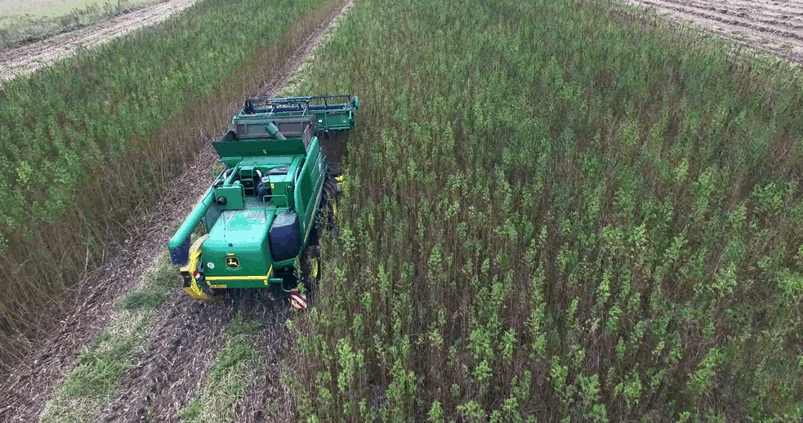
Botswana’s first licence to cultivate medical cannabis and industrial hemp has triggered a continental debate over foreign ownership, value retention and control of Africa’s emerging cannabis industry
GAZETTE REPORTER
Botswana’s newly licensed medical cannabis and industrial hemp producer has been drawn into a growing continental debate about ownership, value retention and control of Africa’s emerging cannabis industry.
The discussion erupted after Sweden-based firm Hemp Holding AB announced on LinkedIn that its Botswana-linked project had secured the country’s first-ever licence to cultivate both medical cannabis and industrial hemp.
The company said the licence, linked to Hemp Innovations Botswana, marked the beginning of a new regulated industry in the country.
“Hemp Innovations in Botswana has officially acquired the first-ever license to cultivate both medical cannabis and industrial hemp in Botswana,” the company said in its announcement.
“This is more than a permit. It is the foundation of a new regulated industry, one built on compliance, science, sustainability and international standards such as GACP and EU-GMP.”
INDUSTRY AMBITIONS
According to the company, the project aims to position Botswana as a trusted exporter to European and global markets while simultaneously building local capacity.
“Our mission is clear: position Botswana as a trusted exporter to the EU and global markets, build local skills, research partnerships, farmer inclusion and job creation, and develop high-value medical and industrial hemp supply chains,” the company said.
CONCERNS OVER FOREIGN CONTROL
However, the development quickly drew criticism from African industry groups, who warned against replicating historical patterns in which African natural resources are controlled and monetised primarily by foreign companies.
The African Hemp Consortium said the expansion of the sector must prioritise African ownership and governance.
“As this sector expands across the continent, licence allocations must prioritise substantive local ownership, governance control and long-term value retention within African economies,” the consortium said.
“Africa’s emerging natural capital industries cannot afford to replicate externally controlled extraction models under the banner of compliance or first-mover positioning.”
The consortium added that the credibility of cannabis regulation would ultimately depend not just on export readiness but on who controls the assets and where economic value is retained.
COMPANY RESPONSE
In response to the criticism, Hemp Holding AB defended the structure of its Botswana project, saying local partners and shareholders were involved in the venture.
“Good day, we have strong local partners and government bodies as partners and local shareholders in the company,” the firm said.
“All employees will be local apart from a few external experts or consultants bringing knowledge to the nation.”
CONTINENTAL DEBATE
The African Medicinal Cannabis Council later joined the discussion, cautioning that Botswana’s natural resources must generate long-term benefits for citizens.
“Botswana’s land and natural capital must generate durable value for the people of Botswana, not function primarily as upstream supply for externally controlled processing and capital structures,” the council said.
It warned that safeguards against regulatory capture and excessive foreign influence would be essential as the industry takes shape.
Meanwhile, UK-based Cannabis Research UK echoed similar concerns, citing research showing that projects primarily structured for export markets often fail to deliver meaningful economic benefits locally.
Hemp Holding AB later clarified that it intends to supply both international and domestic markets.