
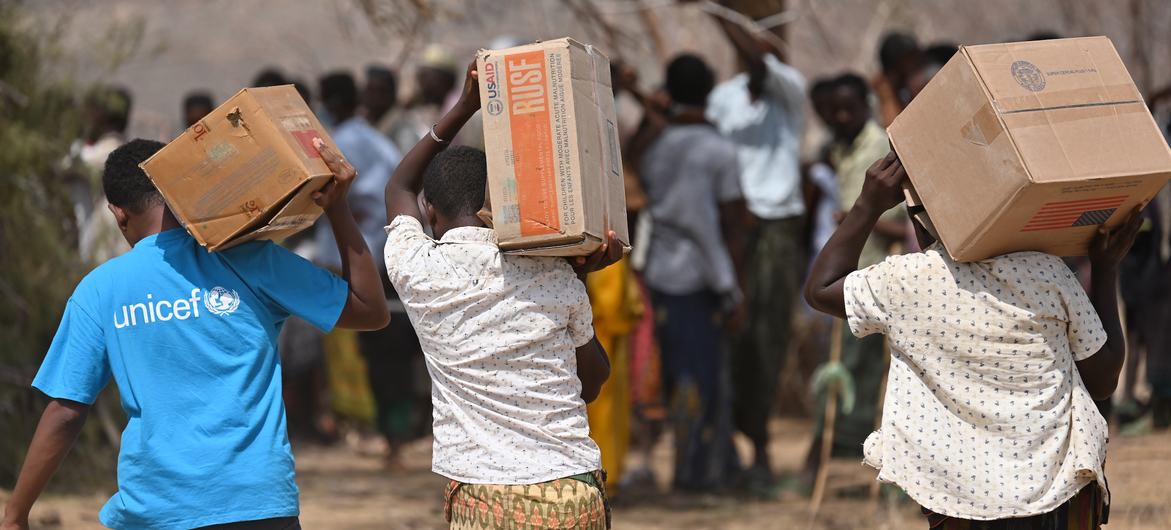
UNICEF has warned that children in Botswana are increasingly bearing the brunt of a strained health system marked by medicine shortages, declining immunisation coverage and widening inequalities
GAZETTE REPORTER
Children in Botswana are increasingly paying the price for a strained health system marked by medicine shortages and widening inequalities that threaten the wellbeing of thousands, according to a new UNICEF report.
A newly released UNICEF country programme document warns that despite Botswana’s upper-middle-income status and historically high public spending on social services, the country continues to grapple with poor child health outcomes, persistent poverty and uneven access to care.
SERVICE QUALITY GAPS PERSIST
The report by UNICEF says healthcare service quality is being weakened by shortages of community health workers, limited community engagement, and ongoing challenges in supply chain management for essential medicines and commodities.
While about 85 percent of the population lives within five kilometres of a health facility, UNICEF notes that proximity does not guarantee quality or consistent access to care, particularly in remote areas where infrastructure deficits deepen urban-rural inequalities.
These disparities, the agency says, leave many children vulnerable despite nominal geographic access to healthcare services.
WORRYING CHILD MORTALITY TRENDS
The consequences of these systemic weaknesses are reflected in child survival indicators. The under-five mortality rate remained at 40 deaths per 1,000 live births in 2023, while neonatal mortality stood at 21 deaths per 1,000 live births.
UNICEF says these figures are concerning for an upper-middle-income country and signal gaps in maternal and child health interventions.
IMMUNISATION COVERAGE COLLAPSE
The report also highlights a sharp decline in childhood immunisation coverage. Full diphtheria-tetanus-pertussis vaccination dropped from 78.8 percent in 2019 to 50 percent in 2023, while measles-rubella coverage stood at 68 percent over the same period.
UNICEF attributes the decline largely to disruptions caused by the COVID-19 pandemic, alongside reduced prioritisation of routine immunisation programmes.
Significant regional disparities persist, with full immunisation coverage ranging from 79.5 percent in Serowe to just 18.6 percent in Jwaneng, underscoring unequal access to preventive healthcare.
MALNUTRITION REMAINS A MAJOR CHALLENGE
Botswana’s children are also affected by what UNICEF describes as a “triple burden of malnutrition.” Nearly 28.9 percent of children under five are stunted, 7.3 percent are wasted, while 10 percent are overweight.
The report notes low infant feeding practices, with only 20 percent of infants exclusively breastfed for the first six months and fewer than half receiving appropriate complementary feeding between six and nine months.
ECONOMIC PRESSURES WORSENING OUTCOMES
Beyond health challenges, the report warns that economic pressures are compounding risks for children. Economic growth has slowed sharply, from 13.6 percent in 2021 to a 3.0 percent contraction in 2024, with further contraction projected for 2025 due to weakness in the diamond sector.
UNICEF says 26 percent of children experience income poverty, while about half face multidimensional poverty — rising to 68 percent in rural areas compared to 27 percent in urban centres.