
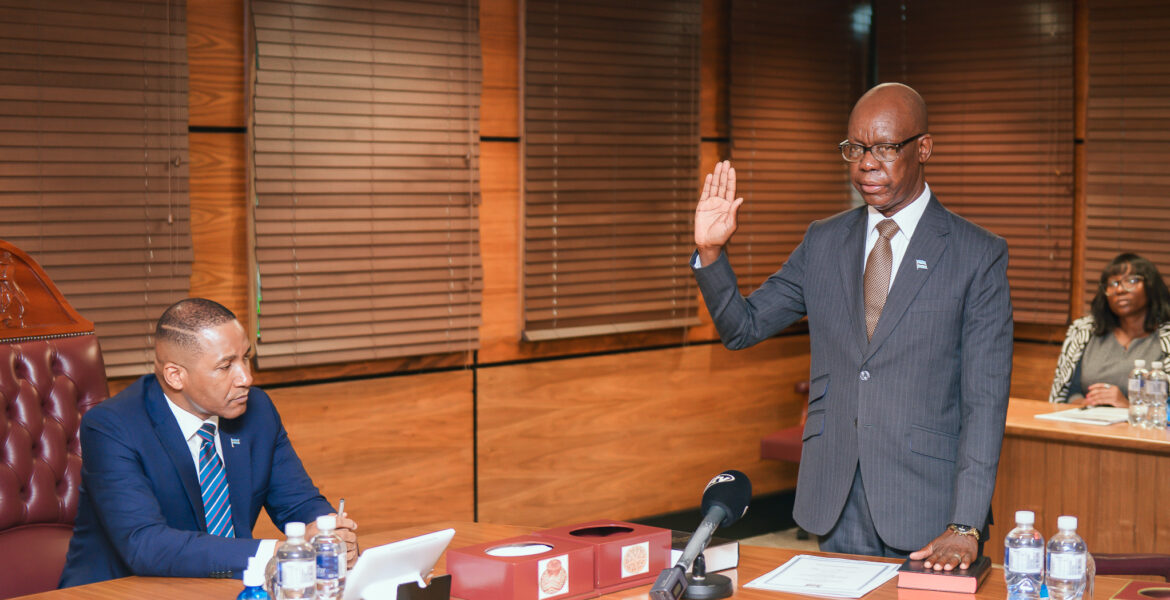
Chief Justice (CJ), Gaolapelwe Ketlogetswe has insisted that the courts will continue to impose the death penalty to deserving criminals, amid fears that President Duma Boko’s ‘undeclared moratorium’ could influence judges.
GAZETTE REPORTER
The Chief Justice Gaolapelwe Ketlogetswe has said the judiciary remains bound by the Constitution, which retains capital punishment as a lawful sentence for capital offences.
“Our duty is to interpret and apply the law, not to impose our personal views,” the Chief Justice said at a press conference yesterday. “That is what we took an oath to do. As you are aware, our Constitution retains the death penalty for capital offences, and the courts will continue to follow the dictates of the supreme law.”
RELUCTANCE TO SIGN DEATH WARRANTS
The remarks come amid growing public and legal debate over President Boko’s alleged reluctance to sign death warrants for condemned prisoners, a constitutional step required before executions can be carried out. Critics argue that the President’s stance has effectively resulted in an undeclared moratorium, as the number of death row inmates continues to rise.
Botswana remains one of the few countries in Africa that actively retains the death penalty, with hanging prescribed for murder under aggravating circumstances. While courts may impose death sentences, executions cannot proceed without presidential assent.
SUSPENSION OF THE LAW?
President Boko, a long-time abolitionist, has previously spoken out against capital punishment on moral and human rights grounds. However, he has denied imposing a formal moratorium, maintaining that his position does not amount to a suspension of the law.
Pressure has nevertheless mounted on the Presidency, with legal commentators warning that prolonged delays in signing death warrants could raise constitutional questions and expose the state to legal challenges from both condemned inmates and victims’ families seeking closure.
The Chief Justice sought to draw a clear line between the judiciary and the executive, stressing that sentencing decisions remain firmly within the courts’ mandate.
CONSTITUTIONAL AMENDMENT
A legal expert told this publication that “the existence or non-existence of executions does not change the law as it stands”. “Until such time as Parliament amends the Constitution, the courts will continue to discharge their responsibilities accordingly,” he said.
Any move to repeal capital punishment would require constitutional amendments, a process that involves Parliament and, in some instances, a national referendum.