
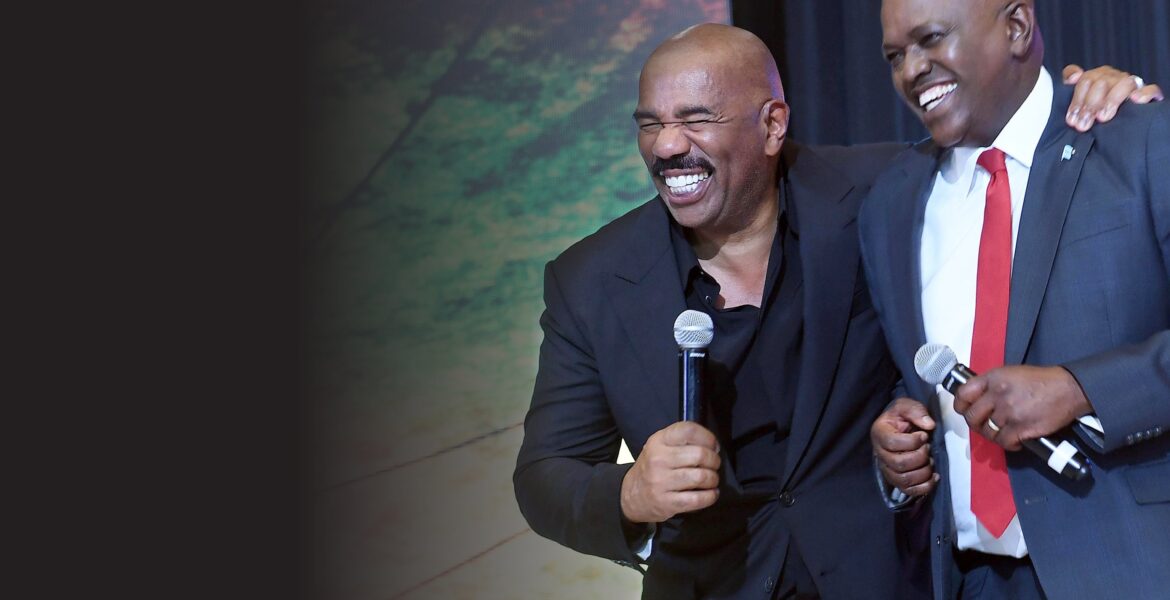
More than P1 billion was committed in the name of developing Botswana’s creative economy, yet much of that value flowed beyond its borders. Five years later, the Steve Harvey deal has become a symbol of squandered opportunity, questionable procurement practices and a generational blow to the local creative economy, while the contract itself remains in force.
BONGANI MALUNGA
The Steve Harvey Global deal has become an expensive inheritance for the UDC government, which is now caught between its desire to distance itself from a controversial procurement decision of the previous administration and the potentially punishing financial consequences of pulling the plug.
The Public Accounts Committee (PAC) heard last week that government has paid approximately P355 million for the first year of Botswana Ignite, while the three-year partnership with the Steve Harvey Group is valued at more than P1 billion. Officials say all first-year contractual deliverables were met, including remodelling the Mass Media Complex auditorium, installing equipment, producing television content including Family Feud Botswana, and conducting training.
Yet phases two and three have stalled because of government’s financial constraints, leaving significant future spending attached to a deal that has attracted sustained criticism over its procurement, secrecy and benefit to Botswana’s creative industry.
WEIGHING OPTIONS
The government is now weighing what to do with an agreement it did not originate. Acting Permanent Secretary in the Ministry for State President, Defence and Security Jeremiah Makgwa told the PAC last week that the ministry was consulting the Ministry of Finance on whether the contract should continue or be terminated. With the contract still live, any attempt to exit it could carry legal and financial consequences, while continuing it would commit government to further expenditure on a deal the UDC inherited from the previous administration.
At the heart of the controversy is the manner in which Steve Harvey Global entered the public procurement system. In June 2021, the Public Procurement and Asset Disposal Board (PPADB) approved the use of direct procurement by the Department of Broadcasting Services (DBS) to engage Steve Harvey Global for radio and television production services over three years. Contemporary reporting put the proposed value at about P470 million. The PAC has now been told that the three-year Botswana Ignite partnership is valued at more than P1 billion.
RAISING QUESTIONS
The procurement decision immediately raised questions about why a competitive process was not used to test whether other companies could provide the same services at better value for money.
The controversy was not merely political. The procurement trail itself became a source of concern because government initially maintained that the PPADB decision was approval of a procurement method rather than an award of the actual contract. Then Permanent Secretary Pearl Ramokoka said the approval authorised negotiations with Steve Harvey Global and that those negotiations might or might not result in a contract.
Yet the underlying question remained: why was direct procurement deemed appropriate in a field with numerous potential local and international production companies?
In 2021, the Botswana Congress Party (BCP) raised precisely that concern, arguing that commonly cited grounds for direct procurement, such as an emergency or a sole capable supplier, did not apply to television production services.
VINDICATED
Reached for comment, BCP president Dumelang Saleshando told this publication that his party feels vindicated after challenging the decision five years earlier. Saleshando said the party had discovered that the PPADB was initially reluctant and had reservations about the direct allocation, but government nevertheless moved to justify it.
“We went to court and sought this allocation to be reviewed. We got stuck when the Department of Broadcasting Services (DBS) refused to disclose the motivation that was used to justify the direct allocation. We went to court before Justice Omphemetse Motumise who ruled that we had no basis to involve ourselves in the matter. We feel vindicated now that what is now coming out seems to clearly suggest that this was possibly a compromised or not a clean transaction resulting in possible loss of public funds to a foreign company that was offering what could actually be sourced comparatively both from Botswana and other international bidders,” Saleshando told this publication on Tuesday. Years later, the same procurement question continues to haunt the project.
A DEVASTATING LEGACY
Speaking on Yarona FM’s News Today lunchtime programme on Tuesday, Tonderai Tsara, chairperson of the Creative Arts and Media Sector at Business Botswana, questioned the legacy footprint of the deal on the local entertainment industry and whether proper procurement protocols were followed.
“What did we buy for this money that we can see visibly so far? A television game show produced in a studio built in South Africa paid for by us. This is not an investment in the creative economy, it is an extraction from it. Just one year of this budget could have financed local production for a generation. This is abuse of taxpayers’ money. There was no need being fulfilled here. There is no value for money and a contract that cannot stand the litmus test of procurement law must fall,” Tsara said on the programme.
These allegations go to the heart of the controversy: whether government went through the motions of procurement after the decision to engage Steve Harvey Global had effectively already been made.
According to Botswana Screen Society chairperson Earnest Seakgosing, a task team established by local film industry players found that there was no genuine Invitation to Tender (ITT) underpinning the appointment. “The ITT that was eventually availed was just a formality, the contents of the ITT do not match what’s happening on the ground,” Seakgosing told The Botswana Gazette.
The historical record shows that government publicly presented the project as a partnership intended to transform Botswana’s creative economy. When Botswana Ignite was launched in April 2024, officials said the three-year project would provide training and development, nurture local talent and grow the television and video production industry.
But the local industry says the reality has fallen far short of those promises.
Seakgosing says the task team found that local participation at the core of production was limited. He says, for example the 49 Batswana involved in the Family Feud production were placed on arrangements resembling internships, while Steve Harvey Global relied on South African production companies that were formally subcontracted.
Government, however, told Parliament in April that 613 Batswana participated across the project, a broader figure that included 21 Film Development Training Academy graduates, 260 contesting families and 332 support personnel.
Botswana Film Association Secretary General Oarabile Carol Keosedile similarly says the industry was effectively presented with a fait accompli. She says local filmmakers first learned about the deal through the media rather than through an opportunity to compete for the work. The secrecy surrounding the arrangement has become another major flashpoint. Keosedile says only selected industry players were invited to some meetings and that they were made to feel that questioning the project was unwelcome. Industry participants, she says, were effectively presented with a choice: climb aboard an already moving train or be left behind.
“When the new government took over in 2024, we held countless meetings with Minister Mohwasa in a series of talks from November 2024 to June 2025. We were able to demonstrate that this deal does not benefit our industry. It was politically motivated,” Keosedile said. She says Minister Moeti Mohwasa advised the industry to take its concerns to the Directorate on Corruption and Economic Crime (DCEC), where, according to Keosedile, the matter has remained since last year while investigations continue.
EXPORTED VALUE CHAIN
The controversial project resurfaced in Parliament in April, when Serowe South MP Leepetswe Lesedi asked how much government had paid for Family Feud and why the programme was filmed outside Botswana. Minister for State President, Defence and Security Moeti Mohwasa replied that 26 episodes had been produced at a cost of US$1,533,711, or P20,932,731.89, and said the show required a set larger than the space available at the Mass Media Complex.
The answer came against the backdrop of an increasingly awkward reality: Botswana had invested over P56 million in upgrading its own broadcasting infrastructure, yet the flagship production associated with the project was filmed in South Africa.
Project officials had acknowledged the problem before filming began. In May 2024, Botswana Ignite project director Duncan Irvine said the Family Feud set did not fit in the auditorium but that plans were for future seasons to be produced in Botswana. The PAC was again told last week that the South African shoot was caused by the set and renovation constraints, and that later production was intended to take place in Botswana.
THE MODEL, NOT THE MAN
Direct appointment is not unlawful in itself. Under the procurement rules then in force, open domestic bidding was the default, but direct procurement could be used in defined circumstances, including emergencies, sole-provider situations, contract extensions, compatibility or continuity needs, or other circumstances the Board found justified.
Crucially, procurement could not begin until the PPADB had accepted a full justification and approved the method, and any award still had to demonstrate value for money. The unresolved issue with the Harvey project is therefore not whether direct procurement was legally possible, but what justification was relied upon and whether it withstands scrutiny.
Government’s 2025 review of the Development Manager model dealt with a different stream of projects under a different framework, but it sharpened the same wider debate about procurement and value for money. The review found that estimated costs under the model had risen from about P13 billion to P56 billion and called for stronger financial controls, greater transparency and a more robust value-for-money framework.
It is not the same procurement exercise as the Steve Harvey deal, but both have put renewed focus on how government explains departures from ordinary competition and demonstrates public value.
DEAL NOT CANCELLED
While recent reports have described the project as suspended, information available to The Botswana Gazette indicates that the contract itself has not been suspended. That distinction is consistent with the PAC evidence: phases two and three have stalled because of financial constraints, but government still regards the contract as live and says implementation can resume when funding becomes available.
“We have not postponed or suspended the contract. It remains ongoing. There are financial challenges that the government is dealing with but it doesn’t in any way mean that the government has suspended the contract. Even from the Public Accounts Committee (PAC) deliberations, there has been contention on the deliverables of the contract,” said Lawrence Seretse, Deputy Director of the Botswana Government Communications and Information System (BGCIS), in an interview with this publication.