
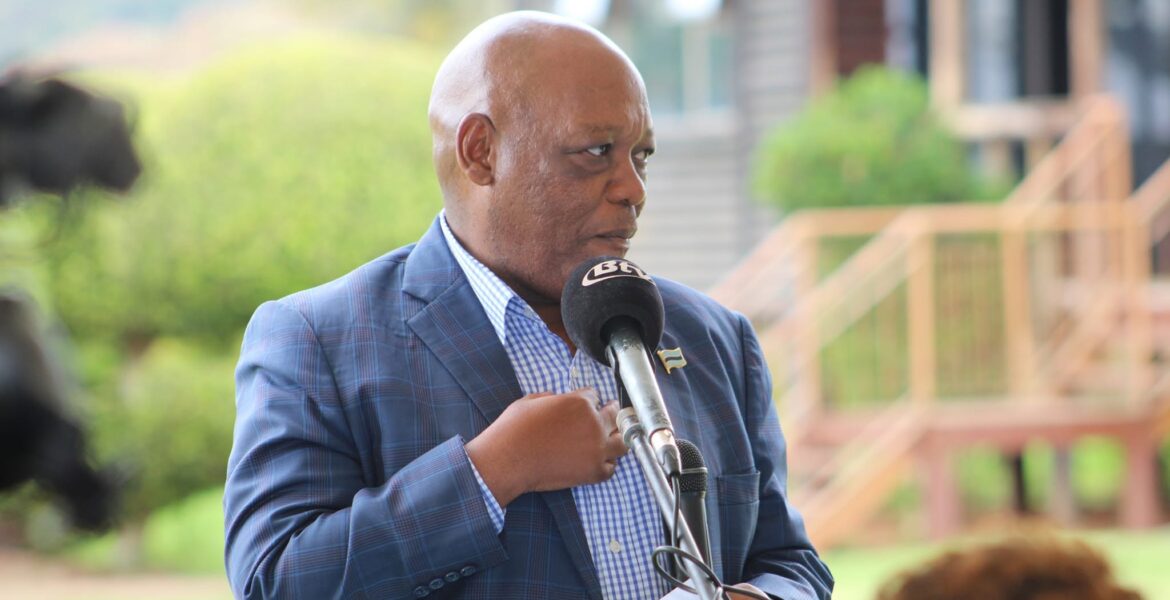
The UDC government has left intact the constitutional amendment it fiercely opposed while in opposition, drawing questions about whether its resistance was based on principle.
SESUPO RANTSIMAKO
The Umbrella for Democratic Change (UDC) government has no immediate plans to repeal the controversial floor-crossing law, despite strongly opposing the constitutional amendment when it was introduced by the former Botswana Democratic Party (BDP) government.
STATUS QUO
Responding to questions from Gabane-Mankgodi MP Kagiso Mmusi, Assistant Minister for State President, Defence and Security Dr Maipelo Mophuting Dikoloti said the government had not taken a decision to repeal or reverse the floor-crossing provisions.
The position leaves in force legislation that the UDC opposed while it was in opposition.
EARLIER OPPOSITION
The floor-crossing provisions were introduced by the BDP government in 2021 and became a major political controversy, with opposition parties questioning their implications for elected representatives and political parties.
The UDC, together with the Botswana Congress Party (BCP) and Botswana Patriotic Front (BPF), opposed the amendment and accused the BDP government of undermining politicians’ freedom of association.
Despite that resistance, the constitutional amendment was enacted, establishing provisions governing MPs who leave the political party under whose banner they were elected.
The law has remained in force after the 2024 general elections, in which the UDC removed the BDP from power.
MMUSI CHALLENGES
Dr Mophuting Dikoloti’s response means the UDC administration is maintaining the legal framework it inherited from the previous government despite its earlier opposition.
Speaking to The Botswana Gazette, Mmusi said his parliamentary question was intended to establish whether the UDC had been genuine in opposing the amendment while it was out of government.
He questioned why the UDC had not moved to repeal the law now that it had the numbers in Parliament to do so.
“If they were genuine, they could have reasons why they are not reversing this law,” Mmusi said.
POLITICAL TEST
Mmusi said the UDC’s failure to repeal the amendment could suggest that its earlier opposition was driven more by political expediency than principle.
“It seems that they were just making noise for the sake of opposing without valid reason,” he said.
The floor-crossing law remains politically sensitive because of its potential impact on MPs who change political allegiance, political parties and the composition of Parliament. The UDC’s decision to leave it untouched gives critics fresh grounds to question whether its earlier opposition reflected principle or political circumstance.