
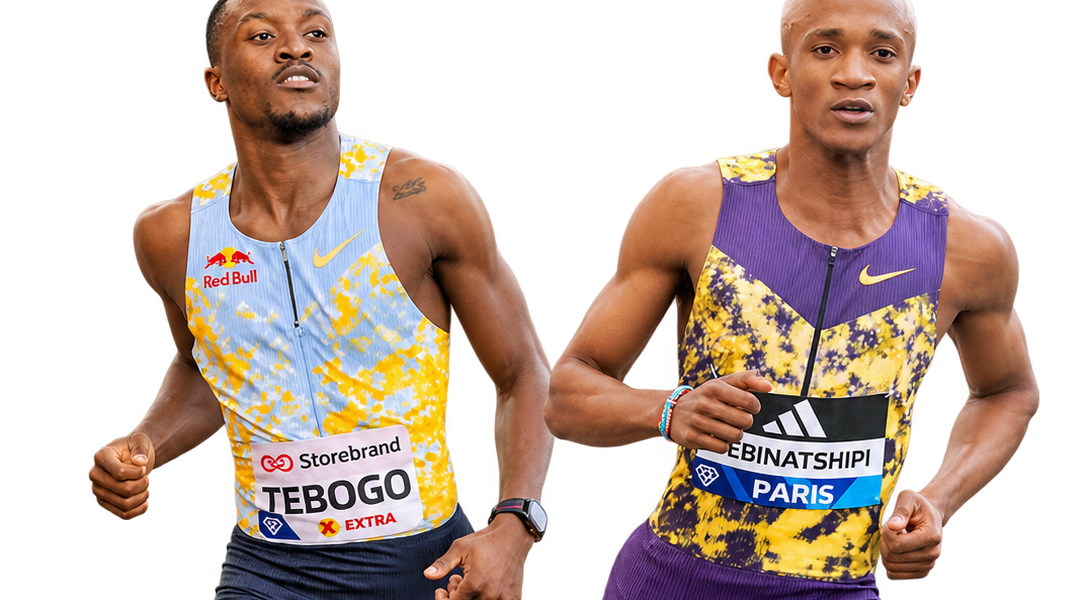
Only two Botswana sprinters recorded what would now qualify as LA28-standard individual times in 2026, highlighting a tougher Olympic road beyond the nation’s established stars
BONGANI MALUNGA
Botswana’s ambitions of maintaining its growing dominance in international athletics face a stern test after World Athletics unveiled significantly tougher qualification standards for the 2028 Los Angeles Olympic Games.
The new benchmarks, announced on 10 November 2026, raise the performance requirements across several disciplines, potentially making it more difficult for Botswana to secure individual Olympic places despite its impressive sprinting pedigree.
An examination of Botswana’s leading performances in 2026 reveals that only Letsile Tebogo and Busang Collen Kebinatshipi recorded times meeting the new standards across the men’s 100m, 200m and 400m events, exposing the challenge facing their compatriots.
THE BIGGEST SQUEEZE
The biggest squeeze is in the men’s 400m, where the qualifying mark has been slashed from 45.00 seconds at Paris 2024 to 44.40 seconds for LA28.
Botswana’s historical depth is impressive, with seven athletes having achieved 44.40 or faster: Kebinatshipi, Tebogo, Bayapo Ndori, Lee Eppie, Isaac Makwala, Baboloki Thebe and Karabo Sibanda. However, that historical achievement contrasts sharply with recent performances.
Kebinatshipi’s national record of 43.39 seconds and Tebogo’s 2026 season’s best of 44.37 seconds are comfortably inside the new benchmark. In contrast, Eppie’s 44.50 and Ndori’s 44.62 season’s bests would have satisfied the Paris standard but fall short of LA28 requirements.
The men’s 200m standard has also tightened from 20.16 to 19.95 seconds. Tebogo’s 19.76 season’s best puts him safely inside that benchmark, while emerging sprinter Prince Phaezel Selepe’s impressive 20.01 leaves him just 0.06 seconds outside the new requirement.
STANDARD DROPPED
In the 100m, the standard has dropped from 10.00 to 9.93 seconds. Kebinatshipi clocked 9.89 twice in 2026, while Tebogo’s season’s best of 9.95 falls marginally short despite his personal best of 9.86.
Botswana’s female athletes face an equally demanding challenge. Oratile Nowe’s national record of 1:56.76 in the women’s 800m is already faster than the new 1:57.00 standard. However, her 2026 season’s best of 1:57.32 demonstrates the narrow margins involved. The Paris requirement was a considerably more forgiving 1:59.30.
The women’s 400m standard has also been reduced from 50.95 to 49.90 seconds, leaving Obakeng Kamberuka, whose personal best stands at 50.97, needing significant improvement. Elsewhere, middle-distance runner Tshepiso Masalela has previously clocked 1:42.70 in the men’s 800m, better than the new 1:43.00 standard, but his 2026 best of 1:44.99 falls short. His 1500m personal best of 3:30.71 is also just outside the revised 3:30.00 requirement.
CHALLENGE
African 400m hurdles champion Kemorena Tisang faces a similar challenge. His national record of 48.32 seconds would have satisfied the Paris qualifying mark of 48.70, but LA28 demands 48.00.
Despite the tougher standards, World Athletics has widened the world-ranking qualification route. Approximately 60 percent of athletes are expected to qualify through rankings, compared with 50 percent for Paris 2024.
Crucially, the individual track performances recorded in 2026 do not count towards LA28 qualification. The qualifying window for most individual track events opens on 19 June 2027 and closes on 18 June 2028.
Botswana’s formidable men’s 4x400m relay team, which clocked a record-breaking 2:54.47 at the 2026 World Relays in Gaborone, also has a separate qualification pathway through the 2028 World Relays, where the top 14 teams will secure Olympic berths.
SUPPORT
In an interview with Gazette Sport, Botswana National Olympic Committee president Tshepo Sitale confirmed that they already have measures in place to assist Botswana’s athletes meet the benchmarks. He cited the existence of the Olympic Solidarity Scholarship and continental scholarships which guarantee financial support of at least P5000 and a peak of P10 300 per month. Sitale noted that the assistance is geared towards helping the athletes access nutrition, gear, event participation and specialist care.