
By Douglas Rasbash
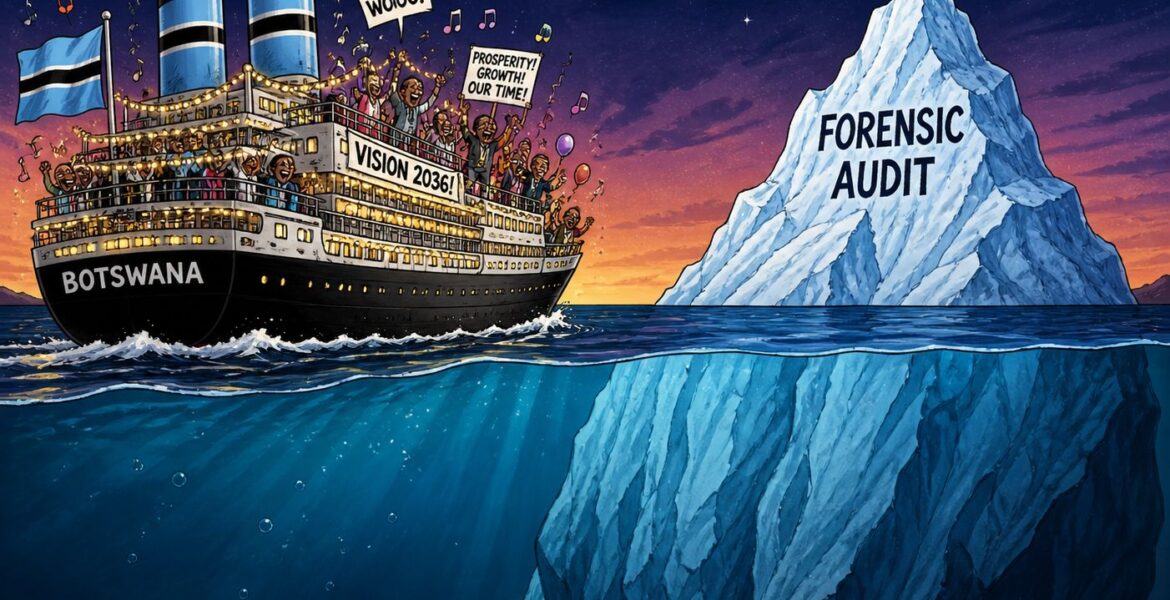
The forensic audit report should be read like an iceberg.
What the public can see above the waterline is already alarming: 814 findings, 585 of them rated Very High or High severity, 80 special investigation referrals, contracts and payments with a combined gross value of about P160 billion, and a conservative preliminary estimate of P33 billion in potential loss or damage.
But the real danger lies below the surface.
This report is not the whole iceberg. It is the visible tip.The forensic audit programme covered 30 selected audits, drawn from a Phase 1 risk assessment of 92 public sector entities. It focused mainly on the period from April 2014 to March 2024, and it was explicitly described as targeted and risk-based, not a statutory audit or whole-of-government review of every public body, project, contract, transaction or allegation. The report itself warns that the absence of a matter from the summary should not be read as meaning no issue exists.
That is the iceberg warning.
If 30 audits produced 814 findings, what might the full public sector contain? If 26 of the 30 audits produced special investigation referrals, what would be found across all high-risk entities not yet audited? If the known referral matters alone expose around P160 billion in gross value, what is the total value at risk across the wider state, parastatal and development-expenditure system?
The report gives us enough to understand the scale, but not enough to claim the full picture.
And what we can see is grave. Procurement and governance account for the largest share of findings. Procurement alone produced 238 findings, while governance produced 215. Together they account for about 56% of all findings. These are not side issues. Procurement is where the state decides what to buy, who to buy from, how much to pay, whether competition is genuine, whether delivery is verified, and whether public money becomes public value.
Governance is where those decisions should be supervised, challenged and corrected.
When procurement and governance fail together, the state loses its immune system.
The audit found repeated use of non-competitive procurement, weakly justified direct awards, emergency procurement, tender manipulation, unsupported payments, weak contract management, compromised oversight, poor records, weak financial discipline and indicators of fraud, corruption, collusion, conflicts of interest and abuse of office. It also found stalled or incomplete projects, assets acquired but not used, services contracted but not delivered or utilised, and weaknesses in the allocation of high-value public resources.
This is not merely corruption in the narrow sense. It is something wider: the corrosion of public administration.
A country can survive individual cases of fraud. It cannot easily survive a system in which controls are ignored, procurement is manipulated, records disappear, oversight is weak, boards do not function, whistleblowers feel unsafe, and consequences are delayed or absent.
The report’s most chilling finding is not the P33 billion estimate. It is the pattern.
The audit identifies systemic enablers: weak oversight mechanisms, ineffective control institutions, vulnerabilities in procurement, weak financial management, operational delivery failures, and a weak culture of accountability. These weaknesses reinforced each other. Poor oversight allowed bad decisions to continue. Weak control institutions failed to convert warning signs into investigation, prosecution, recovery or sanction. Poor records reduced visibility. Weak accountability discouraged challenge.
That is how an iceberg forms.
Not overnight. Not from one official. Not from one ministry. Not from one contract.
It forms slowly, under the waterline, through thousands of decisions: a waiver here, an emergency procurement there, a missing file, a silent board, a postponed audit recommendation, a conflicted official, a politically connected supplier, a whistleblower punished, a project certified without delivery, a payment made without evidence, a virement approved without scrutiny, a parastatal bailed out again.
Eventually the visible tip appears. But by then most of the damage is already below the surface.
The special investigation referrals show how serious this has become. The report states that the 80 referrals include more than 80 current and former senior officeholders and more than 150 contractors, suppliers and counterparties, including local and international entities. That means the most serious matters were not confined to junior staff, isolated suppliers or one rogue institution. They cut across public bodies, decision-making levels and counterparties.
This matters because Botswana is now entering a dangerous economic phase. The country is no longer cushioned by the old diamond economy. Fiscal space is shrinking. Debt is rising. Public expenditure is under pressure. NDP12 and the Botswana Economic Transformation Programme require enormous sums of money. Yet the forensic audit tells us that the machinery through which public money is planned, procured, spent and monitored has serious systemic weaknesses.
That is the national danger.
Botswana is trying to fund transformation through a public-sector machine that the forensic audit says is leaking, distorted and weakly controlled.
This is why the audit cannot be treated as yesterday’s scandal. It is tomorrow’s growth problem.
Every pula lost to overpricing, collusion, non-delivery or weak contract management is a pula not spent on clinics, roads, water, schools, digital systems, agricultural resilience, energy security or youth employment. Every failed project increases future borrowing. Every unsupported payment weakens confidence. Every compromised procurement decision discourages honest investors. Every ignored audit finding raises the cost of capital.
The forensic audit is therefore not only about corruption. It is about the credibility of the state.
Can government implement NDP12? Can it deliver infrastructure? Can it manage public debt? Can it attract serious FDI? Can it protect pension funds? Can it convince markets that borrowing will produce transformation rather than waste? Can it persuade citizens that sacrifice is justified when public money may not be safe?
The answer depends on what happens next.
The report is clear that the remaining issue is execution. It says the programme has identified the issues, isolated the most serious matters for referral, and set out the reforms required. If implementation is weak, delayed or treated as a compliance exercise, the same patterns are likely to recur.
That sentence should be printed and placed on every minister’s desk.
The danger now is that the report becomes theatre. There will be statements. There will be outrage. There may be press conferences, task teams, committees, and carefully worded promises. But unless there are investigations, recoveries, prosecutions where justified, procurement reform, board reform, systems reform, whistleblower protection and visible consequence management, the iceberg will remain.
The public has seen the tip.
The deeper question is whether government has the courage to dive below the waterline.
Botswana does not need another performance of accountability. It needs accountability.
It needs to publish progress without compromising investigations. It needs to recover what can be recovered. It needs to protect evidence. It needs to strengthen the Auditor General, DCEC, prosecution capability, procurement regulation, internal audit, boards, records systems and financial controls. It needs to professionalise procurement and remove excessive discretion. It needs to make public office risky for those who abuse it, not risky for those who report abuse.
Above all, it needs to understand that the forensic audit is not the end of the story. It is the beginning. The iceberg is now visible. The question is whether Botswana turns away before impact.