
Mounting fiscal and governance pressures are forcing Botswana to confront whether fragmented ministerial oversight of SOEs has outlived its usefulness and whether a professional state holdings group offers a credible way forward.
DR DOUGLAS RASBASH
Botswana’s State-Owned Enterprises are once again under the national spotlight. The Public Accounts Committee has raised concerns about governance failures, qualified audits, delayed annual reports, recurring losses and continued dependence on taxpayer support across parts of the SOE sector. Undertakings have been given to return commercial SOEs to profitability and to hold certain Ministers to account if they do not.
A further point is this: is it reasonable to expect civil servants and inexperienced Ministers to become corporate managers? Can PS Transport make business decisions about BR, CAAB and AB? Can a Minister of Agriculture oversee corporate profitability at BAMB and BMC? But perhaps the more important question is no longer whether some SOEs are underperforming. The real question is whether Botswana’s entire model of state enterprise ownership and oversight has reached the limits of its usefulness.
DEVELOPMENT LEGACY
For decades, SOEs were central to Botswana’s development model. At independence, the country inherited a very small private sector, weak capital markets, limited industrial capacity and little indigenous ownership of strategic infrastructure. The State therefore stepped in as investor, operator, planner, employer and economic driver. Governments built power systems, telecommunications, water infrastructure, railways and agricultural support systems because there were few alternatives capable of doing so. SOEs became instruments of sovereignty and nation-building.
But the global economy evolved. Many countries shifted toward corporatisation, professional portfolio management, independent regulation and sovereign holding companies. Botswana, however, still largely manages its SOEs through fragmented ministerial structures designed for the economic realities of the 1970s rather than the competitiveness pressures of the 2020s.
CONFLICTING MANDATES
Many SOEs operate under multiple and sometimes mutually conflicting objectives. Some are expected simultaneously to function as commercial enterprises, providers of public goods, employment generators, instruments of regional development and vehicles of social policy.
An SOE may be expected to remain financially viable while also keeping prices affordable, supporting remote regions and pursuing broader developmental goals. A loss may therefore reflect inefficiency, but it may also reflect deliberate public policy obligations imposed by government. Under the current system, these trade-offs are rarely measured transparently. Subsidies remain blurred, accountability becomes confused and performance assessment becomes inconsistent.
FRAGMENTED OVERSIGHT
Combined annual turnover across major commercial SOEs may already lie between P22 billion and P30 billion. Yet Botswana still does not manage these entities as a single strategic national investment portfolio.
Instead, they remain scattered across ministries operating under differing governance standards, reporting systems, procurement rules and oversight structures. Ministries often formulate policy, influence regulation, supervise boards and monitor performance within their own sectors. The result is structural conflict, duplication, fragmentation and weak accountability.
A recent governance assessment of major SOEs revealed a deeply uneven picture. Only a handful of entities achieved strong governance scores above 70 out of 100, notably Botswana Power Corporation and Botswana Telecommunications Corporation. A large number fell into high-risk territory, including Air Botswana, Botswana Railways, Botswana Agricultural Marketing Board, Botswana Tourism Organisation and Botswana Meat Commission.
FISCAL EXPOSURE
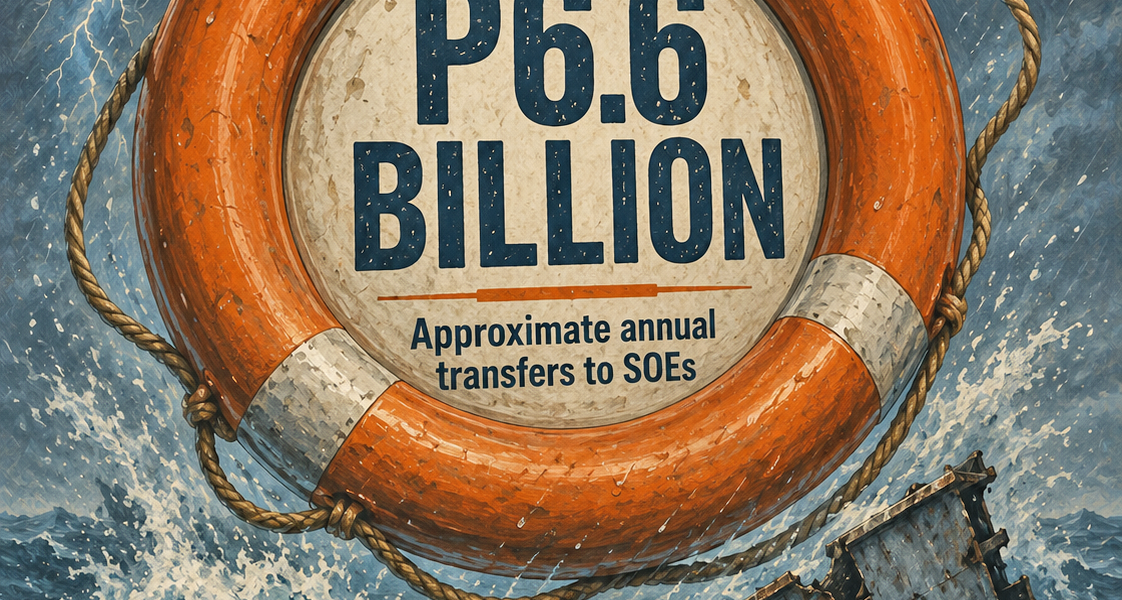
Botswana’s SOE sector is therefore not a marginal governance issue. It is a major macroeconomic system. Current estimates suggest approximately P6.6 billion in annual transfers, P15.4 billion in guarantees, aggregate losses exceeding P2 billion and contingent liabilities above P10 billion. More than half of SOEs continue receiving government support, nearly half received qualified audits and roughly one-third failed to publish audited accounts altogether.
These are no longer merely administrative concerns. They are macroeconomic risks. Every pula transferred to persistently underperforming entities is a pula unavailable for health, education, infrastructure, water security, energy transition or private sector development. Weak governance within SOEs does not simply affect annual reports. It affects productivity, fiscal sustainability, investor confidence and long-term competitiveness.
At the same time, it would be wrong to suggest that SOEs create no value. They provide strategic infrastructure, transport systems, telecommunications, agricultural support, development finance and employment that underpin the wider economy. The issue is whether Botswana is extracting sufficient public value relative to the enormous fiscal resources tied up within the system.
HOLDINGS MODEL
Botswana has discussed SOE reform, restructuring, commercialisation, privatisation and rationalisation for decades. Yet despite recurring PAC concerns and mounting fiscal pressure, the institutional architecture has remained largely unchanged. Fragmentation persists. Oversight remains inconsistent. Accountability remains diffused.
The challenge Botswana faces is therefore no longer ideological. The issue is not whether the State should own strategic assets. Many successful economies retain substantial state ownership in energy, transport, telecommunications and infrastructure. The real issue is whether Botswana can continue managing strategic public assets through fragmented administrative structures that no longer match the scale and complexity of the modern economy.
That leads increasingly toward what may now be the only serious long-term solution: the establishment of a Botswana State Holdings Group plc.
Under such a model, major commercial SOEs would gradually be consolidated under a single professionally managed holding corporation operating with a unified Group Board, common governance standards, integrated performance monitoring, consolidated fiscal oversight and modern corporate reporting disciplines. Ministries would focus on policy. Independent regulators would regulate. The Holdings Group would manage ownership, governance, investment performance, risk and accountability.
Botswana would gain consolidated visibility over the true fiscal position of the SOE system. Shared audit systems, procurement platforms, legal services, governance frameworks and digital systems would reduce duplication and improve efficiency. Fiscal risks and contingent liabilities could be monitored centrally rather than scattered across ministries. Most importantly, Botswana would begin managing SOEs not as disconnected administrative extensions of ministries, but as strategic national assets.
The proposal could even allow for partial Botswana Stock Exchange listings of selected subsidiaries or the Group itself, deepening capital markets, improving transparency, mobilising pension fund capital and introducing market discipline while retaining strategic state control.
In effect, Botswana would move from fragmented state administration toward sovereign asset management. The country may now require a complete redesign of how the State owns, governs and manages commercial public assets. In Botswana’s case, that future may increasingly point toward a Botswana State Holdings Group plc.