
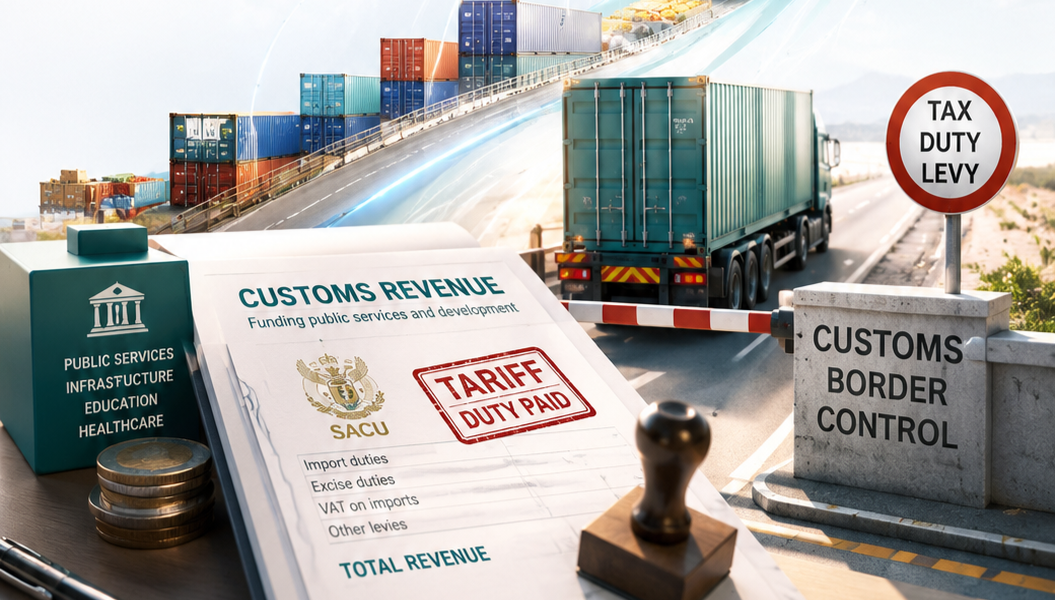
As Botswana looks beyond diamonds, SACU’s import-duty model raises a difficult question: can a region build export competitiveness while taxing the productive imports that make exports possible?
By Dr. Douglas Rusbash
The recent Southern African Customs Union (SACU) Summit in Cape Town was built around a compelling vision for the region’s future. Leaders spoke of industrialisation, regional value chains, export competitiveness, economic diversification and deeper regional integration. Few would disagree with these aspirations. For Botswana, where the urgency of diversifying beyond diamonds has never been greater, they are national priorities.
Yet the Summit also prompts a question that has received remarkably little attention. Could SACU’s own fiscal architecture be working against its long-term economic ambitions?
TRADE TAX PARADOX
This is a provocative question, but not an ideological one. It emerges from a well-established principle of international economics known as Lerner’s Symmetry Theorem, first developed by economist Abba Lerner in 1936. Despite its age, the theorem offers an unexpectedly modern perspective on trade policy and perhaps on SACU itself.
The theorem states something that initially appears counterintuitive: a tariff on imports is economically equivalent to a tax on exports.
At first glance this seems impossible. Import duties are paid by importers, not exporters. The answer lies in the simple fact that imports are ultimately paid for by exports. When a country imposes tariffs, imported goods become more expensive and imports decline. Foreign producers earn less income from selling into that market. Having earned less, they also have fewer resources with which to purchase that country’s exports.
In other words, reducing imports indirectly reduces exports. The tariff never appears on an export invoice, yet its economic effect is remarkably similar to imposing an export tax. While economists have debated its precise application for decades, Lerner symmetry’s central insight remains influential: policies that discourage imports also tend, through market adjustment, to discourage exports.
EXPORT COST PRESSURE
For Botswana, this raises an important question. Our national strategy increasingly centres on expanding non-diamond exports. Whether those exports are manufactured products, processed foods, business services, digital technologies or tourism, the objective is the same: to create a more diversified and resilient economy.
Yet Botswana also participates in a customs union where a significant proportion of government revenue is derived from taxing imports.
Historically, this arrangement has been extraordinarily successful. For more than a century SACU has provided fiscal stability to its smaller members. Botswana, Namibia, Lesotho and Eswatini have all benefited from the Common Revenue Pool, with customs receipts often representing between one-fifth and one-half of total government revenue depending on the country and the year. Botswana itself has frequently received around one quarter of its government revenue through SACU transfers.
These revenues have financed roads, schools, hospitals and other essential public services. From a public finance perspective, customs duties possess obvious advantages. They are comparatively easy to collect, difficult to evade and administered at relatively few border posts. Historically, they required far less administrative capacity than comprehensive income or consumption taxes.
When SACU was established in 1910, these advantages were overwhelming. Modern VAT systems did not exist. Electronic tax administration was unimaginable. Corporate taxation was still in its infancy across much of the world. Border taxes were simply one of the most practical ways of financing government. The question is whether that remains true today.
PRODUCTIVE IMPORTS MATTER
The world economy has changed profoundly over the past century. Today’s exports are no longer produced entirely within national borders. Modern manufacturing depends on imported machinery, electronic equipment, chemicals, industrial components, software, packaging materials and specialist technologies.
A Botswana food processor imports processing equipment. A furniture manufacturer imports adhesives, machinery and fittings. Mining companies import sophisticated equipment. Digital businesses rely on imported servers, computers and telecommunications infrastructure.
These imports are not signs of economic weakness. They are productive inputs. They are the tools from which exports are created. This changes the economics of tariffs. Every duty imposed on productive imports increases production costs. Those costs reduce competitiveness. According to Lerner symmetry, they also reduce exports.
The implication is subtle but important. If Botswana wishes to maximise non-diamond exports, then reducing the cost of productive imports may be just as important as subsidising exporters. This does not mean imports are inherently good or bad. Nor does it suggest that tariffs should simply be abolished. Governments require revenue.
VALUE OVER VOLUME
The relevant question is not whether imports should be taxed, but whether taxing trade is the most efficient way to finance government in an economy whose future increasingly depends on trade.
Most economists would argue that, where practical, governments should finance themselves from domestic value creation rather than from the movement of goods across borders. Income taxes rise as employment grows. Corporate taxes rise as businesses become more profitable. VAT grows with domestic consumption. These taxes increase because the economy has created value.
Customs duties, by contrast, are collected before value has necessarily been added within the domestic economy. That distinction matters. Botswana’s objective is not to import less. It is to create more value from what it imports.
An imported machine that enables P500 million of manufactured exports is not an economic cost. It is an investment. An imported computer that allows a software company to export digital services is not a weakness. It is productive capital.
The question therefore shifts from “How do we reduce imports?” to “How much Botswana value does each pula of imports create?” This may be one of the most useful indicators that Botswana does not currently measure. Policymakers should perhaps focus less on the trade balance itself and more on import productivity: the amount of domestic GDP generated by every pula of imported productive inputs.
Viewed in this way, imports become catalysts for economic transformation rather than statistics to be minimised.
MODERNISING SACU MODEL
None of this diminishes SACU’s achievements. The customs union remains one of Africa’s oldest and most successful regional institutions. Its common market has facilitated trade for more than a century. Its revenue-sharing mechanism has provided fiscal stability to smaller economies. Its role in regional integration remains indispensable.
The question is simply whether SACU’s fiscal model should evolve alongside its economic ambitions. The Cape Town Summit placed considerable emphasis on industrialisation, regional value chains and export-led growth. Those objectives may now justify asking whether the Common External Tariff should distinguish more clearly between productive imports and final consumption goods.
Should industrial machinery, advanced manufacturing equipment and strategic production inputs face lower tariffs than luxury consumer goods? Should governments gradually derive a greater proportion of their revenue from domestic economic activity rather than border taxation? Could SACU preserve its fiscal solidarity while reducing the tax burden on the productive trade needed to drive future growth?
These are not criticisms of the customs union. They are questions about strategic alignment. Indeed, one might argue that SACU has become a victim of its own success. The Common Revenue Pool has worked so effectively that it is easy to overlook the economic incentives embedded within it.
If governments become dependent on customs revenue, there is an understandable reluctance to reduce tariffs, even where doing so might stimulate investment, productivity and exports. That is the paradox. The very mechanism that has successfully financed development for decades may also deserve reassessment as the region’s development strategy changes.
NEXT REGIONAL DEBATE
Ultimately, this is not a debate about free trade versus protectionism. Nor is it an argument against SACU. It is a debate about ensuring that the instruments of public finance reinforce, rather than inadvertently constrain, the objectives of economic policy.
Botswana has rightly identified export diversification as an economic imperative. If Lerner’s insight is correct, then trade policy and tax policy cannot be considered separately. Every tariff deserves to be viewed not only as a source of public revenue but also as a potential influence on export competitiveness.
The real world is more complex than any single economic theorem, but Lerner’s insight remains a powerful reminder that imports and exports are two sides of the same economic transaction.
The Cape Town Summit challenged Southern Africa to become more outward-looking, more industrialised and more export-driven. That vision deserves broad support. As Botswana assumes the rotating chairmanship of SACU, perhaps the next question is whether a customs union created in 1910 should continue to rely so heavily on taxes levied at the border in an economy where future prosperity increasingly depends on the flow of ideas, technology, capital and trade.
It is a question worth debating, not because SACU has failed, but because its success gives the region the confidence to ask how it should evolve over the next hundred years.