
Botswana cannot preach entrepreneurship while policing an informal sector that already accounts for nearly one in four jobs.
DR DOUGLAS RASBASH
Botswana has spent decades asking how it can create jobs. Perhaps it should begin by asking why it makes it so difficult for people to create their own. Walk through Gaborone Bus Rank, Main Mall, Francistown, Molepolole or almost any large village and you encounter an economy that rarely appears in ministerial speeches about diversification. People sell vegetables, clothes, cooked food, airtime, sweets, second-hand goods and countless small services. Individually these activities appear insignificant. Collectively they are an economy.
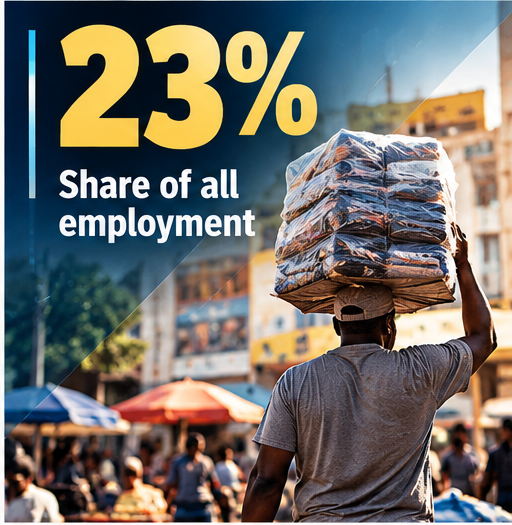
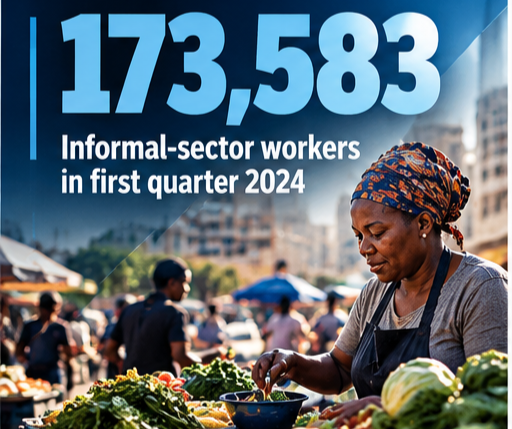
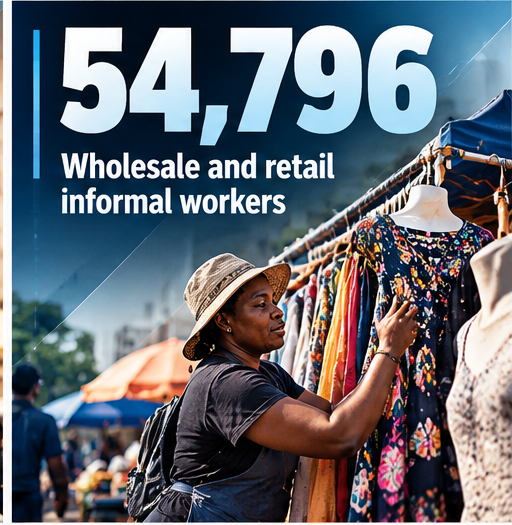
Statistics Botswana estimated informal-sector employment at 173,583 people in the first quarter of 2024, 23 percent of all employment. The largest component was wholesale and retail trade, employing 54,796 people, whom Statistics Botswana says were predominantly working in tuck-shops and as street hawkers. That is not an economic nuisance on the margins of Botswana. It is nearly one worker in four.
Yet Botswana retains an extraordinary contradiction in its approach to these people. Government talks about entrepreneurship, citizen economic empowerment, SMMEs and employment creation while another arm of government regulates, licences, relocates, charges and occasionally confiscates the possessions of people who have done precisely what government says it wants them to do: create economic activity for themselves.
In late 2025, Gaborone City Council publicly announced a crackdown on illegal businesses at the bus rank. Francistown’s own official guidance illustrates the regulatory philosophy rather wonderfully. It poses the question: “I recently lost my job. Can I set up a table in town and sell commodities to make ends meet?” The answer is yes, provided you first obtain a street-vending certificate. The same council confirms that its bye-law officers have powers to arrest people and confiscate goods for contraventions. There, in miniature, is Botswana’s problem. A person has lost a job. The state cannot provide another. Instead of asking what it can do to help that person begin earning again, its first instinct is to ask whether that person has permission to put up a table.
BOTTOM-UP GROWTH
Economic development does not only arrive in billion-pula investment packages. It also starts with somebody selling five loaves of bread, discovering that customers want ten, buying a larger table, employing a cousin, renting a stall, opening a shop and eventually employing five people. Not every street trader will make that journey. But governments cannot know beforehand which tiny businesses will grow. That is precisely why barriers at the bottom matter.
The World Bank has previously made essentially this point in its work on Botswana. Efficient business regulation can support firm creation and productivity, while higher compliance costs can discourage entrepreneurship and therefore job creation. It specifically advocates risk-based regulation: activities presenting significant health, safety or environmental risks warrant stronger regulation, while low-risk enterprises should face lower administrative burdens. But someone selling tomatoes from a table does not present the same regulatory risk as a petrol station. Regulation should therefore regulate risk, rather than simply regulate economic activity because it exists.
TOP-DOWN THINKING
The Botswana Economic Transformation Programme is perhaps the grandest expression of this instinct. From almost 7,000 submissions, an elaborate government-led process has distilled 186 “high-impact” projects. Government stresses that 60 percent are private-sector-led, and that BETP is intended to remove precisely the bureaucratic obstacles that have frustrated investment. But there is nevertheless something profoundly paternalistic about the underlying idea that economic transformation can be engineered through laboratories, dashboards, sector strategies, selected projects and government-defined “True Norths”. The state remains standing above the economy, identifying what transformation ought to look like and then attempting to organise everybody towards it.
 That is almost the reverse of how dynamic economies actually emerge. Government cannot possibly know where Botswana’s next successful businesses will come from. Neither can consultants, ministries, investment agencies or BETP laboratories. Economic development is partly a process of discovery: thousands of people trying things, most failing, some surviving and a few discovering products, services and markets nobody sitting in a government office anticipated.
The contradiction is therefore extraordinary. At the top of the economy we have created BETP to identify 186 transformative projects and mobilise government machinery to help unblock them. At the bottom, someone trying to start the 187th project with a table, an umbrella and P500 worth of stock can be told that she is trading illegally. One entrepreneur gets a delivery dashboard. The other gets a bye-law officer.
BETP itself acknowledges that excessive red tape has stalled projects, and the 2026 Budget promises reforms specifically intended to reduce bottlenecks and compliance costs. But perhaps the most important economic transformation programme Botswana could undertake would be much simpler: stop trying to decide where enterprise should happen and make it extraordinarily easy for enterprise to happen everywhere. Government’s job is not to manufacture an economy. It is to create the conditions in which millions of individual economic decisions can manufacture one.
WORK UNDER PRESSURE
The labour-market numbers make this more urgent. Statistics Botswana’s latest comparable household survey estimates 213,437 actively unemployed people in 2024/25. That is 45 percent more than the 147,206 recorded in 2015/16. Youth unemployment reached 28.9 percent and the broader unemployment measure, including people available for work but not actively searching, was 27.3 percent. Botswana therefore has hundreds of thousands of people whose labour is not being fully utilised. Against that background, the person selling food at the roadside is not the economic problem. She is part of the response to it.
ENABLE ENTERPRISE
There is an encouraging contradiction inside government itself. In Parliament in December 2025, the Ministry of Trade and Entrepreneurship said government wanted simplified regulations, reduced compliance costs and easier access to technology, finance and markets for the informal sector. That is a very different philosophy from the language of crackdowns, confiscations and illegal traders. The two approaches need reconciling. Government has legitimate responsibilities for public health, consumer protection, traffic management and public space. Formal businesses are also entitled to expect that competitors do not permanently escape obligations they themselves must meet.
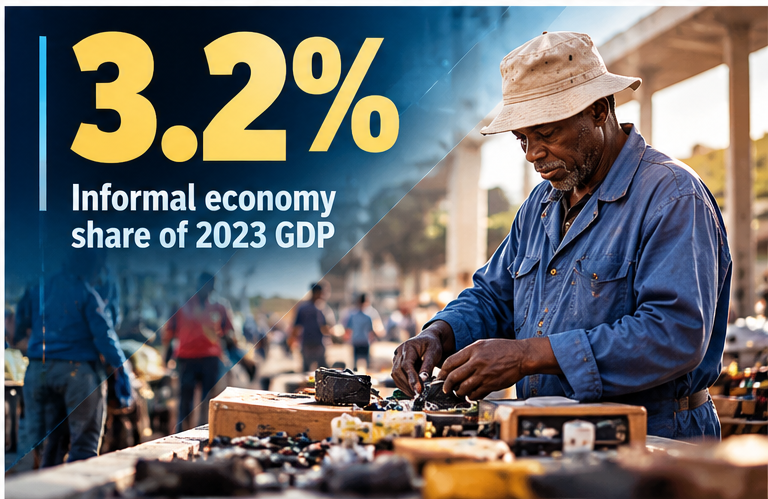
But enforcement should distinguish between protecting society from harm and protecting bureaucracy from non-compliance. Botswana’s informal economy contributed only about 3.2 percent of GDP in 2023 according to figures cited by government when launching Chema Chema, despite supporting a much larger share of employment. That enormous difference is itself revealing. The problem is not that Botswana has too much informal enterprise. It is that informal enterprise is desperately unproductive.
The development challenge is therefore to help the person behind the table become the person behind the counter; the person behind the counter become the owner of the shop; and the owner of the shop eventually become the employer of others. That transition will not be achieved by pretending that street trading is the destination. Nor will it be achieved by declaring war on it. The informal economy is where hundreds of thousands of Batswana are learning to trade, discovering markets, taking risks and, frequently, simply keeping themselves alive.
Economic transformation does not begin when an investor signs a memorandum of understanding in a government conference room. Sometimes it begins when an unemployed person unfolds a table beside the road and sells something. The question for government should not immediately be: Where is your permit? It should first be: How can we help you grow?