
Liking a wine is not the same as judging its quality, and developing a palate means understanding your own preferences rather than learning to admire every glass.
PHENYO MOTHAGODI
There is a particular kind of pressure that comes with drinking wine. Someone pours you a bottle, you take a sip and immediately realise that you do not particularly like it. Perhaps it is too acidic for your taste. Perhaps the tannins make your mouth feel as though you have been chewing a particularly dry piece of furniture. Then somebody at the table announces, with considerable confidence, that it is an excellent wine. Suddenly, you are faced with a decision: do you trust your own palate, or do you assume that your tongue has failed an examination?
Many wine drinkers seem to believe that developing a palate means eventually learning to like everything. After enough tastings, vineyard visits, wine courses and conversations with people who can say things such as “tertiary characteristics” without blinking, you are apparently expected to reach a point where every glass fills you with admiration. Rubbish. Developing your palate does not mean training yourself to enjoy every wine you encounter. It means learning to understand what you enjoy, what you do not enjoy and, perhaps most importantly, why.
PREFERENCE VS QUALITY
Saying, “I don’t like this wine,” is an expression of personal preference. Saying, “This is a bad wine,” is a judgement about the quality of the wine itself. Those are two entirely different things.
You may be drinking a technically excellent, beautifully made and highly rated wine that simply does nothing for you. It may have balance, complexity, a long finish and a pedigree capable of making collectors slightly emotional. Yet, after tasting it, you may simply not enjoy it. That is perfectly fine.
The opposite can also be true. You may love a wine that a critic considers simple or unremarkable. If it gives you pleasure, that matters too.
FAMOUS WINE

We are particularly vulnerable when a wine arrives with a reputation. Give a bottle a famous name and an impressive price tag, and people approach the wine with an entirely different mindset.
The danger is that we become afraid to admit when we do not like what is in the glass. I have watched people drink wines they clearly did not enjoy and then describe them positively because everyone else appeared impressed.
Perhaps the wine really is exceptional. But personal enjoyment is not a democratic vote. One of the most useful sentences in wine is: “I can appreciate why this is a good wine, but it isn’t for me.”
GROUP PROJECT
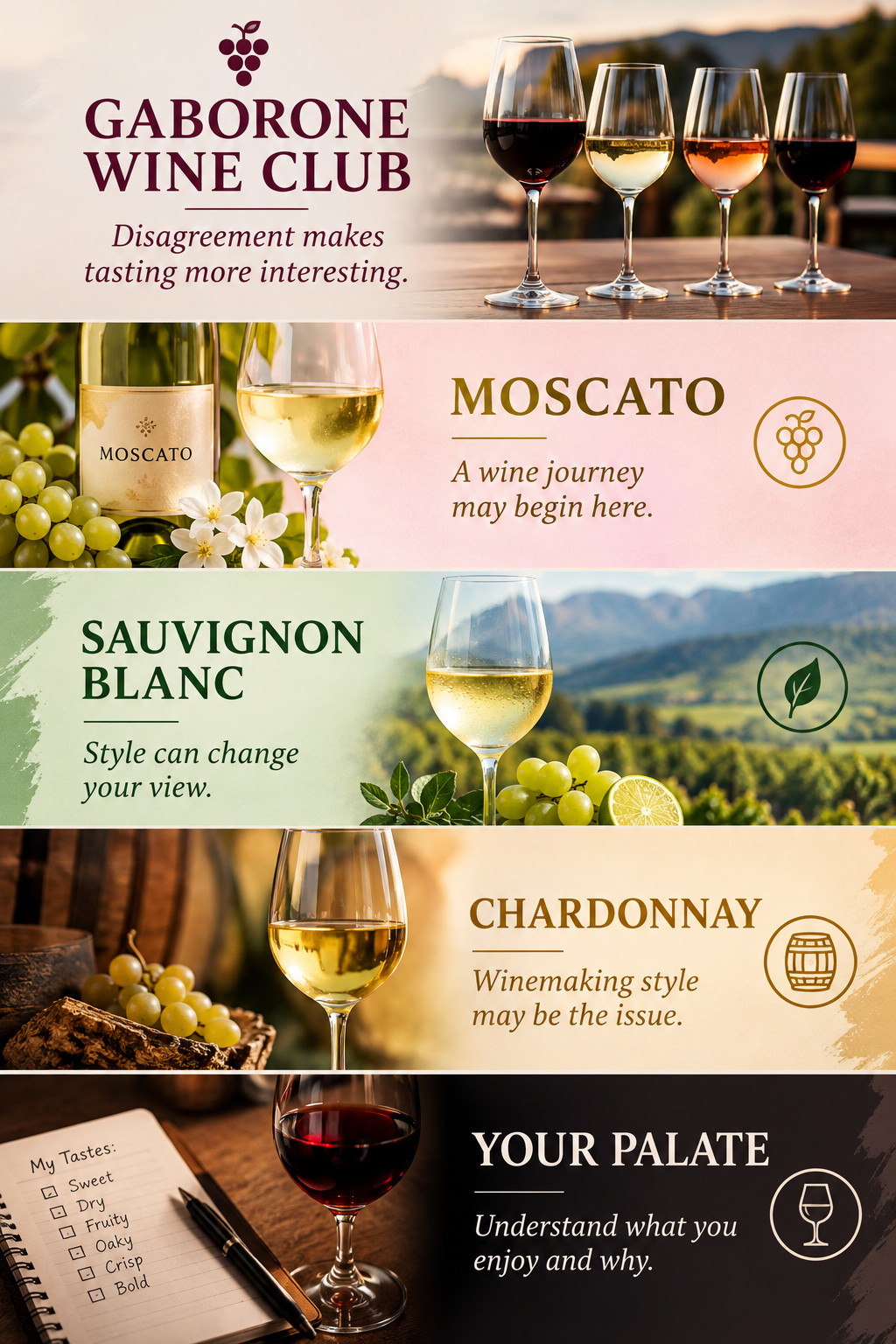
At the Gaborone Wine Club, one of the things I enjoy most is disagreement. Put the same bottle in front of the room and you will receive remarkably different reactions. One person loves it, another is unconvinced, and there will occasionally be one person looking around the room as though the rest of us have collectively lost our minds.
The most interesting conversations often begin when someone says, “I don’t get it.” That is not ignorance; it is an invitation to conversation. Is it too heavy, too acidic, too sweet or too dominated by oak? Sometimes another person will explain what they enjoy about the wine, and sometimes you may simply agree to disagree.
PALATE EVOLVES
A wine journey is rarely a straight line. You may begin by enjoying Moscato and later discover Cabernet Sauvignon. You may spend several years convinced that powerful, structured red wines are the pinnacle of civilisation, only to find yourself drinking Chenin Blanc with alarming enthusiasm every weekend. You may dismiss Pinot Noir for years and then encounter one bottle that makes you reconsider every confident statement you have ever made about the grape.
That is what development looks like. Your palate changes because you experience more. You may eventually discover that you do not dislike Sauvignon Blanc; you simply prefer a different style of Sauvignon Blanc. You may realise that your issue with Chardonnay was not Chardonnay at all, but a particular winemaking style that tasted as though someone had fermented a particularly enthusiastic piece of oak.
The point is not to force yourself to enjoy things because you believe an experienced wine drinker should. The point is to keep tasting with enough curiosity to allow yourself to change your mind.
TRUST YOURSELF
A well-made wine is not automatically your favourite wine. You can recognise that a wine is balanced, complex and well made while admitting that you do not particularly enjoy drinking it. Equally, you can enjoy a simple and inexpensive wine without insisting that it belongs in precisely the same conversation as a great, age-worthy bottle made with extraordinary craftsmanship.
Wine becomes considerably more enjoyable when you stop seeking approval for what you like. If you like a wine, say so. If you do not like it, say that too. Better still, try to understand why. Was it too heavy? Was the acidity overwhelming? Did the alcohol feel too prominent? Was it too sweet, too woody or simply not what you were in the mood for?
That does not mean closing yourself off from wines you have previously disliked. One disappointing bottle is not enough evidence to dismiss an entire grape variety, region or style. Explore again. Try another producer. Taste the grape in a different region or style. You may change your mind, or you may not. Either is fine.
Wine is a world of extraordinary diversity, and your responsibility as a drinker is not to agree with everyone else. It is to remain curious enough to keep discovering while being confident enough to trust your own palate.
So, the next time someone hands you a famous, expensive and critically acclaimed bottle and asks what you think, do not panic. Taste it properly. Think about it. Give it time in the glass. If, after all that, you still do not like it, you are perfectly entitled to say so. “It’s a good wine. It’s just not for me.” Then, with a clear conscience, pour something you actually enjoy.