
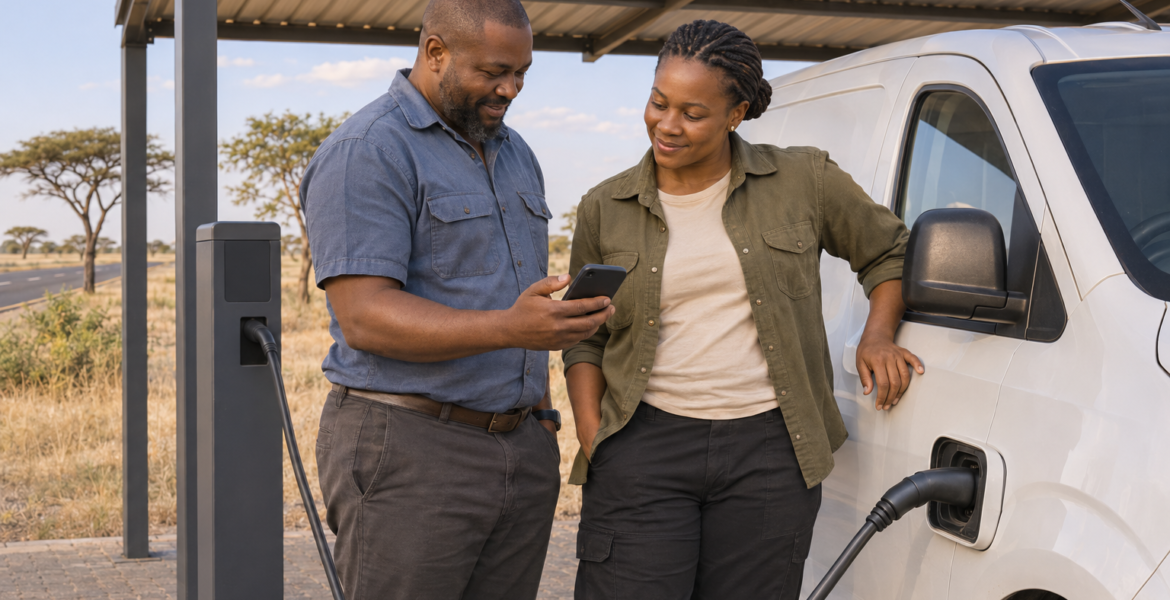
A national charging network planned for 2027 could transform Botswana’s energy security, but the ambition must become a costed and measurable commitment under NDC 3.0.
DR DOUGLAS RASBASH
Botswana’s transition to electric mobility may be approaching a decisive turning point. Dr Ecco Maje, Managing Director of eMobility Botswana (Pty) Ltd, has confirmed exclusively to The Botswana Gazette that a national electric vehicle charging network is planned for 2027. The Special Purpose Vehicle responsible for advancing the programme is now operational.
The significance extends far beyond plugging in vehicles. A comprehensive transition could ultimately displace petroleum imports worth as much as P16 billion annually, approximately 7% of GDP on an illustrative P229 billion base. These are potential gross import savings, not immediate net economic benefits. Nevertheless, the opportunity deserves national attention.
Botswana imports virtually all its transport petroleum, exposing households and businesses to international oil prices, foreign exchange pressures and external supply disruptions. Electric mobility offers an alternative: powering transport increasingly with domestically generated electricity, including Botswana’s abundant solar resources. This is an economic and energy security imperative.
THE KEY
Discussion has concentrated on electric buses, cars and trucks. But vehicles require a system that makes them practical. Motorists considering journeys from Gaborone to Francistown, Maun or Kasane need confidence that dependable charging will be available. Delivery businesses and freight operators require the same assurance.
Without it, electric vehicles remain constrained by battery range and access to private charging. A national network could transform them into a practical option for journeys across Botswana.
International experience demonstrates why infrastructure matters. According to the International Energy Agency, public charging points worldwide exceeded five million in 2024, more than doubling since 2022. China has developed the largest public network alongside its expanding electric vehicle market. Europe requires fast charging at regular intervals along designated transport corridors.
Charging availability and vehicle adoption reinforce each other. Drivers hesitate to buy without reliable chargers; investors hesitate to install chargers without enough customers. A planned national network can break this coordination problem by establishing minimum coverage and market confidence.
Botswana therefore needs a connected system serving towns, economic centres and international corridors. Stations must be accessible, interoperable and reliable, with adequate electricity supply. A collection of isolated installations will not provide equivalent confidence.
ECONOMIC OPPORTUNITY
Consider a passenger vehicle consuming seven litres per 100 kilometres. At an illustrative petrol price of P14 per litre, fuel costs P98 over that distance. An electric vehicle using 17 kWh, at P1.60 per kWh, would consume electricity costing approximately P27.
That suggests an energy cost reduction exceeding 70%, before charging losses and other operating costs. At 20,000 kilometres annually, the illustrative saving approaches P14,200. Actual savings will depend on vehicle efficiency, electricity tariffs and public charging prices.
Nationally, lower petroleum imports could ease pressure on foreign exchange and reduce exposure to volatile energy markets. More transport expenditure could circulate domestically, supporting electricity generation, installation and maintenance services.
These gains must be weighed against imported vehicles, batteries and charging equipment, together with generation and grid investment. Avoided imports do not automatically become additional GDP. Nor will the full opportunity materialise immediately: fleet replacement takes years.
Nevertheless, replacing imported transport energy with domestic solar electricity offers Botswana a powerful route towards diversification and greater economic resilience.
STRENGTHEN NDC 3.0
There is a significant gap between these ambitions and Botswana’s draft international climate commitments. The country’s Third Nationally Determined Contribution, NDC 3.0, sets out mitigation and adaptation commitments to 2035 under the Paris Agreement.
The September 2026 working draft recognises electric mobility, anticipates additional electricity demand and acknowledges charging infrastructure as an enabling requirement. However, it does not establish a clearly defined, costed and national charging network with clear timelines.
It also acknowledges that electric bus and charging infrastructure costs remain unconfirmed and excluded from mitigation investment estimates, and records the absence of a confirmed national corridor charging commitment.
This is an implementation gap. Anticipating transport electrification without explicitly providing its essential infrastructure weakens the credibility of delivery. Dr Maje’s announcement creates an opportunity to close that gap before the document is finalised.
The recommendation is unequivocal: Botswana should explicitly include, cost and prioritise the National Electric Vehicle Charging Network in NDC 3.0, with implementation beginning in 2027.
The commitment should identify corridors, initial station numbers and charging capacities, delivery milestones, responsible institutions, electricity requirements and investment costs. It should distinguish the needs of private motorists, public transport operators and heavy freight, whose charging patterns and power requirements differ substantially.
The network must also enter the NDC’s financing framework as an identifiable priority for domestic investment, private participation and international climate finance. An uncosted aspiration cannot provide the same foundation for mobilising resources or holding institutions accountable.
CREDIBLE DELIVERY
Government need not own every station. Public support can establish essential corridor coverage while private operators develop commercially viable facilities at service stations, shopping centres, hotels, workplaces and transport terminals.
Botswana Power Corporation, the Botswana Energy Regulatory Authority, transport authorities and eMobility Botswana require coordinated responsibilities. Tariffs, payment systems, technical standards and consumer protection should be established before investment expands. Drivers must be able to locate working chargers, understand prices and pay conveniently.
Renewable generation, storage and grid reinforcement should be integrated where economically justified. Reliability matters as much as installation: a charger that regularly fails provides little reassurance to motorists and undermines confidence in the entire transition.
A national master plan should therefore accompany an independently assessed investment programme, measurable coverage and reliability targets, and an agreed delivery framework. Transparent modelling should assess petroleum displacement, emissions reductions and energy security benefits. Charging infrastructure should not receive separate emissions credits where the same reductions are already counted under vehicle adoption.
Early investment should follow transparent demand forecasts and prioritise routes where coverage can support adoption. Remote locations may need public support because their strategic value exceeds their initial commercial returns. Procurement should include maintenance obligations and performance reporting, rather than rewarding installation alone. Publishing station availability and progress against milestones would help citizens, investors and operators judge whether the promised national network is becoming a dependable service across the country.
CONNECTING THE PIECES
Charging infrastructure alone will not complete the transition. Vehicle affordability, electricity supply, grid capacity, public transport reform, regulation and finance must advance together. NDC 3.0 offers the opportunity to connect them within a measurable national programme.
Botswana cannot control international oil prices or geopolitical disruption. It can increasingly influence the domestic production and reliability of the electricity powering its economy.
The proposed network could unlock substantial household savings, lower business costs and greater energy independence. Its inclusion in NDC 3.0 should therefore be treated as an immediate strategic priority. The technology exists and the energy resource is abundant. Botswana must now connect the pieces of the puzzle.