
Botswana’s growth story is impressive, but it has left too many workers behind. A proposed shift to a P4,000 minimum wage is not simply a debate about labour regulation. It is a question of whether employment can deliver dignity, stimulate domestic demand, and gradually unwind one of the highest inequality levels in the upper-middle-income world. At stake is not just fairness, but economic resilience. The real debate is not whether wages should rise, but how to do so in a way that strengthens growth rather than destabilises it.
By Douglas Rasbash and Elliot Majova
INTRODUCTION
Botswana’s economic achievements are widely recognised. Decades of prudent fiscal management, strong mineral revenue governance and political stability have produced sustained growth and upper-middle-income status. Yet beneath these headline successes lies a persistent structural weakness: income inequality. Despite growth, the benefits of economic expansion have not been evenly shared.
With inequality levels among the highest in comparable economies, the next phase of Botswana’s development cannot be measured by GDP alone. It must confront a more direct question: does work in Botswana pay enough to live?
MINIMUM OR LIVING?
A minimum wage sets the legal floor employers may pay. Its purpose is protective, ensuring that workers are not exploited below a statutory threshold. A living wage, however, asks a more demanding question. It considers whether a full-time income can realistically cover food, shelter, transport, utilities, healthcare and education without pushing households into poverty.
Where minimum wages fall below the cost of basic needs, working poverty persists even among the formally employed. This represents a structural failure of inclusion. Employment alone does not guarantee economic dignity, and economies characterised by deep inequality must confront this gap directly.
WHY IT MATTERS
The case for a living wage is not only social. It is economic. Lower-income households have a high marginal propensity to consume. In simple terms, nearly every additional pula earned at the bottom of the income distribution is spent quickly and locally.
That spending supports small retailers, transport operators, landlords and service providers. It circulates through the domestic economy, improving cash flow and sustaining employment. By contrast, income gains at higher levels are more likely to be saved or invested, diluting their immediate impact on local demand.
For Botswana, an economy still heavily dependent on minerals and public expenditure, strengthening internal demand is strategically important. Raising incomes at the bottom of the wage scale can generate more immediate and broad-based demand effects than equivalent gains at the top.
THE JOB FEAR
The most persistent objection to raising wage floors is the fear of job losses. The argument is often presented as economic certainty. Yet modern labour economics paints a more nuanced picture.
Employment effects depend on the scale and pace of wage increases, productivity responses, market structure and broader macroeconomic conditions. Moderate, predictable and phased adjustments do not automatically result in mass layoffs. The automatic equation of higher wages with job destruction lacks empirical inevitability.
South Africa’s experience following the introduction of a national minimum wage offers useful perspective. Despite significant economic shocks over the past decade, wage policy itself did not trigger systemic employment collapse. Real purchasing power improved at the bottom of the income distribution without destabilising the macroeconomy.
THE BOTSWANA CASE
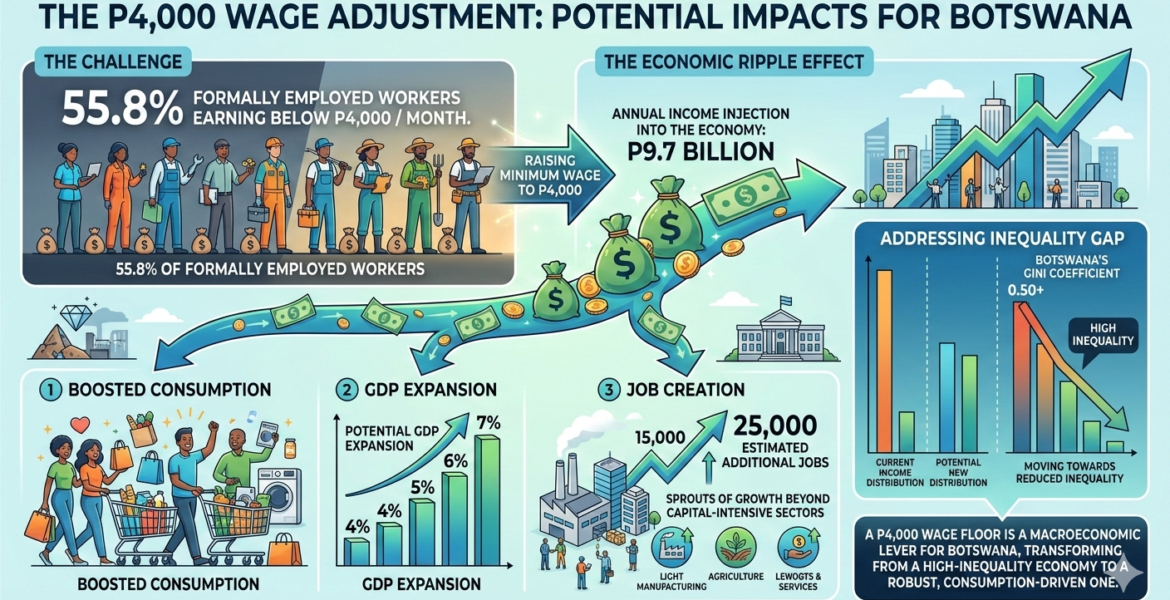
In Botswana, the proposed reform centres on raising the statutory minimum wage to P4,000 per month. More than half of formally employed workers currently earn below this threshold, meaning the policy would directly affect a substantial portion of the workforce.
A calibrated upward adjustment could inject approximately P9.7 billion annually into lower-income households, equivalent to around 3 to 4 percent of GDP. Depending on how domestic supply responds, broader economic activity could expand by between 4 and 7 percent.
Using reasonable employment elasticity estimates, such growth could support between 15,000 and 25,000 additional jobs annually. These gains are not automatic, and risks remain. Short-term inflationary pressure could add one to two percentage points to consumer prices, particularly if domestic production capacity fails to keep pace with rising demand.
BEYOND REDISTRIBUTION
A living wage alone redistributes income. A living wage combined with productivity reform can regenerate growth. For Botswana, this means linking wage policy to agricultural expansion, SME financing, industrial diversification, skills upgrading and regulatory clarity.
If domestic producers are able to meet increased demand, the multiplier effect deepens and inflationary pressures are contained. If not, income gains risk leaking into imports or being eroded by rising prices.
The debate, therefore, is structural rather than moral. Growth has been achieved. The question now is whether that growth can be broadened in a way that enhances resilience, dignity and long-term stability.