
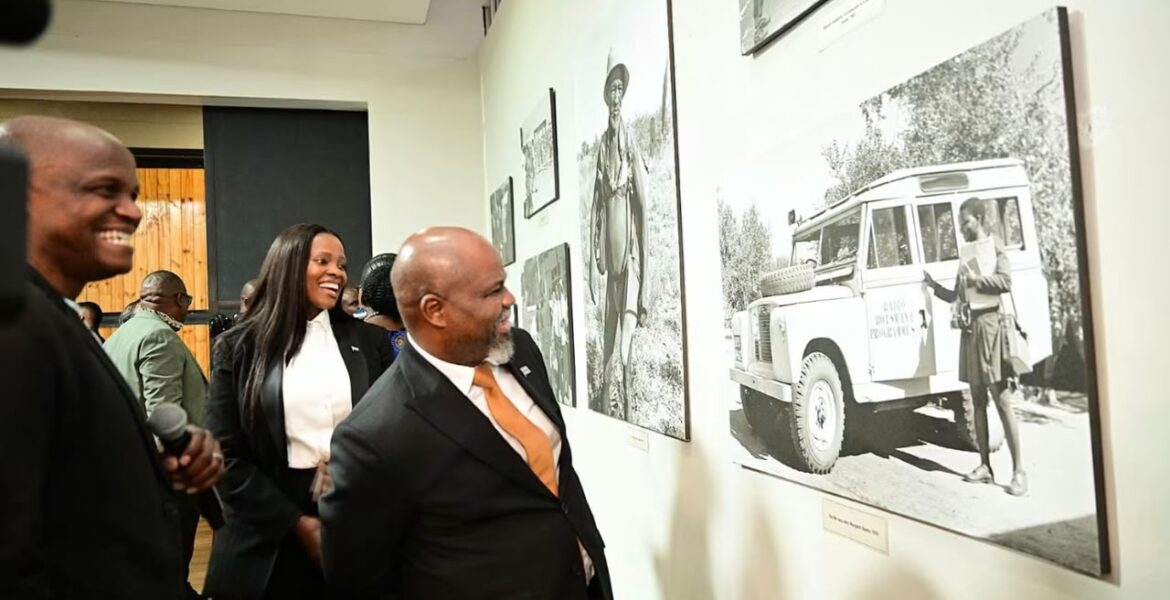
Sixty photographs. Six decades. But a handful of frames at the National Museum demand a second look — from a young Phandu Skelemani to Margaret Nasha before the headlines, and moments that changed Botswana forever.
GOSEGO MOTSUMI
Walk into the National Museum in Gaborone and the first thing that hits is not just the scale of Botswana’s 60-year journey, but its faces. Sixty black-and-white photographs line the gallery, quietly daring visitors to stop, stare and remember.
“Botswana @ 60: A Journey Through the Lens”, by the Department of Information Services, is essentially a national photo album but the kind where certain pictures make you turn back for another look.
THE YOUNG FACES
One of the biggest surprises is Phandu Skelemani, caught in his younger days as a lawyer alongside other figures from Botswana’s legal fraternity. Before the parliamentary gravitas and political milestones, there is simply a young man in a photograph, offering a glimpse of a life chapter that rarely occupies the frame.
Then comes Margaret Nasha, captured as a young reporter at Radio Botswana. It is the kind of image that feels almost like discovering an old photograph in a family drawer — familiar, but wonderfully out of time.
THE FRAMES THAT CHANGED EVERYTHING
Some photographs carry the weight of national turning points. The 1966 Marlborough Conference in London stands out as a visual marker of the road towards independence.
Another striking frame records Dr Gaositwe Chiepe during the 1976 changeover from the rand to the pula. The 1986 handover of the 20th Independence roving torch at Dibete brings another chapter into focus, while photographs of the 1995 Segametsi Mogomotsi riots confront a more difficult moment in the country’s story.
There is also Pope John Paul II’s gesture of reverence for Botswana in 1988, and Sir Seretse Khama with Dr Kenneth Kaunda at Seleka Farm in 1979, two images loaded with symbolism.
Photographer Felicity Male, who guides visitors through the exhibition, explains how such images can reconnect generations.
Assistant Minister for State President, Defence and Security, Maipelo Mophuting-Dikoloti put it neatly: “Some moments we remember because we were there. Others because someone took a photograph.”
And these are photographs worth remembering.
Botswana @ 60: A Journey Through the Lens runs until September 30 at the National Museum.