
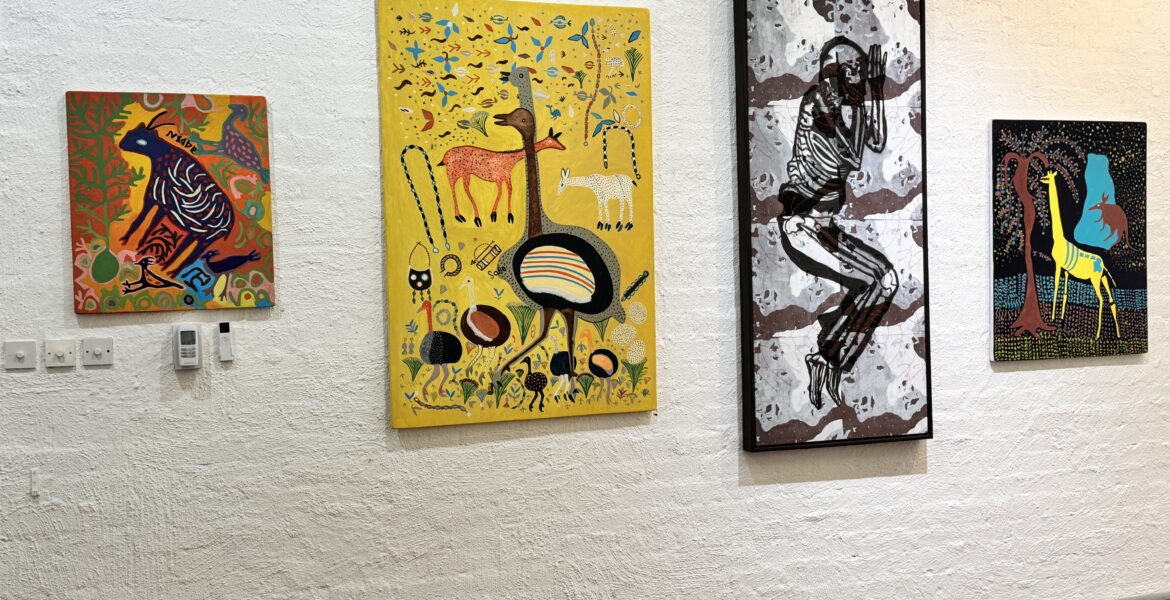
Inside a leafy Gaborone tea garden, ancient San stories, wild animals, dreamscapes and survival collide in colour. Where Stories Meet is not just an exhibition, it is a reminder that culture survives when people dare to keep telling their stories
GOSEGO MOTSUMI
At first glance, Sanitas Tea Garden in Gaborone feels too soft for revolution. The trees sway lazily, teacups clink politely and the city hums somewhere in the distance. But inside Where Stories Meet, the walls roar.
The new exhibition, curated by Ann Gollifer, gathers artists from the Kuru Art Project in D’Kar alongside creatives from the Art Residency Centre in Gaborone. The result is less a formal exhibition and more a living conversation between worlds often kept apart — urban and rural, ancestral and modern, memory and survival.
Born from a July 2025 workshop in D’Kar with South African interdisciplinary artist Sam (!Xam) Fortuin, the exhibition pulses with emotional honesty. Animals appear everywhere. Birds perch gently on fingers. Geckos crawl across patterned huts. Guineafowl strut through landscapes like sacred messengers.
PAINTING AGAINST ERASURE
For decades, the Kuru Art Project has quietly documented the stories of the Naro and Dcui San communities in Western Botswana. The initiative gave artists a way to earn income while preserving histories rapidly disappearing under modernisation.
Today, those histories arrive in Gaborone unapologetically loud.
“This is a beautiful experience of different artists coming together, learning, sharing and inspiring each other.”
The line from Fortuin hangs over the exhibition like a mission statement.
Maudie Brown, whose piece A Bird on My Finger feels both intimate and spiritual, described the collaboration as “special,” particularly because artists from vastly different backgrounds managed to find common language through art.
THE NEW FACE OF BOTSWANA ART
What makes Where Stories Meet fascinating is how effortlessly it breaks the stereotype that indigenous art belongs only in history books or tourist shops. The works are contemporary, emotional and globally relevant. Tradition dances comfortably with experimentation.
The exhibition features artists like Cgoma Simon, Gamnqoa Kukama, Xagu Qoma, Lessie Morris, Naomi Loabile and Karabo Maine among others. It will be showing until the 7th of June.