
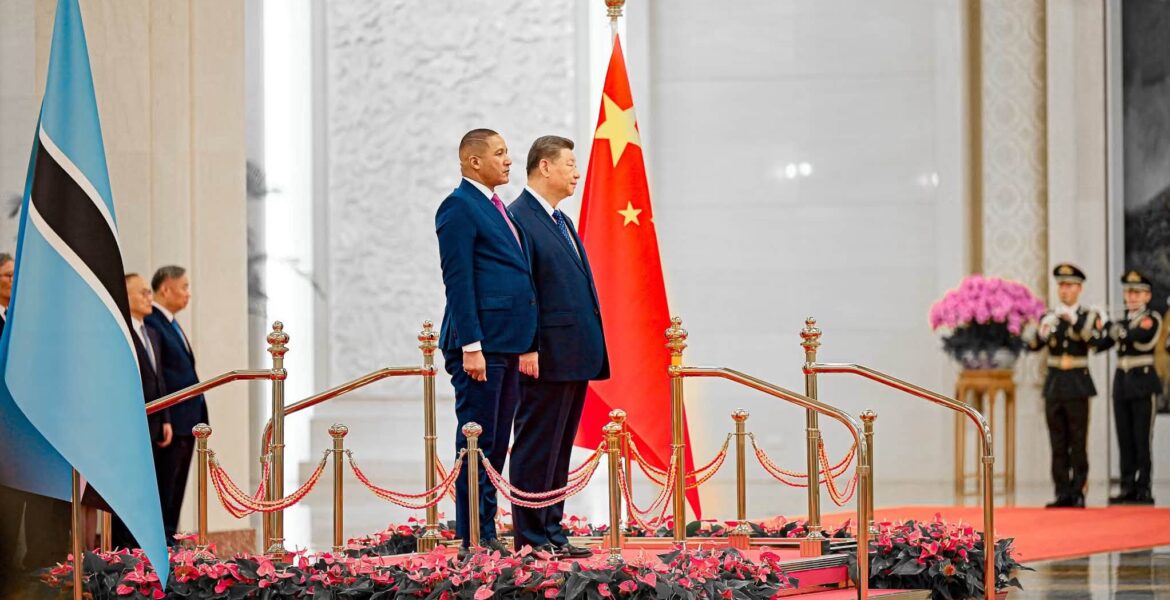
Botswana has explicitly opposed Taiwan independence in a joint declaration with China, placing its diplomatic stance under scrutiny as the countries deepen cooperation.
BONGANI MALUNGA
Botswana has firmly rejected Taiwan’s independence ambitions and thrown its diplomatic weight behind China’s push for reunification, openly backing Beijing’s territorial claims over the self-governing island as the two countries strengthened bilateral relations on Tuesday.
The declaration, contained in a joint statement issued following President Duma Boko’s high-level talks with Chinese President Xi Jinping in Beijing on October 13, places Botswana firmly alongside China on one of the world’s most contentious geopolitical disputes.
The two leaders also agreed to elevate relations to a Comprehensive Strategic Cooperative Partnership, marking a new chapter in diplomatic relations established more than five decades ago.
One-China Position
However, it was Botswana’s stance on Taiwan that stood out in the joint declaration. “Botswana reaffirmed its longstanding commitment to the one-China principle, recognizing that there is but one China in the world, Taiwan is an inalienable part of China’s territory, and the government of the People’s Republic of China is the sole legal government representing the whole of China. Botswana resolutely opposes any form of ‘Taiwan independence,’ supports all efforts by China to achieve national reunification, and steadfastly upholds the authority of United Nations General Assembly Resolution 2758,” the statement declared.
Although Botswana’s recognition of the one-China principle is longstanding, dating back to the establishment of diplomatic relations in January 1975, the latest declaration goes further in explicitly pledging support for China’s reunification efforts.
Taiwan operates under its own democratically elected government and maintains independent political and military institutions. China, however, considers the island part of its territory and insists that reunification must ultimately take place.
Taiwan’s Response
Taiwan’s government rejects China’s sovereignty claims and maintains that its future should be determined by its own people. The declaration consequently raises questions about how Botswana’s position could affect any present or future economic, cultural and unofficial engagement with Taiwan.
It also leaves unanswered whether Botswana’s support for “all efforts” towards reunification is confined to peaceful diplomatic initiatives or extends to more coercive measures. Beyond Taiwan, Botswana aligned itself with Beijing’s position on other internationally contested matters.
“Botswana further noted that matters relating to Xinjiang, Xizang and Hong Kong are internal affairs of the People’s Republic of China,” the statement said.
Diplomatic Implications
The declaration also endorsed the authority of UN General Assembly Resolution 2758, adopted in 1971, which recognised the People’s Republic of China as China’s legitimate representative at the United Nations. The resolution itself does not explicitly settle Taiwan’s territorial sovereignty, an issue on which Beijing and Taipei sharply disagree.
Meanwhile, the renewed partnership between Botswana and China seeks to deepen cooperation in trade, investment, mining, agriculture, infrastructure and technology. The diplomatic development comes as Botswana seeks to diversify its economy and strengthen investment partnerships with major international economies.
However, while the China engagements could unlock fresh economic opportunities, Botswana’s emphatic rejection of Taiwan independence has also placed its foreign policy position squarely within a geopolitical dispute whose consequences extend far beyond Asia.
The Minister of International Relations, Phenyo Butale had not responded to this publication’s inquiries by press time. Butale is part of the government delegation in China.