
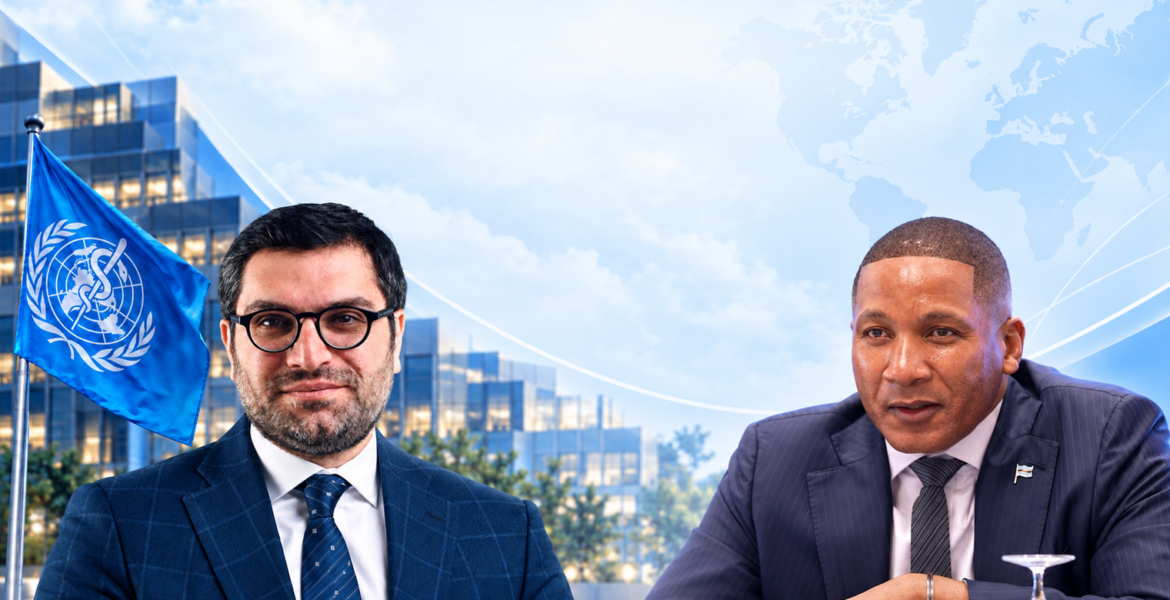
Botswana’s mysterious backing of Armenian oncologist Dr Gevorg Tamamyan for the WHO’s top job has sparked scrutiny over the unlikely nomination and renewed scrutiny of his unfavourable political activism back home
GAZETTE REPORTERS
Botswana’s surprise nomination of Armenian paediatric oncologist Dr Gevorg Tamamyan to become the next Director-General of the World Health Organisation (WHO) is raising questions about how a doctor from the South Caucasus secured the backing of the Botswana government for one of the most powerful positions in global health.
WHO records confirm that Tamamyan has been proposed by Botswana, making him an unusual candidate in a field in which the other publicly declared contenders have generally been nominated by countries with which they have direct national links. WHO lists Tamamyan simply as “proposed by Botswana.”
Tamamyan is Professor and Chair of Pediatric Oncology and Hematology at Yerevan State Medical University in Armenia and Editor-in-Chief of oncology publication OncoDaily. He is Armenian and does not appear to have previously served in Botswana’s public service.
Yet a trail of his activities in the months preceding his nomination shows that Tamamyan had been cultivating relationships connected to Botswana and had visited the country while canvassing international support for his WHO ambitions.
DEFENDING THE UNLIKELY BOTSWANA NOMINATION
In his own account explaining the unlikely Botswana nomination, Tamamyan disclosed that he had deliberately travelled internationally seeking political support for a cross-regional candidacy.
“So I travelled. I went to many countries, met many leaders, presented my ideas, listened, learned, and asked for support,” Tamamyan wrote after questions emerged over why Botswana, rather than his native Armenia, had nominated him.
Botswana, he said, was one of those countries.
According to Tamamyan, discussions here went beyond a simple introduction.
“Botswana listened to my ideas,” he wrote, before confirming that the government ultimately decided to back him despite his nationality.
He also confirmed that he visited Botswana in August 2026, barely weeks before the nomination process closed.
PRAISING PRESIDENT BOKO’S AMBITIONS
There is evidence that by August, Tamamyan had established access to President Duma Boko’s administration.
On 9 August, following his visit, Tamamyan published a glowing commentary on Botswana through OncoDaily titled The Hidden Gem in the Land of Gems, presenting the country as an emerging destination for biomedical investment.
He praised President Boko’s ambitions for the country’s health and biomedical sectors before making an intriguing offer to international investors
He then invited interested biomedical industry players to contact him, saying he would be willing to connect them with the President’s team.
No evidence uncovered by The Botswana Gazette establishes impropriety in those interactions. But the sequence leaves unanswered how a visiting Armenian oncologist progressed from promoting Botswana as a biomedical investment destination in August to becoming the country’s candidate for WHO Director-General the following month.
Global Attention- ‘Why Botswana?’
The unusual nature of the arrangement has attracted attention internationally.
Global health publication Devex noted that Tamamyan’s candidacy stood apart because Botswana nominated an Armenian national while the other candidates had been proposed by their home countries.
Devex said it approached the Botswana government seeking further information about the nomination but had received no response by the time its report was published on 25 September.
Tamamyan himself subsequently addressed the question directly under the heading: “Why not Armenia? Why Botswana?
He argued that he had deliberately sought to construct a candidacy crossing geographical boundaries and pointed out that WHO rules permit any member state to nominate a candidate irrespective of nationality
“Botswana did something different,” he said.
THANKS BOKO PERSONALLY
When formally announcing his candidacy, however, Tamamyan specifically singled out President Boko.
“I am deeply grateful to President Advocate Duma Gideon Boko and the Government of Botswana for their trust,” he wrote.
That acknowledgement puts the Presidency squarely at the centre of questions surrounding the decision.
Neither has government publicly explained what criteria it applied before choosing Tamamyan or whether other candidates approached Botswana for its nomination.
A HIGH-STAKES GLOBAL CONTEST
Tamamyan is among six publicly declared prospective candidates. They include Hanan Mohammed Al-Kuwari, proposed by Qatar; Hanan Balkhy, proposed by Saudi Arabia; Hans Kluge, proposed by Belgium; María Neira, proposed by Spain; Budi Gunadi Sadikin, proposed by Indonesia; and Tamamyan, proposed by Botswana.
His candidacy is already being presented internationally under Botswana’s name. He is participating alongside other prospective candidates at the World Health Summit in Berlin this week, where organisers identify him as the candidate “proposed by Botswana.”
ACTIVISM
A background check of Dr Tamamyan’s local footprint suggest that he may not be on good terms with his government. On 10 June 2024, when Armenia was in the midst of a major opposition campaign seeking to remove Prime Minister Nikol Pashinyan over territorial concessions to Azerbaijan, Tamamyan was among protesters occupying streets around parliament and opposition MPs attempting to initiate a parliamentary challenge to his government.
The Armenian Broadcasting Company carried a story of Tamamyan publicly participating in an Armenian opposition protest movement and accused police of receiving orders from Pashinyan and acting outside the law. He spoke explicitly about the prospect of a “peaceful transition of power.” While that does not constitute wrongdoing, some say it means Botswana has nominated someone who has taken identifiable positions in Armenia’s domestic political disputes.
COMMERCIAL LINKS WITH THE PHARMACEUTICAL INDUSTRY
Another challenge for Botswana’s candidate, according to experts is that he has extensive professional and commercial links with the pharmaceutical industry, which may be perceived as a red flag by some.
A review by The Botswana Gazette of Tamamyan’s professional activities and public disclosures shows that his relationships with pharmaceutical companies extend across clinical research, financial interests and the commercial medical-media organisation he co-founded.
The relationships do not in themselves constitute wrongdoing, and Tamamyan has publicly advocated disclosure and transparency in dealing with pharmaceutical companies.
However, they raise questions about what conflict-of-interest assessment was conducted by the Botswana Government before it nominated him for the WHO’s highest office.
Tamamyan himself appears aware that his pharmaceutical relationships could attract scrutiny during the WHO campaign.
In an extraordinary public disclosure on 3 October, just days after emerging as Botswana’s candidate, Tamamyan revealed that he had arranged a meeting with executives of pharmaceutical company EMD Serono months earlier to discuss a possible partnership with OncoDaily.
Then Botswana nominated him. “I thought about canceling the meeting because of how some people might perceive it,” Tamamyan wrote. He decided to proceed.
According to Tamamyan, however, the nature of the discussion changed after his nomination. Instead of concentrating on an OncoDaily partnership, he said, the conversation turned to how WHO and the pharmaceutical industry could cooperate more effectively.
“Of course, our conversation was different from what we had originally planned,” he said.