
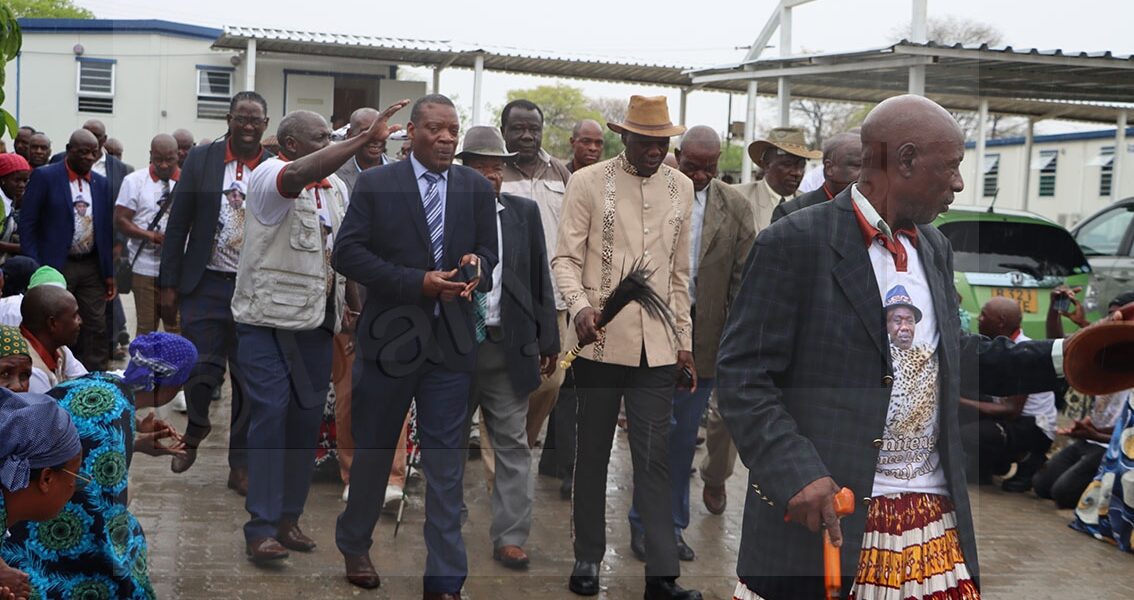
Government has appealed a High Court ruling awarding the Basubiya Paramount Chief the E2 salary scale, arguing that succession under the Bogosi Act does not automatically confer the higher remuneration.
GAZETTE REPORTER
The Attorney General has taken the dispute over the remuneration of the Basubiya Paramount Chief to the Court of Appeal, challenging a High Court ruling that found his recognition under the Bogosi Act entitled him to the E2 salary scale.
Appeal Filed
The appeal follows a 26 June 2026 judgment of the Maun High Court, which ruled in favour of the Basubiya Kgosi in his long-running salary dispute with Government.
The Attorney General, acting for the Ministry of Local Government and Traditional Affairs, is asking the Court of Appeal to overturn the judgment and dismiss the Kgosi’s application.
Act Disputed
At the centre of the appeal is Section 6(2) of the Bogosi Act, which provides for the designation of a successor when a Kgosi’s position becomes vacant. Government argues that the High Court wrongly interpreted the provision as creating an entitlement to the E2 salary scale.
According to the Attorney General, Section 6(2) concerns succession and designation, not remuneration. Government argues that being designated as a successor does not automatically place a Kgosi on the same salary scale as other chiefs who may have benefited from the provision. It further contends that the High Court confused recognition with designation.
Dispute Since 2020
The dispute stems from the respondent’s succession to his late father, who was remunerated at the D2 salary scale. The respondent was initially appointed in 2020 as Kgosi of Kavimba before being recognised in 2023 as Kgosi of Basubiya under Section 6(2).
He subsequently challenged his salary scale, but Government rejected his request in a 17 December 2020 letter. The Attorney General argues that the respondent should have sought judicial review of that decision rather than pursuing declaratory relief. Government says the High Court consequently erred in treating the matter as a declaration of legal rights rather than what it considers a disguised review application.
No Automatic E2
The appeal also challenges the finding that recognition under Section 6(2) created a legitimate expectation of E2 remuneration. Government argues that a Kgosi remunerated at D2 can equally be designated as a successor under the provision.
It says the fact that some previously designated successors were paid at E2 does not establish a general entitlement for every Kgosi designated under Section 6(2). The Attorney General maintains that earlier examples of E2 remuneration involved successors whose predecessors were already on that salary scale before the current Bogosi Act came into force.
Government argues that the Basubiya case is different because the respondent succeeded a Kgosi who assumed office after the Act was promulgated. It is also challenging the High Court’s interpretation of who qualifies as a Kgosi under the Act, arguing that Section 4(c), read with Section 21, recognises chiefs of tribal communities as Dikgosi.
Government says succession under Section 6(2) does not, by itself, change the status or remuneration attached to the office.