
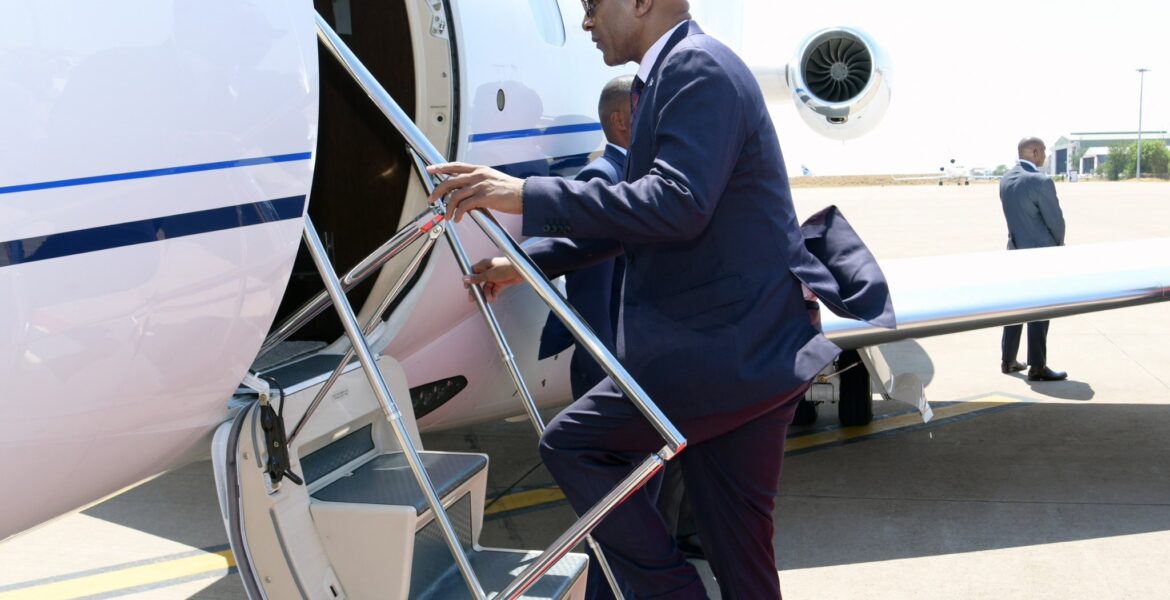
Government says travel cuts will redirect funds toward anti-drug abuse efforts as President and Vice President remain exempt from restrictions
GAZETTE REPORTER
The government has imposed a sweeping three-month ban on internal and external travel across the public service in a drastic cost-cutting move announced by President Duma Boko, while the President and Vice President Ndaba Gaolathe remain exempt from the restrictions.
COST CUTS
A confidential government savingram has exposed the scale of Botswana’s deepening economic anxiety, with Cabinet ordering an immediate freeze on most government-funded travel as spiralling global fuel prices hammer the economy.
The directive, issued recently by the Office of the President, follows a Cabinet resolution under Presidential Directive CAB 16 EXCO/2026 aimed at reducing government travel for three months.
In the savingram marked “CONFIDENTIAL,” Acting Permanent Secretary to the President Matshidiso Bokole informed all Permanent Secretaries and heads of key state institutions that both local and international travel had been suspended for three months, effective April 6.
“Amongst other measures, a decision has been taken to suspend internal (local) and external travel for a period of three months in order to unlock funds for cushioning low-income groups,” reads the directive.
OP RESPONDS
Responding to questions from The Botswana Gazette, Office of the President Deputy Press Secretary Cornelius C. Moloi said the Press Office acknowledged the inquiry and clarified that President Boko had publicly announced the travel reductions during an address on Botswana Television on 2 April 2026 at Mass Media.
“The Government will significantly reduce all government travel for a period of three months. The funds allocated for this travel will be pooled and redirected toward efforts to prevent the escalation of drug abuse in society. This will be done in a manner that ensures the temporary travel restrictions do not disrupt the delivery of essential public services,” Moloi said, quoting the President’s address.
Moloi said that following the President’s pronouncement, internal communications were issued to relevant offices to ensure compliance with the directive.
Regarding the document referenced by The Botswana Gazette, Moloi said the Press Office was unable to verify or comment on its authenticity.
“It would be inappropriate for any internal government communication, intended solely for official administrative purposes, to be in the public domain,” he said.
WIDE RESTRICTIONS
The savingram affects the entire machinery of government, including the judiciary, security agencies, Parliament, anti-corruption bodies and regulatory institutions.
But the directive also reveals clear exceptions.
“Travel by the President and the Vice President” will continue despite the austerity drive, alongside what government classifies as “essential travel.”
It is understood that the exemptions are likely to ignite debate at a time when ordinary Batswana are grappling with mounting transport costs, food inflation and broader cost-of-living pressures linked to volatile fuel prices.
The savingram shows that ministries and departments will only be permitted to undertake travel connected to statutory obligations, national security, international diplomacy, anti-money laundering coordination, tax enforcement, investigations, emergency response operations and oversight of critical infrastructure projects.
STRICT CONTROLS
The government has also moved to tighten bureaucratic controls around travel approvals.
All travel requests submitted to the Ministry of Finance must now first receive clearance from the Office of the Permanent Secretary to the President, while ministries have been ordered to submit applications at least two weeks before departure dates.
“Retroactive requests will not be approved, and all officials who travel without prior approval will not be refunded for any costs incurred,” the savingram warns.
The annex attached to the directive shows a government under pressure to cut expenditure wherever possible.
Even local travel has been restricted to emergency deployments, court appearances, infrastructure inspections, investigations and critical service delivery operations in remote areas.
FUEL SHOCKS
The move comes amid growing concern over Botswana’s vulnerability to imported fuel shocks. As a sparsely populated country heavily dependent on road transport, Botswana remains highly exposed to global oil price volatility, with fuel hikes rapidly feeding into inflation, transport fares and food prices.
Economist and financial sector specialist Keith Jefferis recently told The Botswana Gazette that rising fuel-related pressures could increase costs and alter fuel demand patterns in the country.
“It will obviously increase the transport costs of goods imported into Botswana. It will also increase demand for fuel in Botswana, as cross-border trucks will prefer to fill up in Botswana where fuel is cheaper,” Jefferis told this publication.