
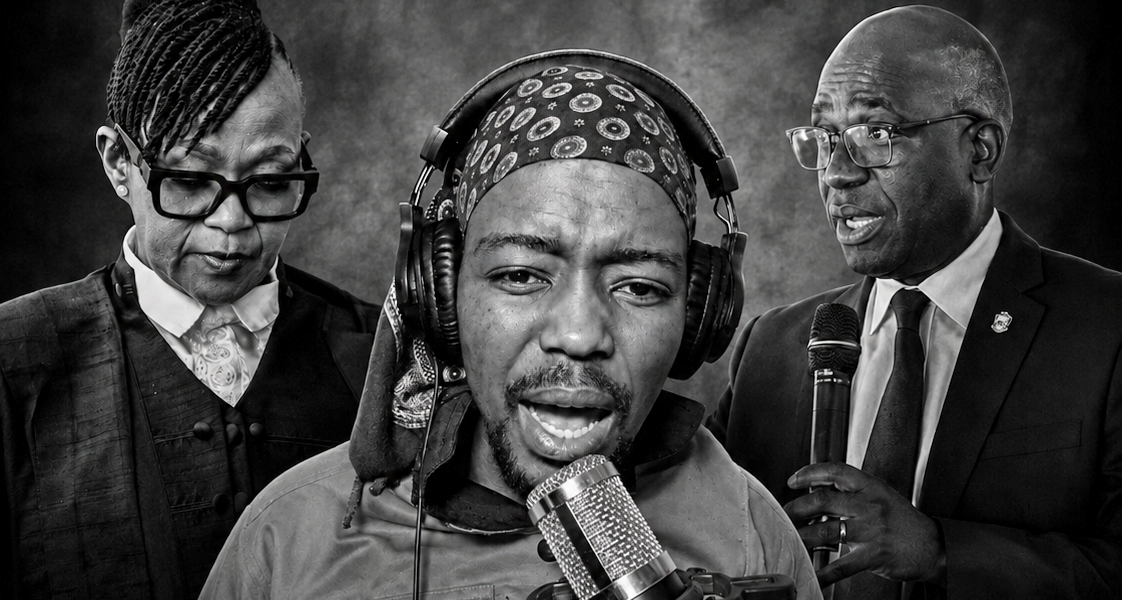
Parliament’s missing-person motion has revived an old Botswana anxiety, forcing the country once again to confront the uneasy boundary between spiritual belief, public desperation and evidence-based policing.
SESUPO RANTSIMAKO
Botswana has been here before: a child disappears, answers do not come quickly enough, frustration hardens into suspicion, and into the vacuum step traditional practitioners, spiritual claims and unofficial investigators. For years, the country has tried to push the spectre of ritual killings and unexplained disappearances to the margins, treating it as an anxiety best answered by evidence and procedure. Yet the bogeyman refuses to leave. Parliament has now brought it back into public life.
Last week, lawmakers adopted an urgent motion tabled by Deputy Speaker and Mmopane-Metsimotlhabe MP Helen Pushie Manyeneng calling on Government to broaden the search for missing people by creating mechanisms through which families and communities, if they choose, may involve traditional practitioners, spiritual leaders and others they believe can help. Their participation would, according to the motion, be coordinated with and subject to oversight by the Botswana Police Service.
The motion arrives at an unusually combustible moment. Families live with unanswered disappearances. Public confidence is strained whenever a search appears to stall. Social media has created an audience for alternative investigators and crusaders for the missing. A new government that came to office promising change is confronting the same dilemma as its predecessors: how to respond to fear, belief and public pressure without allowing untestable claims to substitute for evidence.
That is the tension at the heart of Parliament’s decision. The motion may accommodate Botswana’s cultural reality and give desperate families another avenue of support. But once spiritual claims enter an active police investigation, a harder question follows: what exactly are the police supposed to do with them?
AN OLD DIVIDE
Botswana has never been a society without traditional medicine or spiritual belief. Traditional practice remains embedded in the social landscape, and the courts have acknowledged its existence. In Motiki v The State, the Court of Appeal described traditional medicine as a practice that was “accepted or tolerated” in Botswana. The Ministry of Health has historically acknowledged the country’s pluralistic health system, while the World Health Organisation has documented the role of traditional practitioners. But cultural recognition is not evidentiary recognition.
That distinction becomes critical in a missing-person case. Police are trying to establish facts: where a person was last seen, who was present, what physical traces remain and whether evidence points to a crime. If a suspect is identified, the case must ultimately be capable of surviving a courtroom.
The Botswana Police Service made that distinction during controversies involving traditional practitioners and missing-person investigations in 2013. Police maintained that traditional doctors could provide information like any other member of the public, but did not have a formal investigative role. Investigations had to rest on independently verifiable evidence: fingerprints, clothing, footprints, DNA and other forensic material.
A spiritual revelation may point police somewhere. It does not by itself prove what happened there.
That is why the phrase “police oversight” in Manyeneng’s motion carries so much weight. Does oversight mean officers receive information and test what can be tested? Are they expected to follow every revelation? What happens when a practitioner names a person, household or location? And what happens if a frightened community treats that claim as fact before police find corroborating evidence?
TAKATOKWANE’S SHADOW
Those questions are not theoretical. The disappearance of Collen Loba, a child from Takatokwane, pushed them back into public view. Moeladilotlhoko, founded by Tshepho Sethibe, became involved in the search with assistance from traditional practitioners. The involvement reportedly contributed to tensions and public disorder, reviving concerns about what happens when spiritual claims, community fear and an active investigation collide.
Moeladilotlhoko has become one of the most visible forces in Botswana’s missing-person conversation, advocating greater involvement of traditional doctors and spiritual practitioners when conventional searches appear to have yielded little. Its visibility also shows how the landscape has changed. A police investigation can now unfold alongside social-media claims, counterclaims and public mobilisation.
Police have previously warned that such activity can complicate investigations, particularly where claims by traditional doctors provoke anger or turn communities towards particular individuals. That concern goes to the danger Parliament must confront: a lead can be investigated; an accusation can destroy a life.
Former deputy commissioner of police Kenny Kapinga, now MP for Okavango West, has taken a firm position against introducing spiritual revelations into police work. Speaking to The Botswana Gazette, he argued that the Criminal Procedure and Evidence Act does not recognise such revelations as evidence and that officers cannot reasonably be expected to coordinate claims that cannot be tested through conventional methods.
“Let us stay away from these beliefs and leave the police to do their job without disturbance,” Kapinga said.
Traditional practitioners see the matter differently. Kamogelo Keitholetse, spokesperson for the Dikakapa tsa Setso Association and popularly known as Rabeisane, welcomed Parliament’s move, saying it could allow practitioners to assist families without fear of arrest or accusations that they are causing disorder.
Yet even that support comes with a warning. Keitholetse cautioned against allowing every practitioner into missing-person cases, arguing that some may be motivated by publicity or commercial interests rather than a genuine desire to help. He criticised practitioners who publicise cases on social media, saying some use the exposure to market themselves.
That exposes another complication. Parliament is not simply trying to reconcile policing with culture. It is being asked to define who is legitimate, who is accountable and who bears responsibility when a spiritual claim moves from a private consultation into the public sphere.
SEGAMETSI RETURNS
Botswana has seen before how quickly such fears can become something larger. The 1994 murder of 14-year-old Segametsi Mogomotsi in Mochudi remains one of the country’s most painful examples. Her death triggered protests and riots and eventually drew investigators from Scotland Yard. More than three decades later, the episode still hovers over discussion of ritual killings, missing children and official secrecy.
Kgatleng Central MP Mpho Morolong has called on the UDC Government to release the long-secret Scotland Yard report into Segametsi’s murder. He told this publication that its release could finally provide answers in a case that remains a painful chapter in Botswana’s history and help the country find a way forward on unresolved cases of this nature.
The call matters because the current debate is not happening in a historical vacuum. When reports remain secret, cases remain unresolved and authorities do not fill the information gap quickly and credibly, suspicion has room to grow. Rumour becomes explanation. Explanation becomes certainty. And the country again debates whether forces outside conventional policing should be invited in.
Moeladilotlhoko is expected to present a petition on ritual killings and missing persons to the Office of the President on August 31, preceded, according to the group, by a motorcade and march involving families of missing persons. Efforts to interview Moeladilotlhoko for this story were unsuccessful.
The petition will add pressure to a debate Parliament has pulled back into the national spotlight. The question is no longer whether traditional and spiritual beliefs exist in Botswana, or whether frightened families will seek help wherever they believe it may be found.
The question is what happens when the State formally opens the door.
If the new framework is to work, Government will have to draw a line previous governments struggled to make convincing: one that respects cultural belief and the desperation of families, while ensuring that a police investigation remains governed by evidence, due process and testable facts.
Until that line is clear, the old bogeyman will remain exactly where it has always been: in the space between what the public fears, what it believes and what the State can prove.