
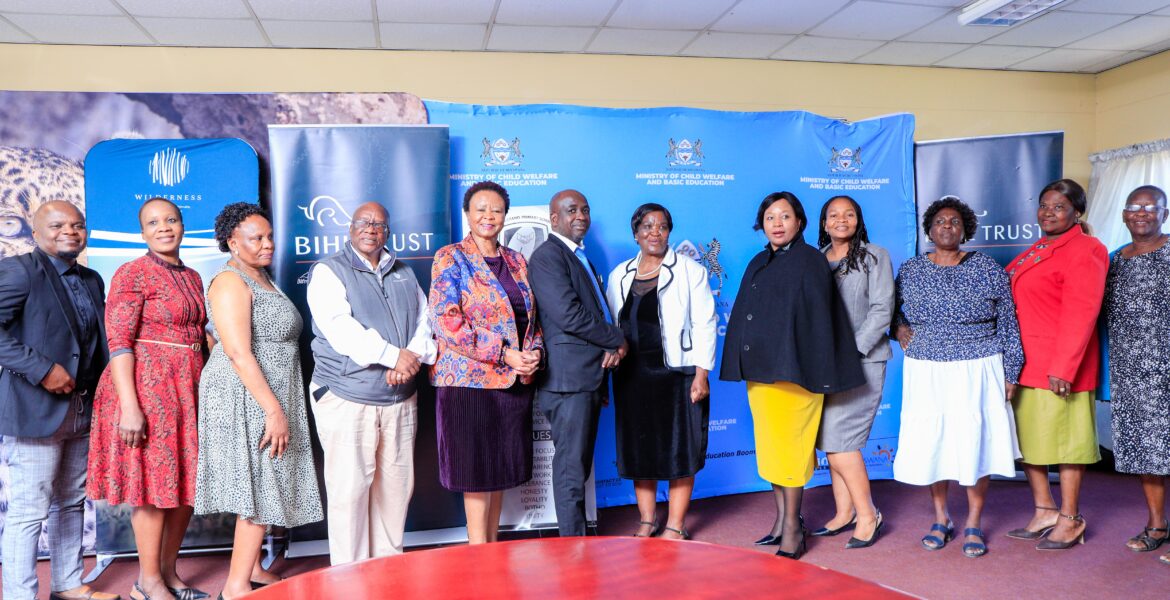
A renewed partnership will expand hands-on environmental education at Tshwaragano Primary School, backed by increased BIHL Trust funding.
A renewed partnership between Wilderness’ Children in the Wilderness (CITW) programme, the Ministry of Child Welfare and Basic Education, BIHL Trust and Mokolodi Nature Reserve will expand environmental education at Tshwaragano Primary School in Gaborone.
The partners signed a new Memorandum of Understanding (MoU), extending a collaboration that has supported environmental learning at the school since 2018. The agreement provides for Eco-Clubs, teacher training, annual camps, educational excursions and school-based conservation projects.
FUNDING INCREASE
BIHL Trust has committed P245,776 over the duration of the new MoU, up from an initial annual programme allocation of about P73,300. The increased funding will cover additional programme costs and activities.
Wilderness Botswana Caretaker Managing Director Joe Matome said the partnership was intended to help learners develop practical knowledge about the environment.
“By joining hands across education, conservation and the private sector, we are helping young people understand the environment they will inherit and empowering them to play an active role in protecting it,” Matome said.
LEARNING BEYOND CLASSROOMS
CITW supplements the national curriculum through experiential learning covering climate change, river systems, the Okavango Delta, sustainable agriculture and biodiversity. Teachers are trained as Eco-Mentors to continue environmental learning in classrooms and communities.
Tshwaragano is currently CITW’s only partner school in southern Botswana. The programme has reached more than 2,700 children through Eco-Clubs nationally over the past decade, while 320 learners are currently enrolled across nine schools.
TRUST BACKS EXPANSION
BIHL Trust Board Chair Esther Kanaimba-Senai said the additional P172,476 approved by the trust would bring its total investment to P245,776.
“The future of conservation depends not only on the policies we put in place or the resources we protect, but on the values we instil in our young people,” Kanaimba-Senai said.