
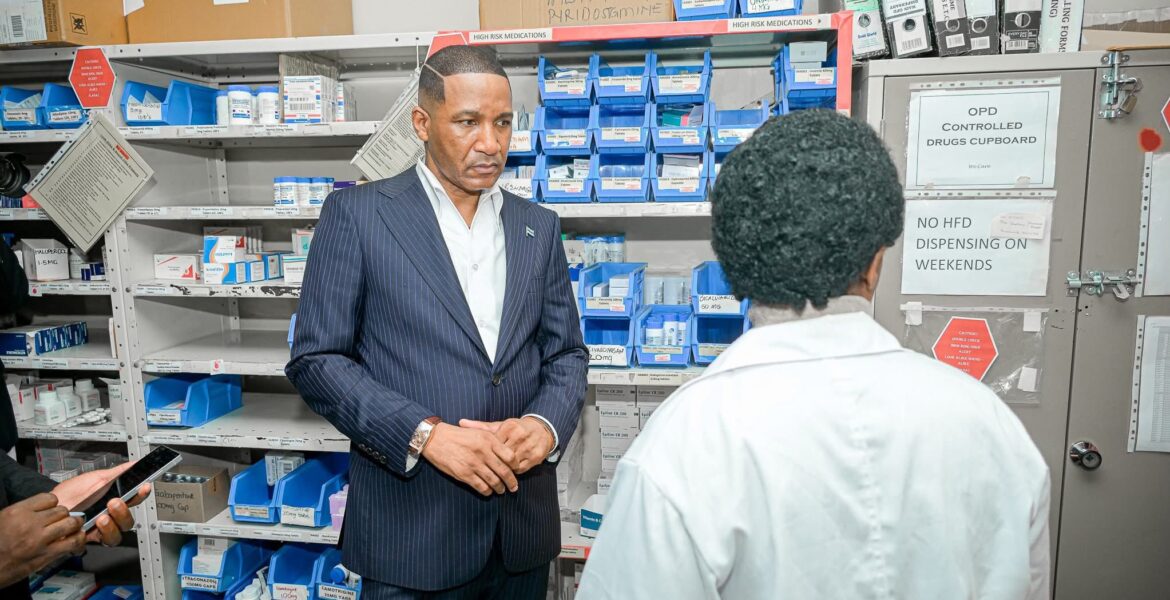
A critical examination of Botswana’s new health cooperation agreement with the United States, questioning whether urgently needed funding comes at the cost of data sovereignty and democratic oversight
BRADLEY FORTUIN
On 23 December 2025, Botswana signed a health cooperation Memorandum of Understanding (MOU) with the U.S. in which the U.S. pledges to contribute $106 million to Botswana’s health system. Botswana is one of fifteen African States with which the U.S. signed health cooperation MOUs in the past 2 months. The planned contributions to domestic health systems range from $106 million to $2.1 billion. It follows the policy set out in the U.S. America First Global Health Strategy, unveiled on 18 September 2025, under which signing these MOUs and the recent exit from the World Health Organisation (WHO) are well-calculated, well-prepared steps to shape U.S. health power and influence in Africa in the years ahead.
While these deals might appear, on the surface, to be about health cooperation, a closer look reveals that a key component of such MOUs is the sharing of data by African States. Health data. A highly valuable good of the 21st century and the age of AI. Against that backdrop, the question is not whether Botswana needs investment. It does. The question is what comes bundled with the help, what it means to modernise under someone else’s terms, and how much sovereignty a country trades away when its future health system is built on another nation’s ideology.
BOTSWANA’S HEALTHCARE
Botswana was hit hard by U.S. cuts to global health funding at the beginning of the Trump administration. And when funding dried up, so did jobs: nurses, outreach workers, and support staff found themselves unemployed in the middle of a public health crisis.
By August 2025, the consequences were undeniable. President Duma Boko declared a national public health state of emergency as government funds ran out and U.S. assistance contracted. Health service delivery began to collapse. On 7 August 2025, the Minister of Health told Parliament that the shortages extended across nearly every category of care.
What emerged was a system pushed to breaking point: a domino effect of funding cuts. The crisis caused by the cut in U.S. funding created a vacuum that the latest MOU is exploiting, leaving Botswana with the Arsonist-Firefighter problem. Botswana’s health system needs relief, but at what cost? A review of other MOUs that the U.S. has signed with other African States reveals the extraction of health data, integration of U.S. health technology architecture and limitations on reproductive autonomy.
THE BOTSWANA DEAL
What the U.S. State Department celebrates as a “partnership” looks very different once you read the fine print. The MOU signed on 23 December 2025 commits Washington and Gaborone to strengthening HIV services, modernising Botswana’s health workforce, and rebuilding failing health information systems through U.S.-supported digital infrastructure. On paper, it is cooperation. In reality, it hard-wires Botswana’s disease surveillance and outbreak monitoring into American systems. Yes, it builds local capacity. It also quietly locks a sovereign public-health function into U.S. strategic architecture.
Under the MOU, Botswana will spend more than $380 million of its own funds over three years, drawn from an already overstretched health budget. The U.S. will contribute $106 million. Before recent health aid cuts, U.S. support to Botswana averaged $55 million a year through the U.S. President’s Emergency Plan for AIDS Relief (PEPFAR) and $12 million through the Global Fund. Botswana has gone even further by signing a separate five-year data-sharing agreement with Washington. This is not generosity. It is leverage. Compared to other MOUs signed by the U.S. since December 2025, the price for influence and access to data in Botswana is a bargain compared to countries like Kenya or Uganda, where the U.S. pledged more than $1.5 billion to finance 65% or more of the entire health cooperation budget.
However, the MOU with Botswana is only one piece of a wider strategy. Following the U.S. America First Global Health Strategy, Africa’s expanding population and health sector are not viewed primarily as humanitarian priorities, but as strategic terrain, a counterweight to China’s growing influence on the continent. In that context, bilateralism is not a retreat from global health leadership; it is a pivot. Bilateral agreements allow the U.S. to set the rules, control data flows, circumvent multilateral oversight, and impose ideological conditions without the constraints of international standards.
The objective is straightforward: maximise unilateral influence, packaged as technical assistance, while reshaping global health in America’s own image: transactional, politicised, and strategic. Other publicly available MOUs, such as the U.S.–Mozambique MOU, underscore how central access to African state data is to U.S. priorities, stating that a failure to fulfil the specimen and data-sharing commitment “could result in changes in the planned assistance contemplated under this MOU”.
NO OVERSIGHT, NO SCRUTINY
The legal architecture enabling these systems is the seemingly innocuous Memoranda of Understanding (MOUs) that the U.S. signs with African states, deliberately informal instruments that avoid treaties, parliamentary approval, public debate, or international scrutiny. While some MOUs have been publicised, the actual text of the Botswana MOU remains unknown, which constitutes a major part of the problem deriving from such a legal architecture. Without access to the MOU, there can be no public discourse or scrutiny, allowing participants to create a system of shadow governance that avoids democratic safeguards.
Another feature of such MOUs is that they are typically non-binding. Publicly available MOUs, such as the one for Kenya, Liberia or Mozambique, are very specific in that regard as they contain a clause stating that:
“This MOU is not an international agreement and does not give rise to legal rights and obligations under international or domestic law.”
While MOUs are commonly used between States, health cooperation MOUs reveal the risks of such arrangements when one participant has greater leverage than the other and can dictate the terms that shape subsequent agreements and implementation. In this case, the MOUs allow States like the U.S. to obtain valuable data and influence without any parliamentary or judicial scrutiny. Ultimately, Botswana loses its data sovereignty and becomes more dependent on the U.S.
WHAT CAN BOTSWANA DO?
A few weeks back, the Prime Minister of Canada, Mark Carney gave a sobering and honest speech on the current state of global affairs and highlighted that:
“You cannot live within the lie of mutual benefit through integration, when integration becomes the source of your subordination.”
It exemplifies the situation that Botswana finds itself in, where such health cooperation agreements appear to be a façade of an underlying power imbalance. But it is not too late. States like Botswana can use the “non-binding” nature of these MOUs to their advantage to renegotiate, pause, or narrow their terms. The importance of the data in question to Botswana’s sovereignty and the people of Botswana requires a proper public discourse about such agreements, which can affect anyone in the country. Therefore, parliamentary and judicial scrutiny cannot be mere afterthoughts. They must guide the negotiations to implement safeguards and avoid establishing a system that, in the long term, is asymmetrical. To achieve this, the MOU must be made public.
African States and the judiciary are not helpless in this context. An example of that can be found in the High Court of Kenya’s conservatory order of 19 December 2025, restraining State officials from implementing, operationalising, and executing the MOU.
Health cooperation cannot be a Trojan horse for the erosion of democratic oversight, public accountability, and human rights. Botswana should not be asked to trade sovereignty for assistance. The government must reclaim full control over its health systems by reopening and renegotiating the MOU to safeguard data integrity, public ownership, and democratic scrutiny.
Bradley Fortuin is a consultant at the Southern Africa Litigation Centre.