
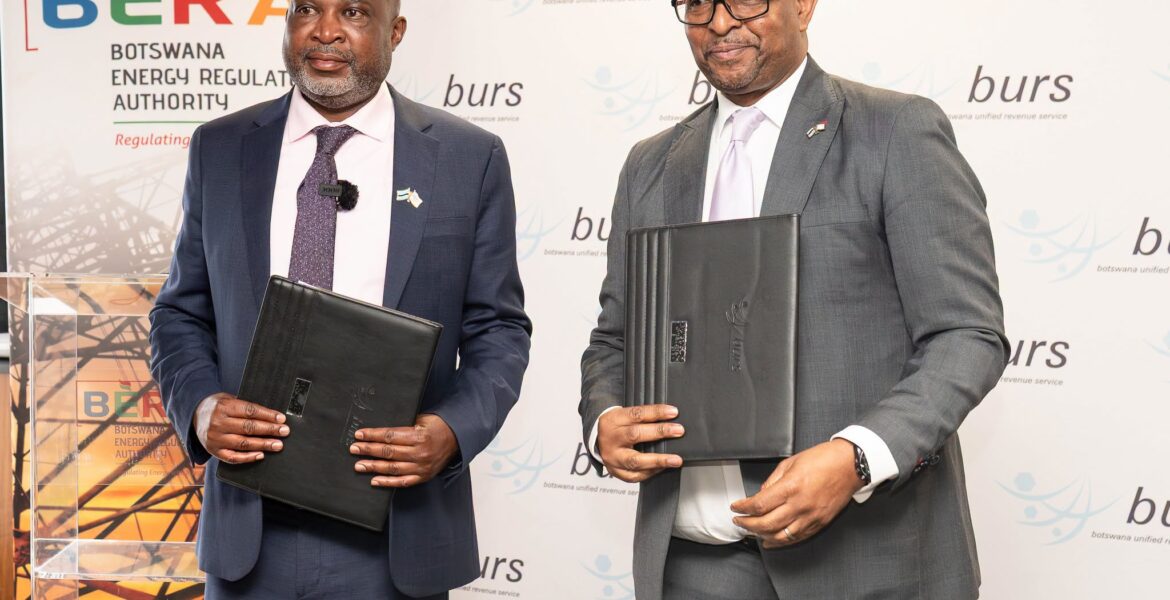
- The agencies say revenue losses could reach billions of pula as they move to tighten controls across Botswana’s petroleum supply chain
GAZETTE REPORTER
The Botswana Unified Revenue Service (BURS) and the Botswana Energy Regulatory Authority (BERA) have joined forces to tackle illicit fuel trading and revenue leakages estimated at billions of pula.
The two organisations this week signed a Memorandum of Understanding (MoU) to strengthen cooperation across the petroleum value chain through information sharing, joint risk management and coordinated enforcement.
BURS Acting Commissioner General Phodiso Valashia said the partnership was necessary to close gaps that allow revenue to be lost through non-compliance and illicit fuel trading.
He said Botswana could no longer afford to overlook what may appear to be small revenue leakages, particularly as the country seeks to reduce its reliance on mineral revenues.
Billions Lost
BERA Chief Executive Officer Never Tshabang said illicit fuel trading was costing the country significant amounts of revenue, with losses sometimes estimated at P4 billion.
Tshabang said the problem included under-declaration of fuel, fuel dumping and the deliberate manipulation of petroleum products to evade government levies.
Some fuel imported into Botswana under declarations that it was destined for countries such as Zambia was later dumped and sold locally, he said, allowing traders to avoid applicable taxes and levies.
“We are dealing with sophisticated traders,” Tshabang said.
He said BERA also lacked some of the technical capacity required to identify adulterated fuel at borders. The collaboration with BURS, he said, would help close those gaps, particularly at border posts where officials have struggled to detect illicit practices.
Fuel Adulteration
Tshabang also raised concerns about fuel adulteration, saying some traders mix petrol or diesel with paraffin to increase profits.
He said the practice can damage vehicles and pose risks to consumers. Authorities had previously intercepted about 3.3 million litres of contaminated fuel containing manganese and lead, substances he described as harmful to human health.
Valashia said the MoU would provide a formal framework for the two organisations to work together rather than relying on ad hoc interventions.
The agreement will focus on protecting public revenue, consumers and the country’s energy security through intelligence sharing, technological integration and coordinated enforcement.
Valashia said the signing marked the beginning of implementation and warned there would be “no hiding place” for those involved in illicit petroleum trade.
At the same time, he said legitimate fuel traders would be supported through a fair and level trading environment.
The two agencies are expected to develop clearer mechanisms for monitoring fuel movements, identifying suspicious transactions and improving enforcement across the petroleum supply chain.
PULL QUOTE
“There will be no hiding place for those involved in illicit petroleum trade.”