
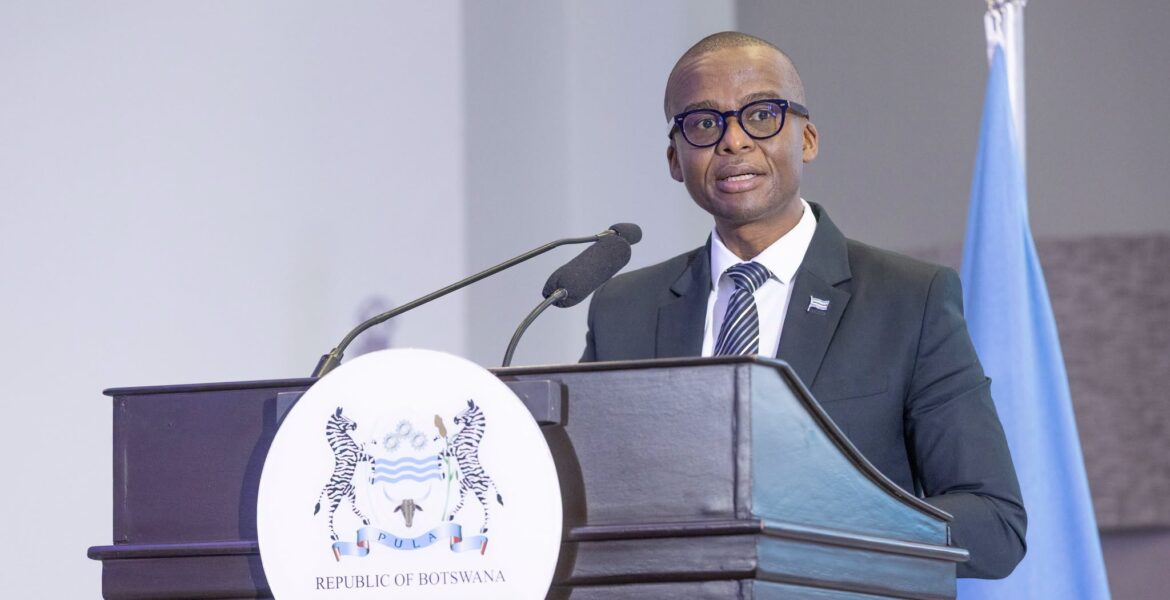
The government is shifting from cash-first enterprise funding towards tailored business support after Gaolathe flagged staggering failures in legacy funding schemes
BONGANI MALUNGA
The Botswana government is moving away from indiscriminately distributing money to aspiring entrepreneurs after Vice President and Minister of Finance Ndaba Gaolathe revealed that some legacy business funding initiatives have recorded failure rates approaching a staggering 99 percent.
Speaking at the 2027/2028 Budget Pitso for General Stakeholders on Monday, Gaolathe delivered a damning assessment of the government’s historical approach to entrepreneurship financing, singling out the Chema Chema programme and Youth Development Fund (YDF) as examples of initiatives undermined by structural weaknesses.
His remarks signal a fundamental shift in government’s enterprise financing philosophy, with future funding expected to prioritise business preparedness, sector-specific support, access to markets and sustainability rather than simply disbursing money.
NO CLEAR CRITERIA
“When you look at the way Chema Chema was structured in the past, first of all, there was no clear criteria, there was no monitoring, there were no sectoral priorities, there were no segmentation priorities, and many of the projects actually that have been that were awarded Chema Chema, the failure rate is near 98, 99 percent,” Gaolathe revealed.
The Vice President argued that the shortcomings of previous financing models went beyond loan repayments, suggesting that many beneficiaries had been inadequately equipped to establish commercially viable businesses in the first place.
He noted that the exceptionally high failure rates associated with Chema Chema and the YDF exposed longstanding weaknesses in how government identifies, prepares and supports prospective entrepreneurs.
NO THROWING MONEY AT ASPIRING BUSINESSES
“But what we have done going forward, which is what is important, is that the government is now moving away from throwing money at aspiring businesses,” he declared. Under the emerging approach, entrepreneurs will be expected to benefit from capacity building, business management support, partnerships and market access before progressing to the financing stage.
“The government is moving towards building systems and building ecosystems, and that realisation means that even before you hand out money to support businesses, you need to ensure that those to whom you are handing the money are empowered to actually use that money wisely,” Gaolathe explained.
“You need to ensure that they are empowered in terms of capacity to find partnerships, capacity to manage, capacity to find markets, and once they are empowered in that sense, then you move to the next stage of funding them.”
PROPOSED CHANGES
The proposed changes also recognise that a one-size-fits-all financing model cannot adequately support businesses operating across different sectors.
Gaolathe explained that agriculture, technology and property ventures require distinct financing instruments and interventions, reflecting differences in their operating environments, capital requirements and commercial opportunities.
The government also intends to accommodate entrepreneurs in remote areas and indigenous communities whose economic circumstances and access to resources may require specialised assistance.Central to the transition will be a new Youth Fund and an ecosystem Fund of Funds, designed to strengthen coordination between training institutions, financial lenders and guarantee providers.
“With the new youth fund, with the new ecosystem fund of funds, government will no longer be throwing money at businesses. It will be an ecosystem that ensures that there’s collaboration among training institutions, collaboration among guarantee institutions, financial lending institutions, some of which specialise at startups, some of those specialise at expansion,” Gaolathe stated.