
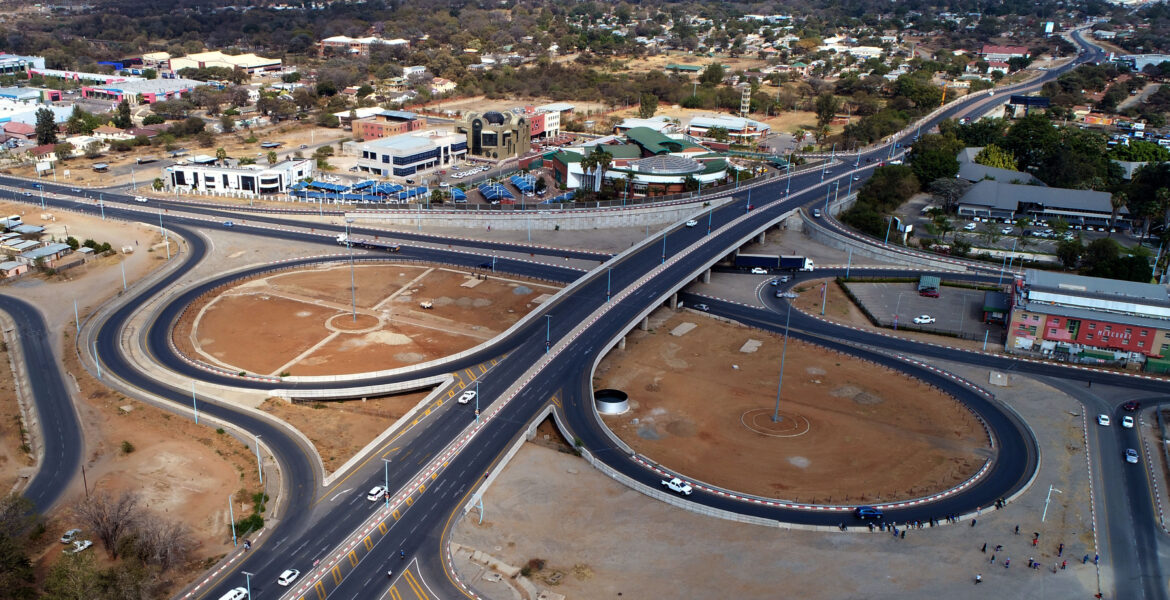
Botswana may be measuring an economy-wide burden approaching 17% of GDP as though it were merely another industry.
DR DOUGLAS RASBASH
Transport is arguably the most commonly experienced but least understood of all economic activities. Ask how large Botswana’s transport sector is and official statistics provide a reassuring answer. Transport and storage account for only about 2.2% of GDP. Except that transport may be nothing of the sort.
National accounts measure the output of the transport industry. They count services produced by trucking companies, buses, taxis, airlines and railways. That is correct for calculating GDP, but it answers the wrong policy question. The economic question is not simply how much the industry produces or the scale of its infrastructure. It is how effectively transport enables the economy to grow.
THE HIDDEN ECONOMY
Every litre of fuel imported into Botswana carries a transport cost. Every road crash imposes medical, emergency, policing, insurance and productivity costs. Every hour spent in congestion is lost time. Businesses holding additional stock because deliveries are unreliable carry an inventory cost. Then there are air pollution, carbon emissions, road maintenance and the cost imposed by distance itself.
The Second Republic Policy Think Tank estimates that, when these wider costs are considered, Botswana’s total transport cost structure may approach 17% of GDP. Roughly 6% is associated with transport energy, 4% with road crashes, 3% with congestion and delay, and about 2.2% with measured transport sector output, alongside further environmental and carbon costs. But the conclusion is important. Transport is not a 2.2% sector. It is an economy-wide cost structure.
WHO IS ACCOUNTABLE?
Who is actually responsible for transport? Roads sit within one institutional structure, public transport within another. Road safety crosses transport, police and health. Fuel pricing involves energy regulators and fiscal policy. Urban congestion is affected by land boards, councils and planning authorities. Rail, aviation and climate policy add further layers.
Yet the economy experiences them as one transport system. A worker in Mogoditshane does not experience separate land use, road, bus and fuel policies. She experiences the cost and time required to get to work. A farmer in Ghanzi does not care which ministry is responsible for roads, fuel or logistics. He experiences the cost of getting beef to market. A manufacturer experiences electricity costs, inputs, inventory delays and freight charges as part of the cost of producing in Botswana.
So who is accountable for reducing Botswana’s total transport cost per unit of economic output? At present, arguably, nobody. Ostensibly, the transport minister is chief executive of the sector. But does he appreciate the accounts? Is he aware of the total transport costs to the nation? More importantly, is it his job to reduce them? Institutions are accountable for assets, budgets and mandates. Roads authorities build roads. Regulators regulate. Police enforce traffic laws. Ministries administer programmes. But who owns the national outcome? That outcome should be simple: better access at lower economic and social cost.
INFRASTRUCTURE OUTCOMES
This is not an argument against infrastructure. For a landlocked country located between 700 and 1,800 kilometres from major seaports, efficient transport is fundamental to competitiveness. Botswana cannot diversify into manufacturing, agro-processing or regional distribution while ignoring the cost of moving goods. Roads, railways, border infrastructure, logistics hubs and reliable public transport remain critically important.
But infrastructure is a means, not an end. A road is valuable if it reduces travel time, vehicle operating costs, crashes and logistics costs, or unlocks productive investment. A railway is valuable if it moves freight more efficiently than the alternatives. A bypass is valuable if the benefits of reduced congestion exceed its lifecycle cost.
The mistake is to measure success in kilometres constructed and pula spent. The correct measure is cost removed from the economy. Yet performance indicators remain skewed towards outputs such as paved road kilometres, vehicle registrations and traffic flows, rather than GDP generated, jobs created and wellbeing improved.
TRANSPORT INTENSITY
Economists measure energy, carbon and water intensity. Why not transport intensity? It asks how much movement, energy, time and infrastructure an economy requires to generate a unit of economic value. A spatially dispersed economy with low density settlements, long commuting distances and weak domestic production will naturally be transport intensive. Botswana has these characteristics. Gaborone has expanded outwards into neighbouring settlements.
Botswana is naturally transport intensive. Settlements are dispersed, housing and employment are often far apart, public transport remains fragmented and freight is overwhelmingly road dependent. We also import much of what we consume.
The result is that we may be using too much transport to produce too little economic value. A growing transport sector may reflect economic dynamism, but it may equally reflect longer journeys, worsening congestion, greater import dependence and rising logistics costs. More transport is not automatically more prosperity.
THE GREAT DECOUPLING
Botswana should seek to grow its economy faster than its transport costs. GDP should rise while transport energy per pula of GDP falls. Economic activity should expand while road deaths decline. Household incomes should rise without commuting distances rising at the same rate. Freight volumes can increase while fuel consumption per tonne-kilometre falls. Access to employment, education and healthcare can improve without requiring everybody to travel further.
That is transport decoupling. It requires compact spatial planning, better public transport, efficient freight corridors, cleaner vehicles, improved road safety, digital services, better logistics and intelligent use of pricing and technology. Sometimes the solution will be new infrastructure. Sometimes it will be better use of existing infrastructure. Sometimes the best transport policy will be not needing the journey in the first place.
Perhaps we have been asking the wrong question. Instead of asking how Botswana can move more people and goods, the Second Republic should ask: how can Botswana provide greater access, economic opportunity and connectivity at the lowest total cost to society?
If transport imposes an economy-wide burden approaching 17% of GDP, the implications are enormous. A one percentage point reduction in total transport costs would release resources equivalent to approximately 1% of national economic output. That is money available for households, investment, jobs and human development.
POLICY VACUUM
Botswana has never had a comprehensive national transport policy. That is an extraordinary omission for a landlocked country whose prosperity is shaped by distance, accessibility and the cost of movement. Billions of pula have nevertheless been spent on transport infrastructure and services without fully appreciating what the system is intended to achieve. Investment has too often been driven by individual projects, institutional mandates and available budgets rather than by a coherent understanding of transport’s wider economic and social role.
A national transport policy must begin with a different objective. The goal is not simply to move more vehicles, passengers or tonnes of freight. Nor should success be measured by kilometres of road constructed or infrastructure budgets. The objective should be to maximise access to economic and social opportunity while minimising the total cost of mobility to the economy, households and the environment.
This means measuring transport intensity, logistics costs, travel time, road trauma, energy consumption and emissions alongside conventional transport sector output. It means subjecting major investments to lifecycle costing and economic appraisal. Above all, it means assigning clear institutional accountability for reducing Botswana’s total transport cost burden.
Transport policy should not seek to optimise the transport sector. It should seek to optimise the economy.