
As diamond revenues weaken, Douglas Rasbash argues that Botswana must judge infrastructure by the jobs, productive output and domestic value it creates, not by the size of the project.
DOUGLAS RASBASH
Spending Isn’t Development
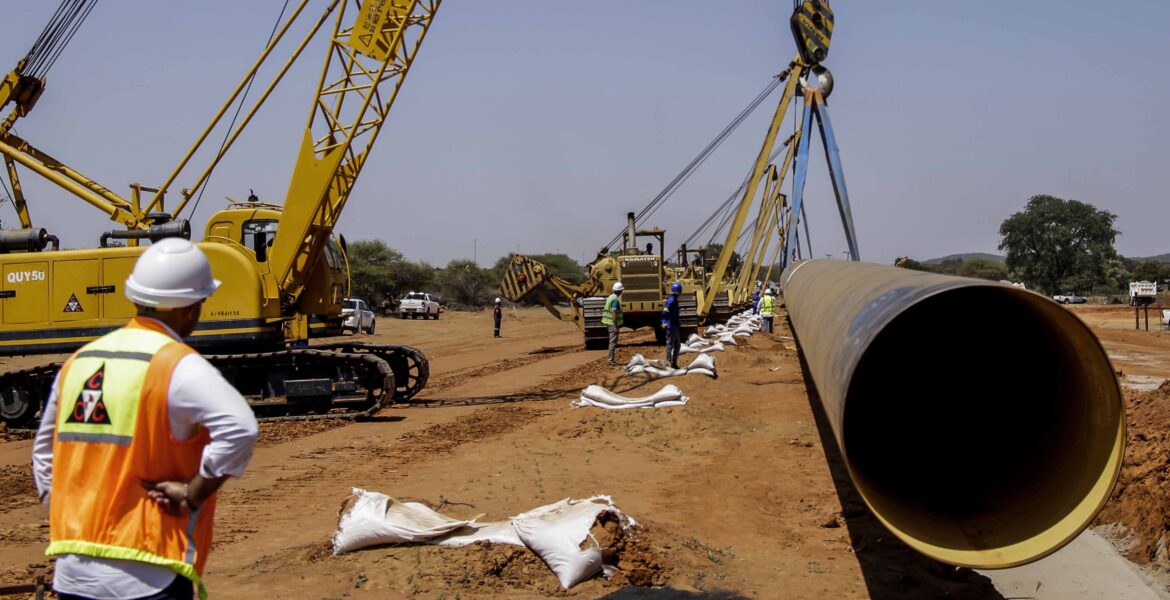
Botswana has a weakness for mega-projects. The bigger the railway, water-transfer scheme, power station or highway, the more readily it is presented as evidence of economic transformation. Billions of pula are announced, construction jobs are counted, kilometres and megawatts celebrated, and another great national development project is born.
There is a problem with this thinking. Mega-projects become an economic delusion when expenditure and construction are confused with development. A P20 billion project does not create P20 billion of development. It creates P20 billion of expenditure.
Development must appear somewhere else: in sustainable jobs, increased industrial output, additional GDP, diversification and greater economic efficiency. As diamond revenues weaken and capital becomes scarcer, Botswana can no longer afford infrastructure whose principal achievement is its own construction.
Transit Trap
Consider the Trans-Kalahari Railway. Its enormous physical scale makes it appear transformational. Yet if much of its traffic consists of commodities originating elsewhere and passing through Botswana to Walvis Bay, its domestic economic impact may be limited.
A train carrying another country’s minerals can enter Botswana at one border and leave at another. Botswana has provided a transport service, but the commodity has not been manufactured or transformed here. Modern heavy-haul railways are also designed to move enormous volumes with relatively few people. That makes them efficient transport systems, but poor long-term employment creators.
Thousands may work during construction, but most of those jobs disappear when construction ends. Nor does transit traffic, by itself, diversify Botswana’s productive economy. Moving somebody else’s trade more efficiently is not industrialisation.
Power For What?
The same logic applies to power. Megawatts are not industrialisation.
Botswana clearly needs reliable and competitively priced electricity. But generating capacity is an input, not a development outcome. Five hundred additional megawatts mean little for diversification unless Botswana does something productive with them.
If cheaper, reliable electricity enables mineral processing, food manufacturing, engineering, chemicals, data centres or other competitive industries, then power becomes transformational. Energy security and reduced electricity imports are worthwhile goals, but they are not the same thing as industrialisation.
Before celebrating another 500 MW, government should be able to explain what additional industrial output those megawatts will support, how many permanent jobs will result, and how much additional manufacturing GDP and exports will be generated. Exporting raw energy is no better than exporting raw diamonds if the productive value is created somewhere else.
Beyond The Pipe
Water follows the same logic. Moving millions of cubic metres across Botswana is an engineering output. Connect that water to commercially competitive agriculture, however, and farms can produce more crops, employment can expand, food-processing industries can develop, imports can be displaced, and exports and rural incomes can grow.
The development lies not in the pipe, but in the production the water enables.
Botswana too often builds the means and assumes the economic outcome will somehow follow. The deeper problem is that the country has become stuck in a development economy in which ministries compete to spend more, projects become ever more ambitious, and size risks mattering more than outcomes.
Assets At Risk
Meanwhile, what Botswana already owns is deteriorating.
The obsession with building something new is especially troubling because the country already has an enormous stock of infrastructure. Sixty years of diamond revenues paid for roads, schools, hospitals, clinics, dams, water networks, electricity systems, railway infrastructure and thousands of public buildings. This accumulated capital is one of Botswana’s greatest national assets.
Yet too much of it is deteriorating. The IMF and World Bank have repeatedly identified weaknesses in Botswana’s public investment and asset management, including inadequate maintenance and premature deterioration of infrastructure. This is not simply an administrative failure. It is the destruction of national wealth.
Indicative estimates suggest that poor asset management can destroy substantial proportions of asset value. If losses approached even 10 percent of an asset base of around P270 billion, the value at risk would be approximately P27 billion. The precise Botswana figure requires proper measurement, but the economic principle is unavoidable: billions can be poured into creating new assets while assets already paid for are allowed to deteriorate.
It is the development equivalent of filling a leaking bucket while refusing to repair the hole.
Maintenance Matters
Part of the problem is how government thinks about expenditure. Build something new and it is called development. Maintain something old and it becomes recurrent expenditure. Economically, that distinction can be misleading because maintenance preserves capital.
Resealing a road today can avoid reconstruction tomorrow. Servicing a pump can prevent failure of a water system. Maintaining electricity infrastructure reduces outages. Maintaining hospital equipment protects both the asset and the service it provides.
Botswana’s first decades necessarily concentrated on construction because there was so little infrastructure. Sixty years later, the challenge has changed. The diamond era built Botswana. The post-diamond era must learn to maintain it.
Without proactive asset management, even sustained annual erosion in asset value would destroy a large share of the national wealth built during the diamond era within a decade.
Jobs Everywhere
Maintenance also has an economic characteristic that mega-projects often lack: it is labour intensive.
Maintaining roads, drains, pumps, buildings, electrical systems, machinery and water networks requires people continuously and across the country. Instead of one temporary concentration of employment around a giant construction site, maintenance can support jobs in towns and villages. The same applies to land reclamation and rehabilitation, which are also employment intensive.
The better measure is therefore not how many people a mega-project employs at its construction peak, but how many sustainable job-years Botswana gets from every million pula invested.
Skills From Work
The importance of maintenance extends beyond jobs because it develops many of the skills Botswana needs for diversification.
Electricians, mechanics, plumbers, welders, refrigeration technicians, machine operators, solar technicians, fabricators and engineering contractors form the foundations of an industrial economy. A technician maintaining pumps develops skills relevant to irrigation, mining and manufacturing. A workshop repairing government machinery can repair industrial equipment. An electrical contractor servicing schools can eventually service factories.
Employment creates skills. Skills create businesses. Businesses accumulate equipment and expertise. Some eventually progress into fabrication and manufacturing.
That is diversification from the bottom up. Botswana’s economic growth strategies are often fixated on the reverse: build an industrial park, designate an economic zone and wait for industry to arrive. But industrial economies grow from deep networks of technical capability. Maintenance can help create those capabilities while simultaneously protecting national assets.
Keep Value Here
There is another advantage that matters particularly in a post-diamond economy: mega-projects can leak money out of the domestic economy.
Heavy machinery, rolling stock, turbines, electrical equipment, technology, specialist engineering and often major contractors come from abroad. Botswana receives the infrastructure, but much of the income generated by constructing it may accrue elsewhere.
Smaller maintenance and rehabilitation programmes can retain more value domestically. Pay a Motswana electrician and the money becomes household income. A local engineering company employs workers, purchases services, trains apprentices and accumulates capital. Those workers and businesses spend again.
The development value of a pula depends not only on what government buys, but on where that pula goes next. As diamond foreign-exchange earnings decline, Botswana must increasingly consider not merely how much it spends, but how much of that expenditure remains and circulates inside the domestic economy.
Do The Arithmetic
Botswana will still require major infrastructure. But size must cease to be confused with economic importance.
Every mega-project should face four basic tests: how many sustainable jobs will it create; how much additional domestic GDP will it generate; how will it diversify production; and what measurable efficiency improvement will result? Botswana should then ask how much of that value remains in the country.
Most importantly, exactly the same tests should be applied to the alternatives. Perhaps P10 billion concentrated in one spectacular project provides the greatest return. But perhaps the same money spent rehabilitating roads, maintaining water and electricity systems, repairing public facilities and supporting thousands of Botswana contractors creates more employment, more skills, more domestic value and greater economic efficiency while preserving assets worth many billions more.
Botswana should do that arithmetic before assuming bigger means better.
A New Model
The diamond era gave Botswana the resources to build a country. The challenge now is to protect that inheritance, make it work harder and use its maintenance to develop the skills and businesses of the economy that comes next.
There may be no ribbon to cut when a pump is repaired or a road resealed. But a functioning asset, a skilled technician and a growing Botswana engineering business may deliver considerably more development value than some projects costing billions.
The argument is not that Botswana should stop building major infrastructure. It is that the development model should be judged by outcomes. If it does not stimulate investment, generate new employment, diversify the economy or improve efficiency, then faster implementation alone will not solve the problem.
The issue is not only how quickly Botswana builds. It is what Botswana builds, what that investment produces, and how much value remains after the construction crews leave.