
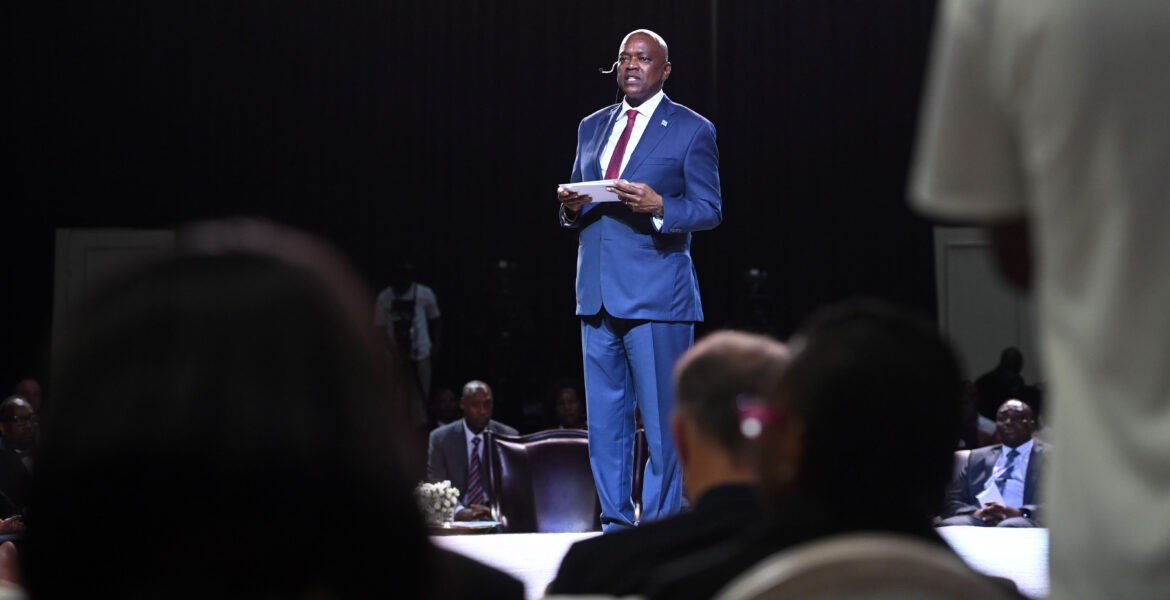
Former president Mokgweetsi Masisi has urged Nigeria and other resource-rich African states to avoid mining terms that can leave foreign partners controlling critical market knowledge.
BONGANI MALUNGA
Former Botswana President Mokgweetsi Masisi has warned Nigeria and other African resource-rich nations to never sign a “non-compete clause” with a foreign mining partner, arguing that it can cost nations decades of value even after building a national success story.
Speaking at the 13th Anniversary Olusegun Agagu Memorial Lecture, held in Lagos, Nigeria, last Monday, Masisi described the clause as one of “the most horrific” terms his country ever agreed to, and said it “completely defeated” Botswana’s later efforts to build independent market expertise.
“You Nigerians must never allow” such a clause into any resource agreement, he said, arguing that ownership of a resource means little if the foreign partner controls all the market knowledge around it. “Ownership is not market knowledge,” he warned.
SUCCESS ASTERISK
Masisi’s remarks trace Botswana’s transformation from one of the poorest countries on earth at independence in 1966 into an upper-middle-income nation, powered by the discovery of a massive diamond deposit at Orapa just a year later. The story is often held up as a model for African resource management.
Masisi said the full picture is more sobering as Botswana’s original joint venture with De Beers left the government owning just 15% of what came out of the ground, with De Beers taking 85%, later renegotiated to 50-50 on paper. He stated that since Botswana lacked the technical expertise to mine, clean, sort and value its own diamonds, it leaned entirely on De Beers to do it and the non-compete clause locked the country out of ever building that capability independently.
“The minute we dug into the ground… we relied on our technical partner to do the digging, to do the cleaning, to do the sorting, valuation,” Masisi said. “The non-compete then said to us we were excluded from then going forward.”
LOPSIDED RETURNS
Botswana spent years clawing back ground, creating the state-owned Okavango Diamond Company in 2011 to independently market a share of production and buying a 15% equity stake in De Beers itself. Masisi cast this as real but limited progress: “Trade and transform, meaningful progress but it remains incomplete.”
According to Masisi, the arithmetic never balanced. Despite being the country that “contributed the most for the longest to the wealth of De Beers,” Masisi said Botswana was only ever able to capture a maximum of 15% of the potential value of its own diamonds, leaving De Beers with roughly 85%.
“De Beers owns no country. It has no citizens but shareholders.”
AFRICAN LESSONS
Masisi advised countries against rushing into demanding full control before building the skills to use it. “Do not demand tomorrow’s participation before building today’s capabilities,” he said. “But do not let yesterday’s bargain determine participation forever.”
“A resource owner cannot maximise bargaining power if its partner knows materially more about the market for its products,” Masisi said.