Botswana’s herd-expansion ambition must be judged by productivity, sustainability and farmer income, not cattle numbers alone.
DR DOUGLAS RASBASH
President Duma Boko reiterated the goal of rebuilding the national cattle herd from around 1.6 million animals in 2024 to close to five million by the end of the decade. Lands and Agriculture Minister Dr Edwin Dikoloti has put the Government target at 4.6 million cattle by 2029/30.
But are they right to fixate on herd size rather than economic contribution? Four or five million cattle is a bold and politically attractive ambition. Cattle are deeply embedded in Botswana’s history, culture and rural economy. A revitalised beef industry could increase rural incomes, strengthen exports, create employment and support diversification as diamond revenues weaken. But there is a fundamental policy question to ask before celebrating the number.
WHY FIVE MILLION?
The Botswana Gazette has been unable to identify any published feasibility, carrying-capacity or economic study from which the five-million figure was derived. Why five million rather than three million, four million or six million? What beef exports, earnings and farmer incomes should result? What land, water and veterinary capacity will be required?
Five million is certainly a memorable number. But a memorable number is not yet a development policy. Therein lies a much larger issue for Botswana.
OUTPUTS, NOT OUTCOMES
Botswana has developed a tendency to measure development by what government delivers rather than by what those interventions achieve. A road is built, and kilometres constructed become the measure of success. Yet the outcome is improved accessibility, lower transport costs and greater economic activity. More power is generated, but what matters is how that changes industrial output.
Training is counted, but the outcome is productive employment and higher earnings. The value of business loans is celebrated, but what matters is how many sustainable enterprises survive, expand, employ people and repay them.
The same distinction applies to cattle. A five-million national herd is an output. The outcomes are increased beef production, higher exports, greater value addition, improved agricultural productivity and, ultimately, higher and more secure incomes for Botswana’s farmers.
That distinction is not semantic. It fundamentally changes how livestock policy, and indeed development policy, should be designed. Government should first establish what it wants the livestock sector to achieve economically and socially. Only then should it determine what herd size is necessary to achieve it.
PRODUCTIVITY FIRST
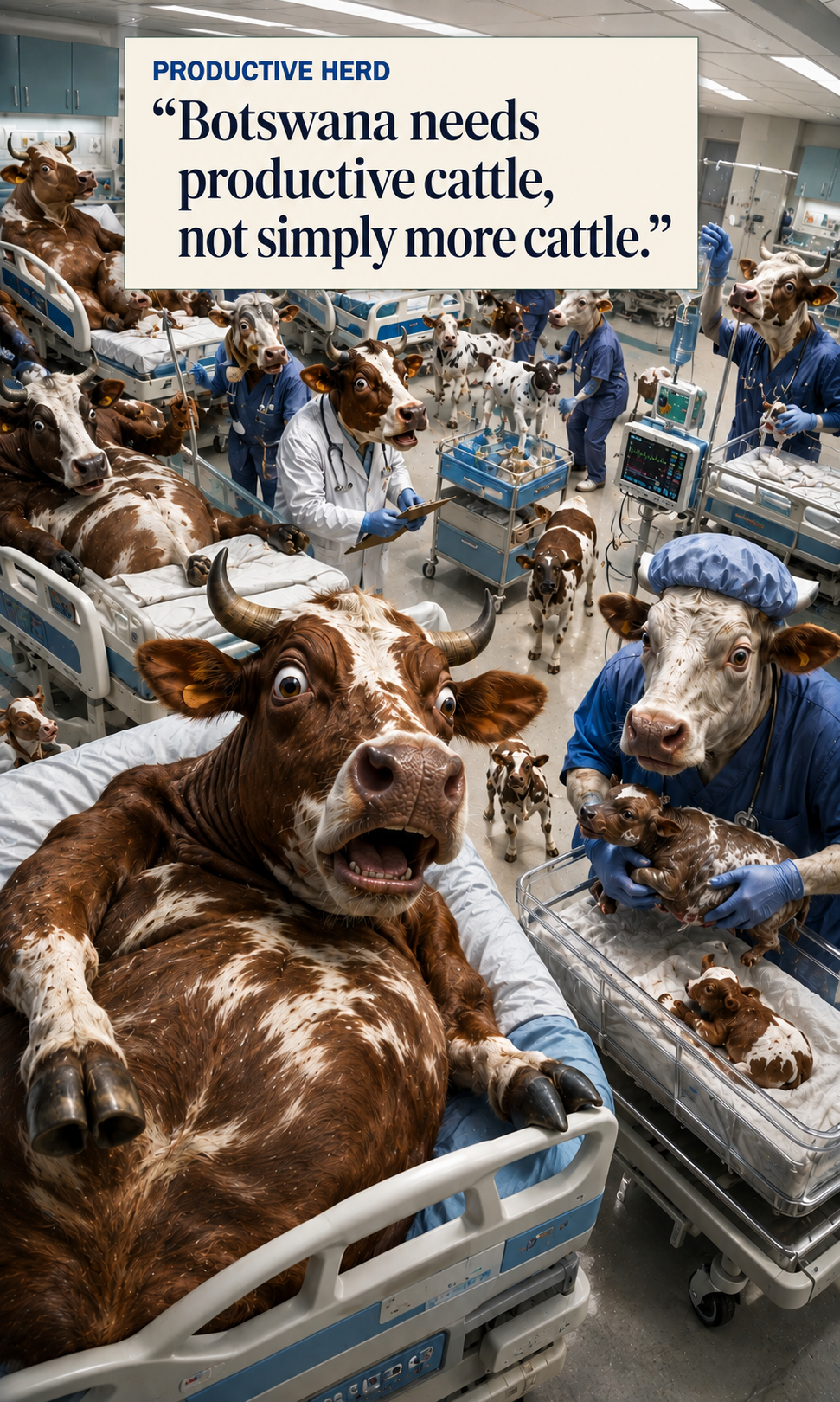
Botswana needs productive cattle, not simply more cattle. There is a strong case for rebuilding the depleted national herd. The country once had cattle numbers approaching 3.5 million. The present herd is dramatically smaller, while more than 80 percent of cattle are held within communal production systems. That makes livestock potentially one of Botswana’s most inclusive mechanisms for increasing rural wealth.
But the industry also has substantial unused capacity. Current calving rates are estimated at 45 to 50 percent, compared with an achievable 65 to 70 percent under better conditions. Many breeding cows therefore produce no surviving calf in a particular year.
Improving nutrition, genetics, animal health, water availability and calf survival could increase beef production significantly before Botswana comes anywhere near five million cattle. Would Botswana be better served by five million relatively unproductive cattle or three million highly productive ones? The answer depends not on the cattle census but on how much beef they produce and how much income they generate.
LAND AND WATER
The land cannot be ignored. At a recent FAO stakeholder engagement, Dr Dikoloti acknowledged growing pressure from climate change, overgrazing, degradation and water scarcity. Government, he argued, must balance production with conservation through rangeland restoration, efficient water use and improved soil management. That warning goes directly to the five-million ambition.
Cattle-expansion feasibility work available to The Botswana Gazette estimates that approximately 46 percent of Botswana’s land shows measurable degradation. In some areas, overgrazing, bush encroachment and prolonged drought have substantially reduced carrying capacity. The same analysis concludes that existing natural rangelands, without substantial external feed supplementation and rehabilitation, may sustainably support only around 2.2 to 2.5 million cattle in their present condition.
This does not establish that five million cattle are impossible. Land productivity can be improved through bush control, reseeding, rotational grazing, fodder production, and better water harvesting and distribution.
But those interventions must precede or accompany herd expansion. The scientifically derived sustainable herd might eventually be five million. It might be 3.2 million or 4.1 million. Good policy should not care which. The number should emerge from the analysis rather than become the assumption around which the analysis is subsequently constructed.
Increasing cattle numbers also increases water demand in one of southern Africa’s driest countries. Much livestock water comes from groundwater, while some borehole systems are already under pressure. Reliance on natural pasture also exposes cattle and farmers to drought.
The question is not whether Botswana possesses enough land on a map to accommodate five million cattle. It is how much productive grazing and reliable water will be available through repeated drought cycles in 2030, 2040 and beyond. An outcomes-based livestock policy would measure kilograms of beef produced per hectare and pula of farmer income generated per unit of land and water, not simply the number of animals using those resources.
FMD SHADOW
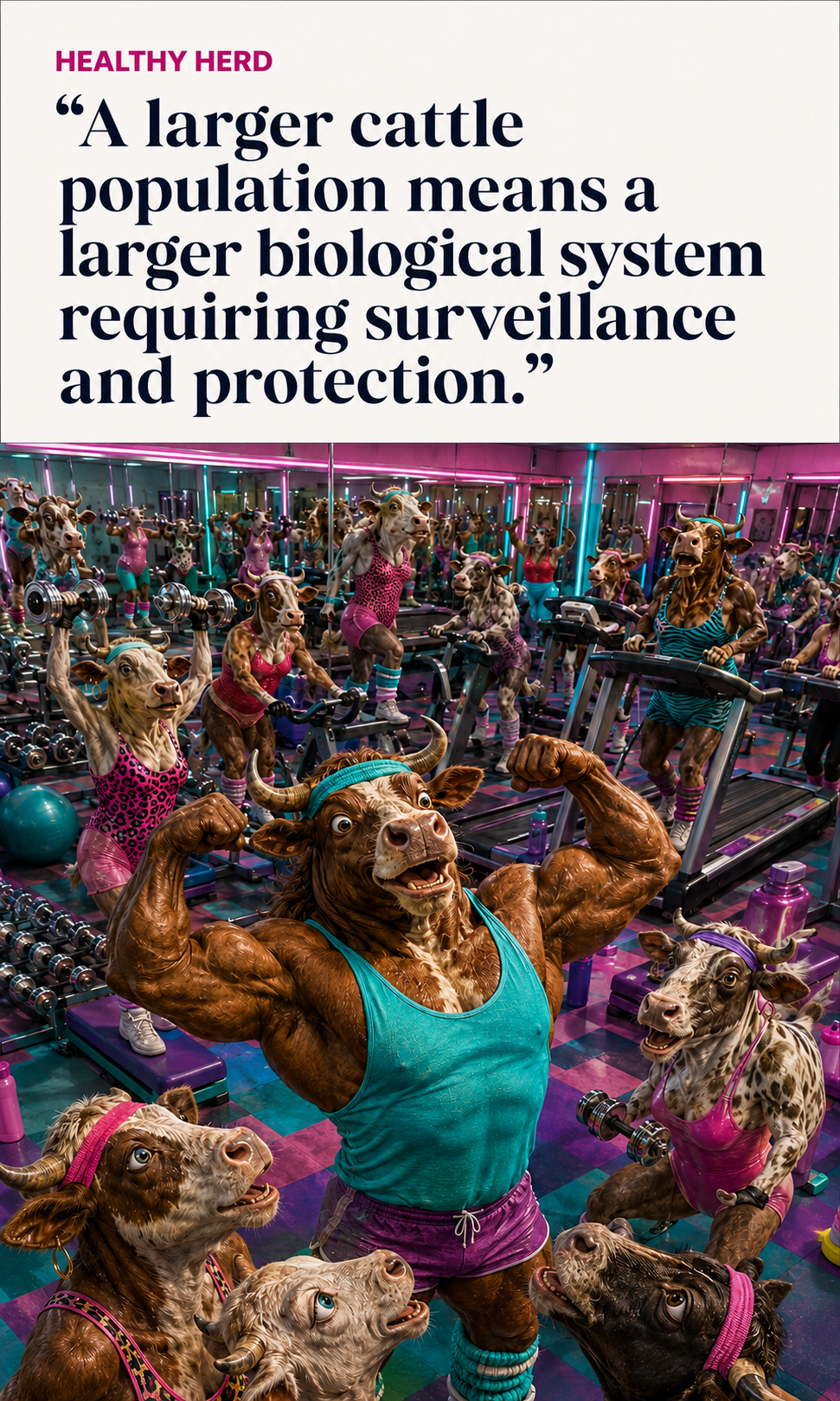
Another constraint deserves greater attention: foot-and-mouth disease. A larger cattle population means a larger biological system requiring surveillance and protection. Animal density, movements, communal grazing, shared watering points, vaccination, veterinary controls and detection speed all shape disease risk. Increasing livestock interactions can create more transmission opportunities unless control capacity expands accordingly.
FMD’s economic consequences extend beyond infected cattle. An outbreak can restrict movement, interrupt abattoir throughput and close premium export markets.
A Second Republic Policy Think Tank paper on beef branding noted that disease-related market interruptions create losses through closed markets, interrupted processing, additional inventory and logistics costs, and the diversion of beef towards lower-value destinations. Government estimated that disruptions and market restrictions during 2025 exposed BMC to revenue losses exceeding P500 million.
Five million cattle behind a disease-related export restriction may be worth considerably less to Botswana than three million productive, healthy and internationally marketable cattle.
VALUE ADDED
Beef tonnage is not the end of the policy chain. Botswana captures only part of the value generated by its cattle. Much product leaves the primary industry as live cattle and carcasses. Yet the same animal can support premium cuts, aged beef, processed foods, biltong, sausages, ready meals, leather and other by-products. Branding, retailing and intellectual property can add still more value.
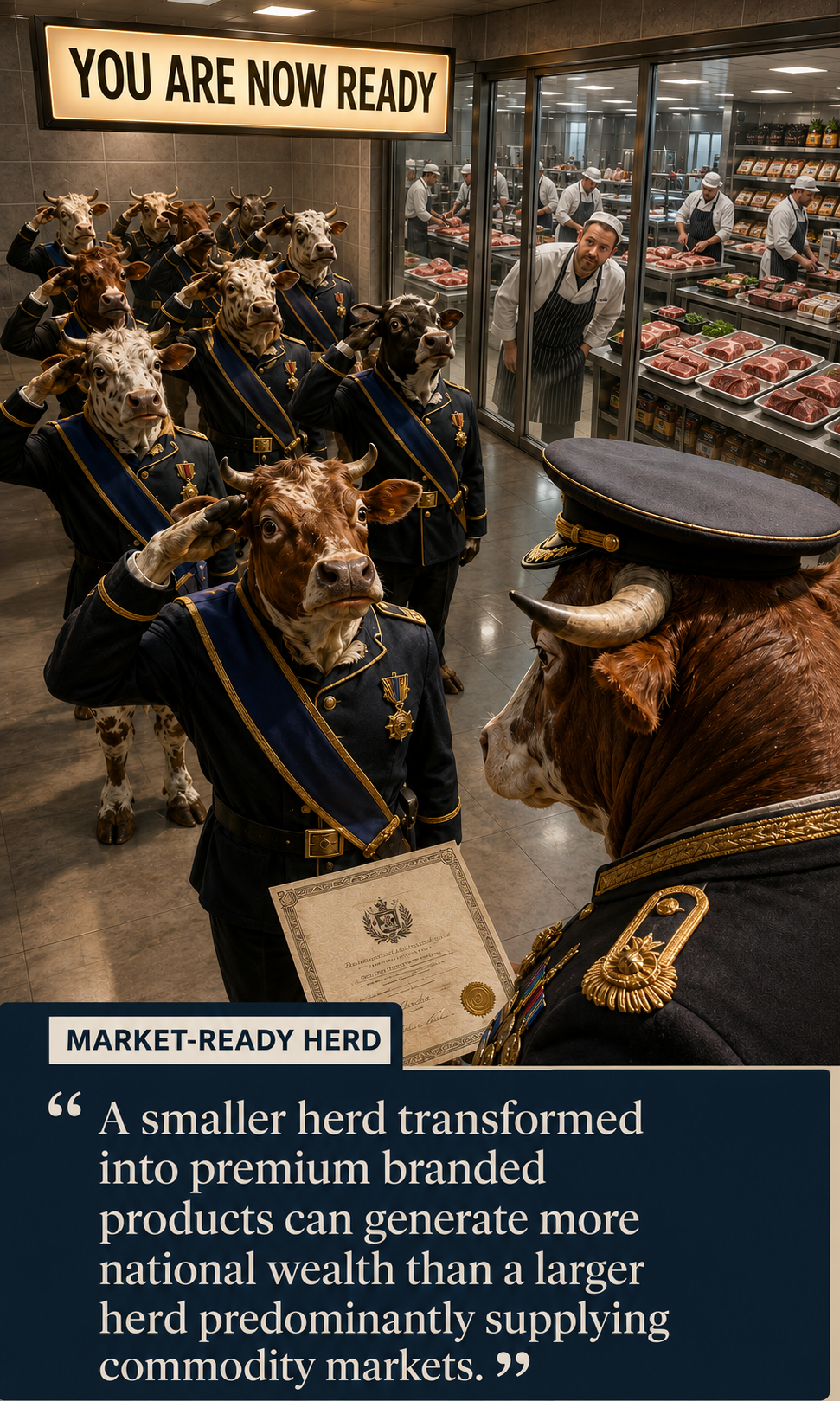
The BotswanaBeef analysis makes an important point: a smaller herd transformed into premium branded products can generate more national wealth than a larger herd predominantly supplying commodity markets. It proposes measuring success through tonnes of certified beef marketed, export earnings, value added per kilogram, producer income, employment and contribution to GDP.
Botswana beef is not presently branded, which is why a high-level group has reportedly been established to address the issue. The analysis estimates that branding alone could add 10 to 15 percent to the product’s value. Those measures are much closer to development outcomes.
For too long, Botswana’s development conversation has been dominated by what can easily be counted: kilometres constructed, facilities opened, money spent, people trained, loans distributed and now, perhaps, cattle accumulated. Botswana’s next development model must make a more demanding transition, from counting outputs to delivering outcomes, and from five million cattle to higher farmer incomes.