
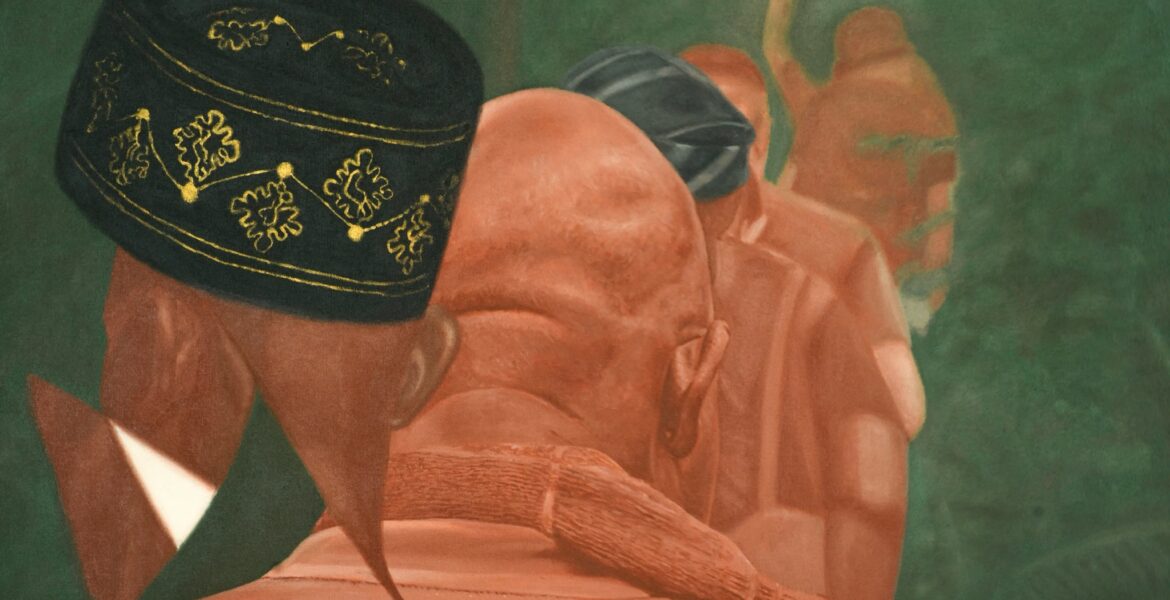
What happens to identity when you become a stranger somewhere else? In Ke Moeti, Oteng Keabetswe turns travel, memory and cultural dislocation into a visual conversation about where we belong.
GOSEGO MOTSUMI
Sometimes you have to leave home to really see it.
That tension sits at the centre of Ke Moeti (I Am a Visitor), a new exhibition by Motswana visual artist Oteng Keabetswe opening at Alliance Française de Gaborone on October 8.
The title sounds temporary. The questions are anything but.
Drawing from encounters with places he has visited, Keabetswe turns the experience of being a visitor into a meditation on identity, belonging and the strange business of trying to locate yourself between worlds.
FROM CARTOONS TO THE UNKNOWN
Keabetswe’s journey began innocently enough, with childhood drawings of cartoons. It eventually moved into finely rendered charcoal and pencil portraits before taking a more experimental turn into surreal, abstract and geometric compositions.
His portraits linger on emotional states — introspection, longing and contemplation — while the abstract works bend form, colour and space towards uncertainty and possibility.
The result is an artist seemingly unwilling to stay in one visual neighbourhood.
BETWEEN TUTUME AND EVERYWHERE
As a Kalanga artist from Tutume, Keabetswe draws from the rhythms of village life while confronting the disorientation of modernity.
That push and pull gives the work its pulse: rural versus urban, tradition versus innovation, recognisable figures versus distorted forms.
But Ke Moeti isn’t simply asking where Keabetswe has been.
It asks what those places have done to the person who visited them.
His work treats identity as something less like a fixed address and more like luggage — constantly unpacked, rearranged and repacked after every encounter.
WHO GETS TO BELONG?
The exhibition ultimately turns the gaze back on the viewer.
What happens to your sense of self when you enter unfamiliar territory? What pieces of heritage travel with you? And what changes when you return?
Keabetswe’s answer appears to be that belonging is never entirely settled.
“Ke Moeti” becomes less a declaration of distance than an invitation to look again — at home, at elsewhere and at the person standing between the two.