
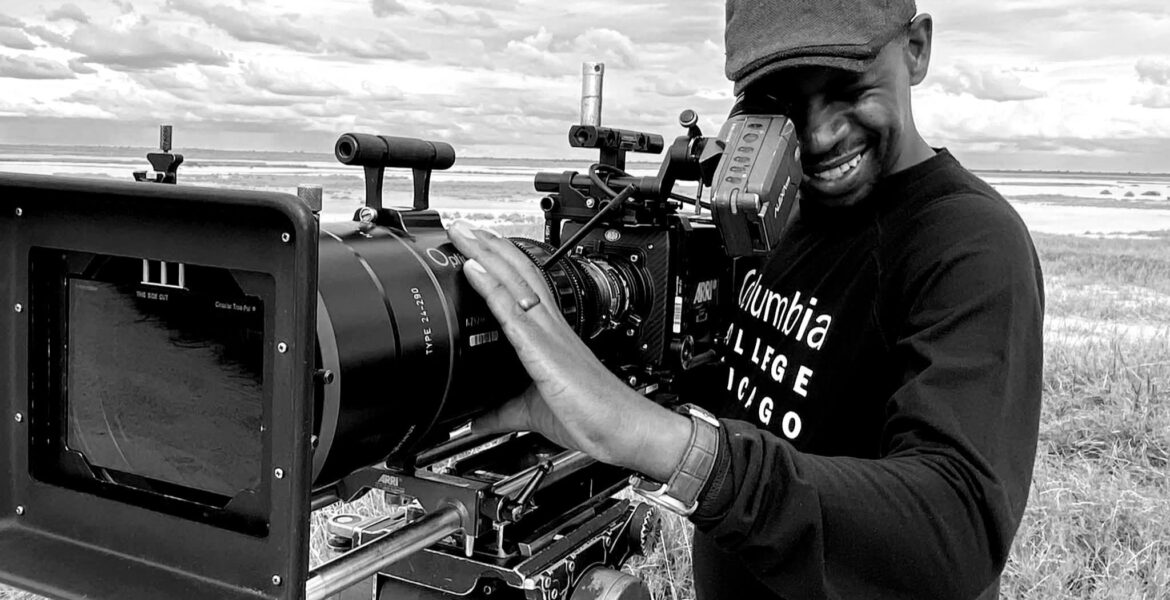
In Batho ba Metsi, filmmaker Moabi Mogorosi turns the camera away from the Okavango’s postcard beauty and towards the people whose knowledge, labour and memory have sustained it for generations.
LEATILE ZACHARIAH
The Okavango Delta has long been captured as a kind of earthly paradise: water curling through reeds, elephants crossing floodplains and mokoro silhouettes gliding beneath an immense African sky.
It is one of Botswana’s most recognisable images. Yet in many of those images, the people who live there are little more than figures in the distance.
Batho ba Metsi, meaning “People of the Water,” begins where that familiar portrait ends.
Beyond scenery
For producer-director Moabi Mogorosi, the documentary is not simply about the Okavango. It is a tribute to the communities that have carried its knowledge, protected its waterways and built their lives around its changing rhythms.
“Batho ba Metsi is a tribute,” he says. “It is a celebration of the people who took care of, and continue to take care of, the Delta. They are the custodians of the Delta.”
The feature documentary is an Nkashi Trust production, developed with support from Okavango Diamond Company, which came on board as a partner and principal sponsor. Presented by Palesa Molefe, the film journeys through Delta communities, meeting polers, farmers, guides, elders, basket weavers, artists and cultural custodians whose lives reveal the deep relationship between water, identity and survival.
For Mogorosi, the central question was simple but uncomfortable: How can the Delta be celebrated globally while its people remain in the background?
“The people who have been taking care of the Delta for so many years should not be in the background,” he says. “They should be in the foreground. Who are they? What are their needs? What are their concerns? Are we taking care of them?”
Becoming a student
Mogorosi entered the Delta not as an authority, but as a filmmaker prepared to surrender his assumptions.
“When you go into an environment that you are familiar with, but which is not primarily your area, you become a student, not a teacher,” he says. “I was there in the Delta learning.”
That distinction became fundamental to the film. Batho ba Metsi does not present its subjects as relics of an older Botswana, nor does it romanticise hardship as simplicity.
“Lack of something is not going to rob them of their joy or their humanity,” Mogorosi says. “Just like all of us, they have needs. We have different expectations, but the same needs.”
Living knowledge
The filmmaker describes the people of the Delta as its “primary scientists,” custodians of knowledge developed not in laboratories, but through generations of observing water, wildlife, fire and land.
During filming, Mogorosi recalls being alarmed by a controlled fire, believing that the landscape was being destroyed. When he later returned, the same area was flourishing.
“If we had not done what seemed to worry you, you would not see what you are seeing right now,” a resident told him.
The encounter exposed the gap between observing the Delta and truly understanding it.
“They have been in that environment forever. They know,” Mogorosi says. “But we are quick to judge.”
Seen at last
Before the film’s wider release, Batho ba Metsi was screened in Delta communities. Those pre-screenings became more than previews. They allowed the people on screen to respond, correct, expand and recognise themselves.
“They start telling you more,” Mogorosi says. “Then you realise there is a lot more to do.”
The reaction crystallised the film’s purpose.
“There is joy in people seeing that we are not background actors,” he says. “We are not props in the story. We are the story.”
Wider waters
Batho ba Metsi is scheduled to premiere in Gaborone on 4 August 2026. A student screening and a tribute to the late Professor Lydia Nyati-Ramahobo will follow on 5 August.
The documentary will then begin an international festival run before eventually screening freely on BTV. Wider broadcast discussions are underway, after which the film is expected to become available through the Nkashi Trust YouTube channel.
For Mogorosi, however, the film’s journey will matter only if it changes how audiences see the Delta and how visitors enter the homes of others.
“We need to honour the people we find there,” he says. “We must learn to be received. We must never be teachers.”